

The Trial Of A Ghost: What Survives The Zodiac Myth
By the end of a famous unsolved case, everyone wants a verdict. That instinct is understandable. Five people are dead. Two survived. Families were left with grief instead of answers. Cities were threatened. Newspapers became delivery systems for a killer's vanity. Police files grew fat with suspects, letters, fingerprints, handwriting reports, ciphers, false confessions, disputed victims, and names that still get dragged across the internet like trophies. The human instinct is to put someone in the chair.
Arthur Leigh Allen. Paul Doerr. Richard Gaikowski. Gary Francis Poste. A local drug crew. A cab robber. A cop. A hoaxer. A committee of hoaxers. The media. Robert Graysmith. David Toschi. Everybody, apparently, except the one person the evidence keeps circling without naming: the unknown offender who wrote, called, stabbed, shot, mailed cloth, and understood that fear becomes more powerful when it learns to speak in headlines.
This final article is not a trial in the legal sense. No courtroom could convict a dead suspect on vibes, old documentaries, half-matching shoes, or a sentence from a fanzine that looks sinister after 50 years of staring. A criminal trial asks whether the state can prove a named defendant guilty beyond a reasonable doubt.
That is not the question here. This is an inquest into the record: what can the Zodiac file still sustain after we remove the movie lighting? What happens when we separate confirmed crimes from claimed crimes, authenticated communications from disputed letters, local leads from solved cases, and suspect heat from proof?
Most importantly, does the case collapse when the mythology is stripped away? No. It gets smaller. It gets messier. It gets less glamorous, less supernatural, and much less useful to people selling a favorite suspect. But it does not evaporate.
The public Zodiac is too large. The file Zodiac is still real. That is the verdict this record can bear.
The Question Before The Inquest
The question is not whether every traditional Zodiac story is true. It is not.
Some of the late letters are disputed. Some claimed victims do not belong in the confirmed count. Some suspect theories survive mainly because repetition is cheaper than evidence. Some police recollections changed over time. Some authorial claims are built from clippings that do not say as much as the argument needs them to say. Some famous details have been polished by documentaries, books, websites, message boards, and movie memory until the source underneath is hard to see.
Good. Scrape it down.
The confirmed count in this series remains five dead and two wounded survivors: David Faraday, Betty Lou Jensen, Darlene Ferrin, Michael Mageau, Cecelia Shepard, Bryan Hartnell, and Paul Stine. That is not because the Zodiac persona politely stopped there. By July 1970, the writer was claiming thirteen victims while law enforcement could definitely link him to five murders. The inflation is part of the story.
But inflation is not invention. The cleanest way to handle the case is to divide the material into baskets.
There is the core 1968-1969 attack chain: Lake Herman Road, Blue Rock Springs, Lake Berryessa, and Presidio Heights. Even inside that core, the strength varies. Stine is the strongest physical-authorship anchor because of the shirt pieces. Berryessa has the car-door writing and the Napa phone call. Blue Rock Springs has the immediate phone call and the July 31 letters. Lake Herman Road is the most vulnerable because the claim is retroactive.
There is the communication record: the July 31, 1969 cipher letters, the August follow-up, the Stine shirt-piece letters, the bus-bomb and Z340 materials, the Belli letter, the 1970 letters and cards, and the later disputed mess. These do not all carry the same weight. A letter with a piece of Paul Stine's shirt is not the same evidentiary animal as a later questioned card.
There is the phantom case: Riverside, Kathleen Johns, Donna Lass, Domingos and Edwards, Ray Davis, and other cases that orbit the Zodiac because of resemblance, claim, geography, or later theory. Some deserve serious discussion. None should be smuggled into the confirmed count without proof.
There is the suspect field: Allen, Doerr, Gaikowski, Poste, and the long parade of lesser names. Some have heat. None survive as an identification.
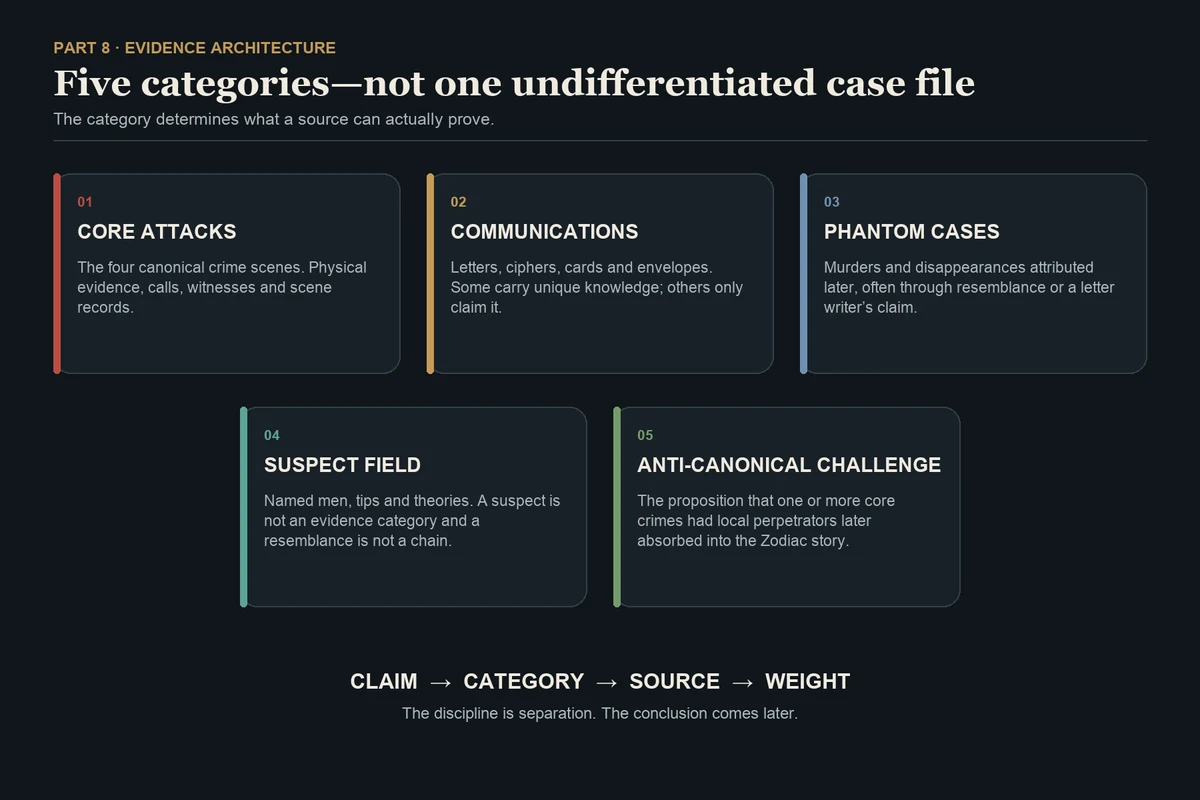
And now there is the anti-canonical challenge, sharpened recently by Eddie McNamara's Zodiactually: The Real Story of a Fake Serial Killer. That challenge deserves a fair hearing because it attacks the lazy version of the case in exactly the right place. It says: stop assuming the legend is the file. Stop turning every strange crime into Zodiac. Stop letting newspapers, cops, document examiners, and later authors bundle weak things into one clean monster.
That critique is useful. The leap after it is the problem.
To say the Zodiac myth inflated is not the same as saying the Zodiac offender was fake. To show that one crime has an alternative suspect is not the same as dissolving the linkage evidence. To show that some letters may be hoaxes is not the same as explaining away the shirt pieces, the Berryessa car door, the Napa call, the Blue Rock Springs call, and the July 31 cipher mailings.
The inquest question is narrower and harder: after the myth is stripped away, what remains?
The Body Of Evidence
Start at the end of the 1969 sequence. That feels backward, but it is the right way to test the case. Lake Herman Road can be argued over because Zodiac did not speak immediately after it. Blue Rock Springs can be complicated by Darlene Ferrin's local world. Lake Berryessa can be challenged because the crime looks behaviorally different. But Presidio Heights forces the question into the envelope.
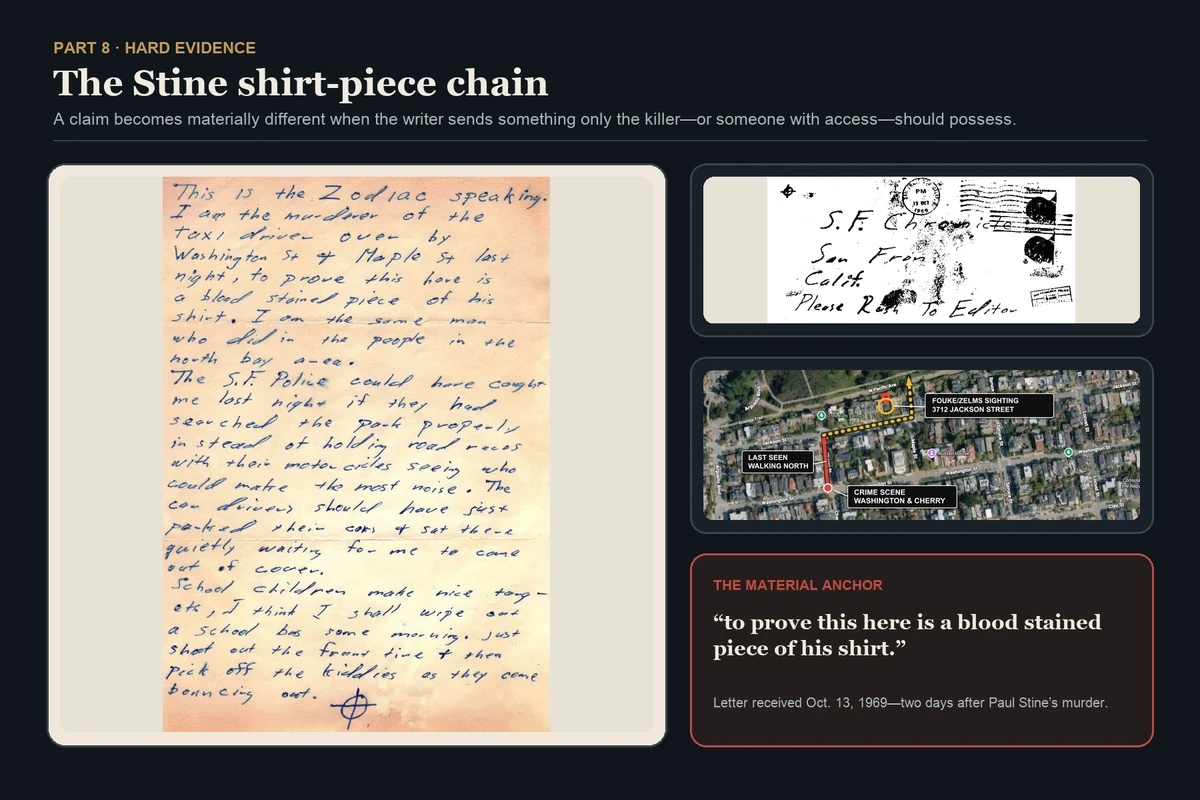
Paul Stine was killed in San Francisco on October 11, 1969. The first police report places the Yellow Cab at Washington and Cherry. Witnesses saw a white male suspect with Stine slumped partly over him. The man appeared to search or handle the victim and wipe surfaces before walking north on Cherry Street toward the Presidio. Stine's wallet, money, keys, and part of his shirt were gone.
Then the Chronicle received a Zodiac letter containing a piece of Stine's shirt. That is the kind of fact that makes theories sweat.
Anybody could have written a creepy letter after reading the newspaper. Anybody could have claimed a public murder. But the writer had a piece of the dead man's shirt, and Department of Justice material says that cloth was identified as part of Stine's shirt, torn at the time of the homicide. Another piece was later mailed to Melvin Belli.
So if someone wants to remove Stine from Zodiac, there are only a few roads available. Maybe Stine's killer wrote the Zodiac letters; that is the ordinary canonical route. Maybe a separate cab robber killed Stine, took the shirt, and then either wrote as Zodiac or supplied the shirt to someone who did. Maybe an insider obtained the shirt from the scene, body, or evidence handling and fabricated the letters. Maybe some unknown third party acquired the shirt through an unexplained route and used it to impersonate Zodiac.
Only one of those routes is simple. The others require more actors, more access, more misconduct, more motive, and more invisible machinery. They are possible in the abstract, because many things are possible in the abstract if you are willing to spend enough imagination. But "possibility" is not the same as reasonable evidentiary weight.
The Stine shirt is the strongest anchor in the case because it links a murder to the correspondent through physical possession. It does not identify the killer. It does not prove Lake Herman Road. It does not make every later letter authentic. But it does prove that the Zodiac correspondence cannot be treated as generic press noise.
The ghost had cloth. The next anchor is Lake Berryessa.
On September 27, 1969, Bryan Hartnell and Cecelia Shepard were attacked beside Lake Berryessa. This crime looks different from the others because it is different. Daylight. Knife. Conversation. Binding. A hooded costume with a crossed-circle symbol. A false story about an escaped convict. A long, intimate, terrifying encounter.
If someone says Berryessa is behaviorally strange inside the Zodiac series, they are right. Behavioral strangeness is not disproof.
The linkage at Berryessa was not invented years later by writers trying to make the case prettier. The attacker wrote on Hartnell's car door. The message used the crossed-circle symbol, listed the prior Vallejo attack dates, gave the Lake Berryessa date and time, and ended with the method: by knife. Then a caller contacted Napa police and reported a double murder, saying he was the one who did it.
That is not a faint resemblance. That is an announced linkage at the crime scene and immediately afterward.
Could a copycat have done it? Yes. By late September 1969, the Zodiac letters and cipher had been public. A separate offender could have borrowed the name, the symbol, and the dates. But the copycat explanation is not free. It requires a separate knife attacker to adopt the Zodiac identity almost immediately, write the prior dates on the victim's car, call police, and perform under a hood bearing a symbol the victims apparently did not decode as "Zodiac" in the moment.
That last point matters because if the hood was only for public recognition, it was oddly inefficient. Hartnell and Shepard were not supposed to survive. The public signal was the car door. The hood was private performance: a symbol worn inside the crime, before an audience the attacker expected to erase. That does not make copycatting impossible. It does make the attack feel less like a cheap newspaper imitation and more like the offender living inside the persona while he worked.
Then there is the handwriting. Department of Justice material records Sherwood Morrill's opinion that the Berryessa car-door printing was by the same person who sent the handprinted Zodiac letters to the Vallejo Times-Herald, San Francisco Chronicle, and San Francisco Examiner. A handwriting opinion is not a DNA match. It is not divine revelation. But in the evidentiary stack, it is another bridge.
So Stine gives us the shirt. Berryessa gives us the car door and call. Blue Rock Springs gives us the immediate link backward.
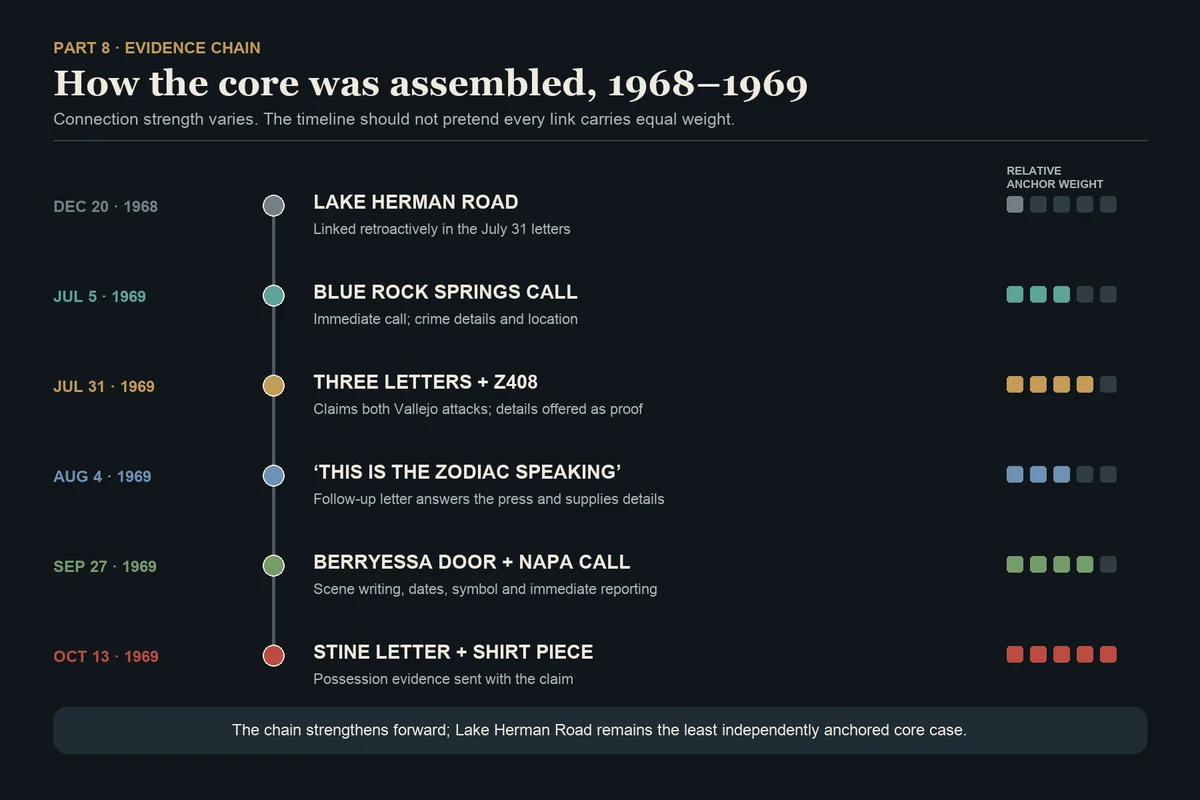
In the early morning of July 5, 1969, Darlene Ferrin was killed and Michael Mageau was wounded at Blue Rock Springs Park in Vallejo. About 40 minutes later, a caller contacted Vallejo police. The report records him saying he wanted to report a double murder, that the victims were in a brown car, that they had been shot with a 9mm Luger, and that he had also killed those kids last year.
"Those kids last year" meant Lake Herman Road, and that call is a problem for any theory that treats the Zodiac chain as a later invention. The linkage between Blue Rock Springs and Lake Herman Road was not created by a 1970s book, a movie, a suspect website, or a retired detective on camera decades later. It was made within an hour of the Blue Rock Springs attack, before the Zodiac name had fully emerged in public.
That does not prove the caller killed at Lake Herman Road. A caller can lie. The July 5 caller could have been the Blue Rock Springs shooter borrowing an earlier crime. He could have been someone else trying to shield a local motive. He could have known enough from gossip, police sources, or press coverage to make the claim.
But again, the alternative has to explain more than the crime. It has to explain the bridge.
Blue Rock Springs has local-suspect gravity. Darlene Ferrin's life has been abused by rumor, but the police reports really do contain leads from her local world: "George" claims, fear claims, harassment claims, relationship-circle claims, and a July 11 police interview with George William Waters. That material should not be mocked. Ordinary homicide motives are ordinary for a reason.
The problem is that a good local lead does not erase a call from the killer. The local-suspect theory must explain why the caller reported the attack immediately, correctly identified core details, claimed Lake Herman Road, and then why the July 31 letters continued the same linkage in public.
Those July 31 letters matter because the writer did more than brag. He mailed three cipher parts to three newspapers and demanded publication. The Vallejo letter claimed Lake Herman Road and Blue Rock Springs. The 408 cipher was real and solvable. The message did not name the killer, but it established the performance: murder as pleasure, slaves, afterlife fantasy, and the letter writer as a self-manufactured monster.
Then came the August follow-up: "This is the Zodiac speaking." The name arrived. The persona sharpened. The writer supplied more details and pushed back against police skepticism.
The early communications can be overread. Some details are dry. Some may have been public. Some may overlap with police-report language. The letter writer's own boastful phrasing is not reliable scene reconstruction. But the answer to overreading is not counter-overreading. It is a detail-by-detail test: what did the letter say, what did the report say, what had been published, what could the offender have known by observation, and who had access to the rest?
That is how the record should be judged: not by slogans.
Lake Herman Road: The Weakest Link Is Still A Link
Lake Herman Road is the most vulnerable of the canonical attacks, and it should be. The murders of David Faraday and Betty Lou Jensen on December 20, 1968 did not produce an immediate Zodiac letter. No phone call. No cipher. No crossed-circle symbol. No self-applied name. No public terror campaign that night or the next morning.
For more than six months, the crime sat as a terrible unsolved double murder on a lonely road. Then the Blue Rock Springs caller claimed it. Then the July 31 letter writer claimed it. Then the August follow-up tried to authenticate it.
That means the Lake Herman Road link is partly retroactive. It is not anchored like Stine. It is not announced at the scene like Berryessa. It is not immediately claimed after the attack like Blue Rock Springs. If the anti-canonical case has an opening, this is where the blade goes in.
McNamara's strongest argument begins there. He says Lake Herman Road looks less like the first act of an already-formed Zodiac and more like a local Solano crime later appropriated by the Blue Rock Springs letter writer. He points to drug activity around the Lake Herman Cottage, local criminal networks, Hells Angels connections, and later claims involving David Magris and related figures. He says authorities knew by 1970 or 1971 that Faraday and Jensen had nothing to do with Zodiac.
That is a serious claim. It is not a proven one.
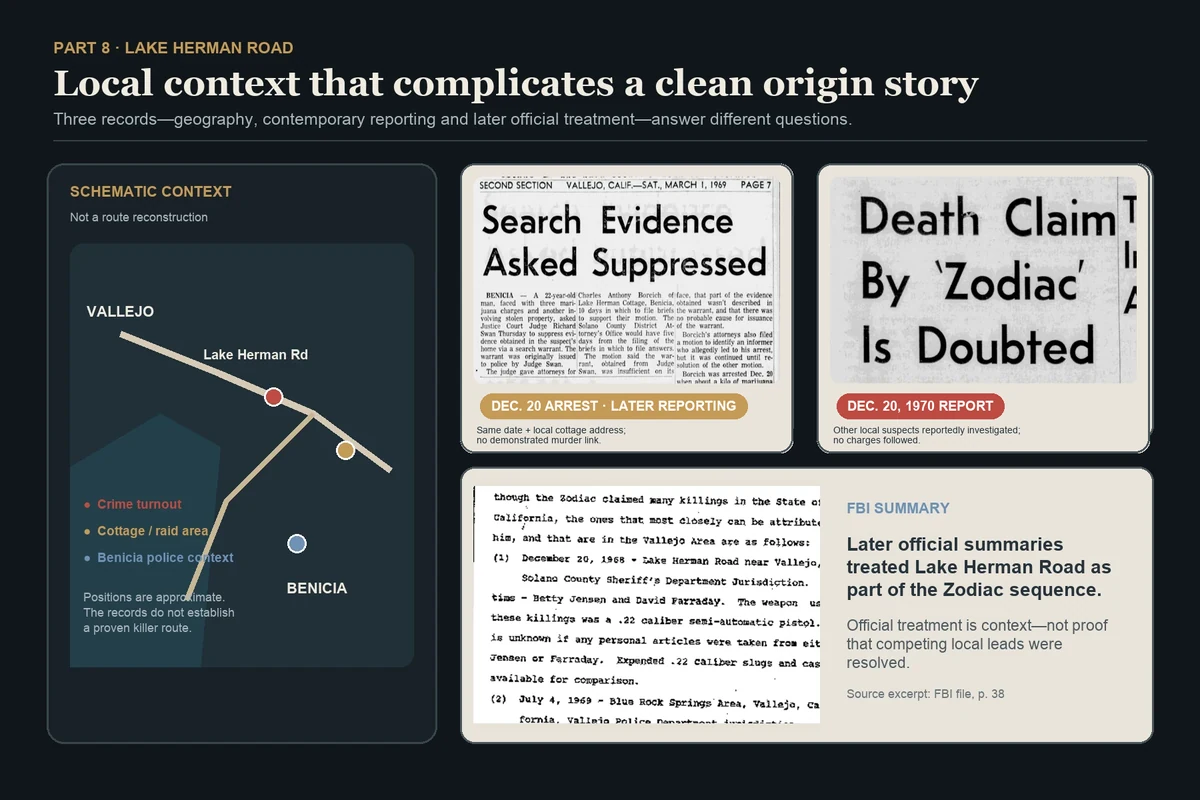
The local-drug context is real enough to deserve space. The record and contemporary press materials I have collected show smoke around the area: marijuana-seizure reporting; Charles Anthony Borcich's tie to the Lake Herman Cottage and his December 20 arrest after marijuana was found in a garage; and a later newspaper report that authorities had statements from two people linking unnamed new suspects to the Lake Herman murders. The 2007 documentary This Is the Zodiac Speaking also helps here: Detective Pierre Bidou discusses the Cottage narcotics warrant, the marijuana seizure, and the route back toward the Benicia Police Department before the double-murder call came in.
That material matters because it keeps Lake Herman Road from becoming a cardboard prologue. Real people were moving through that landscape. Real police work was happening nearby. Real local criminals existed. A non-Zodiac explanation is not ridiculous just because Zodiac later claimed the murders.
But the missing bridge is still missing. A marijuana seizure near Lake Herman Road is not a murder motive. Borcich's arrest is not proof that Faraday and Jensen were killed over drugs.
Here is why the Borcich point matters. If he was arrested during the Cottage raid, then he was not just a name in a drug clipping. He was a prisoner. Someone had to transport him, book him, watch him, or hand him off. The seized marijuana also had to go somewhere. So if Bidou and other officers were leaving the raid area when the Lake Herman Road call came in, the timeline should eventually be able to answer some basic police-work questions: where was Borcich, where was the evidence, and which officers were actually free to respond to the murder scene? Those are fair questions because they test whether the later story fits the original movements of police, suspects, and evidence.
But a fair question is not the same as a broken case. The documentary gives us Bidou's later memory of the raid and the call. It does not give us the dispatch log, booking record, transport record, or evidence-handling chain. Until those records are nailed down, the fact that a later retelling leaves gaps does not prove that the murder narrative collapses.
The 1970 article about new suspects matters for the same reason. It shows that authorities publicly acknowledged statements implicating unnamed suspects in the Lake Herman murders. That is important smoke. But the same story also says there was not enough evidence to charge anyone. That is not a solved case.
The Magris argument is stronger in one way and weaker in another. It is stronger because David Magris was not invented out of fog. Contemporary newspapers show a real 1969 Vallejo murder/robbery trial cluster involving Magris and associates. Reports connect that world to other violent crimes, robbery, weapons, and testimony about prior acts. If McNamara's larger point is that Lake Herman Road should be tested against local criminal networks rather than automatically swallowed by Zodiac mythology, that is fair. It is weaker because the named-party trail gets ugly.
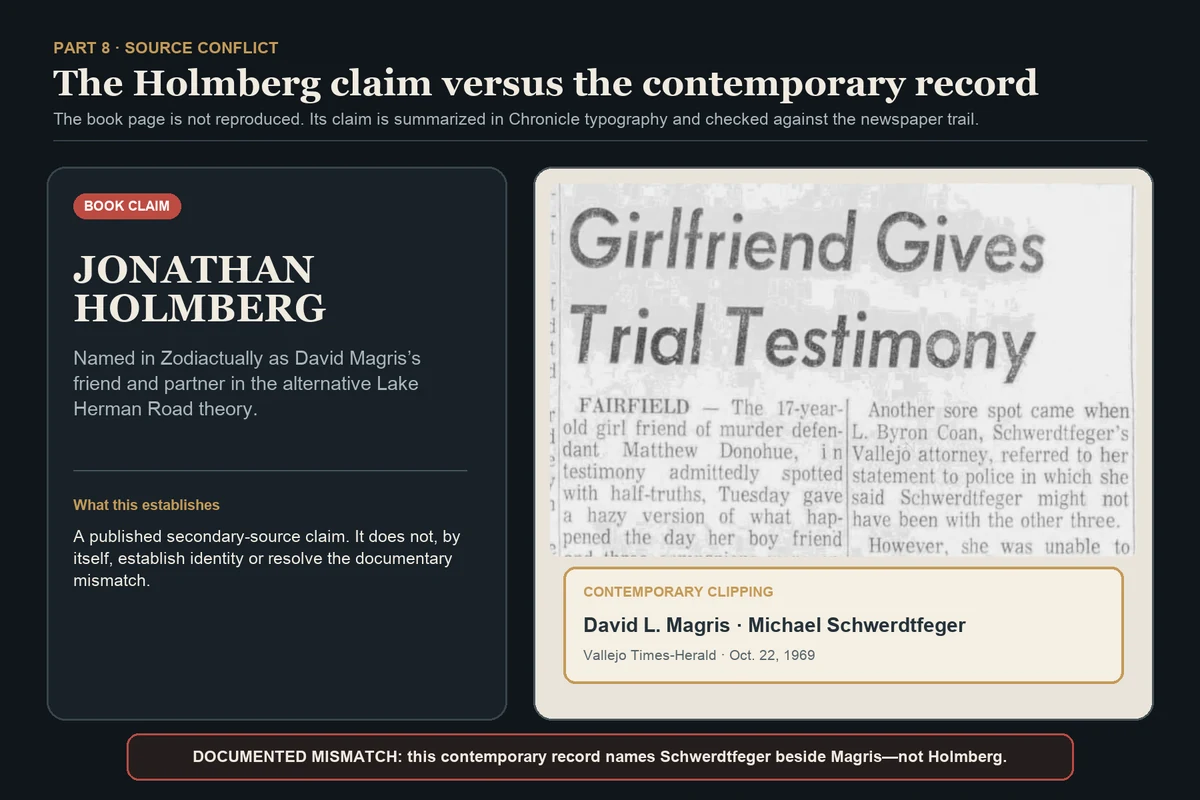
McNamara's book builds a vivid figure named Jonathan Holmberg: a 23-year-old veteran, medically discharged, high IQ, Hells Angels connection through a sister, partner to Magris, six-foot-three redheaded Nordic type, attorney L. Byron Coan, and central player in what the book frames as People v. Magris and Holmberg. The problem is that the contemporary newspaper clippings I have found do not name Jonathan Holmberg in that role. They name David Magris, Michael Schwerdtfeger, Matthew Donohue, and Robert Donohue. They identify Coan as Schwerdtfeger's attorney. The October and November 1969 trial coverage points to Magris and Schwerdtfeger, not Magris and Holmberg.
There may be an explanation. Holmberg could be an alias. It could be a pseudonym insufficiently disclosed. It could come from court records I have not obtained. It could be a source-confusion knot where multiple names from the same criminal orbit converged.
But at the article level, the caution is unavoidable: the public clipping trail currently places Michael Schwerdtfeger in the slot McNamara assigns to Jonathan Holmberg.
That is not a small footnote problem. It touches the spine of the alternative Lake Herman Road theory.
McNamara's book does disclose that "Cindy" has had her name changed in the Holmberg introduction. In that same introduction, it does not give the same warning for Jonathan Holmberg or Joyce. That matters because the name Holmberg then carries evidentiary work. If it is a pseudonym, the reader needs to know that. If it is not a pseudonym, the public record needs to show him.
Right now, the contemporary clippings I have found do not. That does not make every Magris-related claim false. It does mean the Magris/Holmberg section cannot be treated as careful proof until the court records, captions, transcripts, affidavits, and source documents are on the table. A theory that says the canonical story was built by sloppy source use cannot afford a central replacement figure whose name disappears from the contemporary newspaper coverage.
The same caution applies when McNamara turns from people to letter details.
McNamara also argues that the July and August Lake Herman details sound like someone copying police-report facts rather than remembering the attack. This is a fair test to run, but several examples do not carry the weight he puts on them.
Take the Jensen body-position detail. In the Lake Herman Road material, one description places Betty Lou Jensen's head toward the east. In Zodiac's July 31 letter, the writer describes her from the other end, saying her feet were to the west. Those two statements can both be true. If her head was east, her feet would be west.
McNamara's argument is not that Zodiac got the direction wrong. His argument is that the matching direction is itself suspicious. He reads the change in phrasing as a kind of camouflage: as if someone had a police report in front of him, saw "head east," and deliberately rewrote the same fact as "feet west" so the letter would sound less like copying.
That is possible. It is also an enormous logical leap. A killer, a witness, a reporter, or a police officer could describe the same body from either end without performing a coverup. The fact that two descriptions are compatible does not prove one was copied from the other. To make the copying argument carry, we would need more than matching orientation. We would need the exact police-report wording, proof the letter writer had access to it before publication, and a broader pattern of details too specific to explain by firsthand knowledge, public reporting, or ordinary description. Without that, the orientation point is not a tell. It is an inference standing on tiptoe.
Then there is the "water hose" line. In the August follow-up letter, Zodiac described the Lake Herman shooting in theatrical terms, saying he sprayed the kids as if with a water hose. McNamara reads that as a major tell. David Faraday was not sprayed with bullets from a distance. He was shot once at close range in the head. If the letter writer had really been there, McNamara argues, he would not describe the attack that way.
That criticism has a fair core. Zodiac's language is not a clean reconstruction of Faraday's death. But the line still does less work than McNamara needs it to do, because the Lake Herman attack did not consist only of Faraday's final wound. The evidence also includes shots into the Rambler and five wounds to Jensen's back as she fled from the car. A recovered bullet near Jensen's blood-spattered escape path fits a moving, outdoor shooting much better than a calm execution.
That matters for the lighting argument too. Nobody needs a special aiming-light theory to explain Faraday being shot at close range. The question is Jensen. She was the victim running away in the dark, and that is exactly the portion of the crime where a crude barrel-mounted light, if it existed, would make the most sense. So the "water hose" phrase may still be boastful, ugly, imprecise, or self-mythologizing. But as a rough description of the car being hit and Jensen being shot repeatedly while fleeing, it is not absurd on its face. It does not, by itself, prove the writer was absent.
The flashlight detail has the same problem. Zodiac claimed he had taped a small flashlight to his gun. McNamara treats the detail as absurd if it is imagined as a tiny light meant to illuminate the whole Lake Herman turnout. Under that reading, the letter starts to sound like someone inventing an impractical explanation after police asked for more proof.
But the wording matters. In the letter, Zodiac described a "small pencel flash light" taped to the gun barrel. That sounds less like lighting up the scene and more like a crude aiming aid: put a little light on the barrel, point the light, point the gun. That does not prove the claim is true. It may still be a boast, a lie, or a bad explanation. But the detail should be tested against what the letter actually says, not against a tidier paraphrase that makes it easier to dismiss.
Then there is the FBI point. In an interview with Michael Shermer, McNamara argues that after October 1969 the FBI did not affirmatively say that the same person wrote the later Zodiac letters. That matters because his larger theory allows for multiple writers, copycats, and a letter record that gets less reliable as the case becomes more public.
That is a letter-authorship argument. It is not the same as saying the FBI never treated Lake Herman Road as part of the Zodiac case. Those are different questions. One asks whether all the letters came from one hand. The other asks whether the December 20, 1968 Faraday/Jensen murders were linked to the Zodiac series.
On the second question, the FBI files push against the stronger anti-LHR claim. Federal case material lists the Lake Herman Road murders among the Vallejo-area crimes most closely attributable to Zodiac. Other federal file material describes the Zodiac killings as beginning in 1968 or otherwise treats the Faraday/Jensen murders as part of the Zodiac case picture. That does not prove Zodiac killed at Lake Herman Road. It does mean the absolute claim that the FBI never linked it is not supported by the available files.
So Lake Herman Road remains what it has always been in the honest version of the case: the weakest canonical link, but still a link. The anti-canonical theory has earned questions. It has not earned victory.
The Named Suspects Fail Identification
If the canonical core survives, then who was Zodiac? Here comes the bad news, dressed as intellectual hygiene: we do not know.
The suspect field is crowded because the case is famous, not because the evidence has kindly arranged itself into a final answer. The previous suspect article walked through the major names, and the conclusion did not get prettier with distance.
Arthur Leigh Allen remains the hottest named suspect and still a broken case. He has the long police history. He has Vallejo geography. He has suspicious materials seized decades later. He has the Zodiac watch. He has Don Cheney's damaging claims. He has Michael Mageau's delayed identification. He has enough heat that pretending he is just another random name would be silly.
But Allen also has the drag: no clean handwriting identification, no available print match, a reported partial-DNA non-match to one known-letter profile, source conflicts around Hartnell, late witness discounts, and no physical bridge that puts him at the core scenes. The evidence keeps making him interesting and then refusing to finish the sentence.
Paul Doerr is the best modern document suspect. He has a real paper-trail attraction: zines, bomb-writing claims, Tolkien/Cirth/cipher interests, survivalist culture, Bay Area geography, and possible overlaps with Zodiac's correspondence world. He is interesting because Zodiac was not only a killer; Zodiac was also a writer of himself. A suspect's publications and cultural universe matter more here than they would in an ordinary homicide.
But Doerr still has no scene placement, no witness identification, no forensic bridge, and no public official adoption as a suspect. His best claims still need the boring work: original pages, exact dates, exact wording, and a clear showing that the overlap is unusual rather than just another item from the same late-1960s culture of ciphers, weapons, fantasy, and fringe politics. Interesting on paper is not guilty in blood.
Richard Gaikowski is source-rich and direct-evidence poor. He has counterculture press geography, Good Times material, publication overlaps, and claims pushed by a former associate who later suspected him. He also has a late voice-comparison claim involving Nancy Slover, the Vallejo police dispatcher who took the Blue Rock Springs call. That deserves attention. But the caution is just as important: a subjective voice reaction decades after a brief phone call, especially in a suspect-advocacy and television context, is not a contemporaneous police identification. Geography and print culture make him discussable. They do not put him in a cab, a car park, a lakeside hood, or a phone booth.
Gary Francis Poste is a warning label with a name attached. The Case Breakers' public claim made headlines. Law enforcement did not accept the solved-case framing. The public evidence leaned heavily on scars, anagrams, disputed Riverside linkage, and unsupported or hidden forensic/cache claims. That is not how a case gets solved. It is how a media cycle gets fed.
The named suspects fail for different reasons, but they fail in the same direction: none of them becomes the man the evidence identifies. This is where suspect culture gets the case backward. It acts as if the unknown offender is a blank space waiting to be filled by the most interesting named man. But the unknown offender is not blank. He has evidence attached to him: phone calls, letters, ciphers, Stine's shirt, Berryessa's car door, witness descriptions, weapon changes, and a narrow but real pattern of public claiming.
That unknown offender has more case heat than any named suspect. It is epistemologically frustrating. It is also the truth.
The Fake-Zodiac Theory Fails Dissolution
Now for the opposite error. If suspect culture tries to turn weak names into Zodiac, anti-canonical culture can try to turn a messy Zodiac into nothing.
That is where Zodiactually becomes useful, because McNamara's argument is not merely "my suspect is better." It is broader and more provocative: the Zodiac Killer, as a serial murderer, was a fake construction. In this telling, the canonical crimes were separate events pulled together by hoaxing, police error, media incentives, suspect-world confusion, and later mythology. That is a better challenge than most suspect books give us, and it deserves to be taken seriously.
It is also a much heavier lift than it first appears.
The strongest version of the fake-Zodiac argument starts with points that are either true, plausible, or at least worth testing. The media enlarged Zodiac. Later letters need tiering. Claimed victims should not become confirmed victims. Riverside/Bates is disputed, not a sixth confirmed murder. Some investigators disagreed about Lake Herman Road. Darlene Ferrin's local world had leads that deserve scrutiny. Lake Berryessa really does look behaviorally different from Blue Rock Springs. Presidio Heights really can look like a cab robbery until the shirt piece arrives. Toschi's later controversy really does matter for late-letter caution.
That last point needs a word of explanation. David Toschi was one of the famous San Francisco inspectors on the Zodiac case, and his public reputation later became part of the story. In 1978, after a new "I'm back with you" Zodiac letter appeared, newspaper material preserved in the FBI files reported that Toschi had been transferred after admitting he wrote self-praising fan letters to Armistead Maupin under false names. That was the admitted misconduct. The larger suspicion was whether he had also written the 1978 Zodiac letter. Toschi denied that, and the public reporting I have found said police had no evidence he wrote the Zodiac communication. Even so, the episode is a real warning about the late-letter environment: by the late 1970s, the case was tangled with celebrity, hoax suspicion, document disputes, and institutional embarrassment. That is a reason to quarantine late letters carefully. It is not, by itself, proof that the 1969 evidence chain was fake.
That is the best part of the argument. It forces the reader to stop worshiping the poster version of the case. The Zodiac legend is contaminated by publicity, disputed writings, false links, and the suspect industry. Anyone who cannot admit that is not defending the file. They are defending merchandise.
But after that useful cleanup, the fake-Zodiac theory has to do the harder thing: it has to explain the bridges. Not the mood of the crimes. Not the similarities that can be argued away. Not the public myth that grew later. The bridges.
For Stine, that means explaining how the letter writer got the shirt. A cab-robbery theory must either make the robber the Zodiac letter writer, make the robber supply the shirt to a hoaxer, or invent an insider access route. Each move adds weight. For Berryessa, it means explaining why a separate offender wrote the Zodiac symbol and prior attack dates on Hartnell's car, then made the Napa call. A copycat theory can do this, but it has to admit it is proposing a second offender adopting the identity quickly and extensively.
Blue Rock Springs has the same problem, but with less room to hide. By the time of Lake Berryessa, the public already knew there was someone calling himself Zodiac. A copycat at Berryessa would at least have had a name, symbol, published letters, and prior attack dates to imitate. That does not make the copycat theory easy, but it gives the imitation something to imitate.
Blue Rock Springs is different. If that attack was really a local-stalker or relationship crime, then the theory has to explain why the caller reported the attack immediately and claimed Lake Herman Road before the Zodiac persona existed in public. Lake Herman Road was not a famous serial-killer chapter yet. It was an unsolved local double homicide. So why reach for that crime, in that first phone call, unless the caller had a reason to bind the two events together? Misdirection is possible, but now the local crime has acquired a strategic phone hoax, a retroactive double-murder claim, and then a letter/cipher campaign continuing the same bridge. For Lake Herman Road, the anti-canonical case has to prove more than vulnerability. It has to show that the alternative suspect record carries enough documentary weight to displace the July 5 call, the July 31 letters, the August follow-up, and the official files that treated LHR as part of Zodiac's core.
This is the central problem. The fake-Zodiac argument is strongest when each attack is isolated:
- Lake Herman Road could be a local drug-world killing.
- Blue Rock Springs could be a Ferrin-centered local murder.
- Lake Berryessa could be a different costumed attacker.
- Presidio Heights could be a cab robbery.
Each sentence, alone, can sound reasonable. But all four must be true at once, and then the theory still has to explain the communications and physical evidence binding them together.
The full replacement model begins to look like this: one local drug murder at Lake Herman Road is falsely claimed by a later caller; one Blue Rock Springs offender immediately uses that prior murder as cover and launches or inspires a cipher-letter campaign; one Napa-area knife attacker adopts the Zodiac symbol and dates for his own unrelated crime; one cab robber kills Paul Stine while someone obtains Stine's shirt and mails it as Zodiac; later communications may involve additional cranks, disputed writers, or Toschi-adjacent scandal; and police, press, and authors keep the bundle alive.
That is not a simple demolition of a myth. It is a replacement mythology with extra hinges.
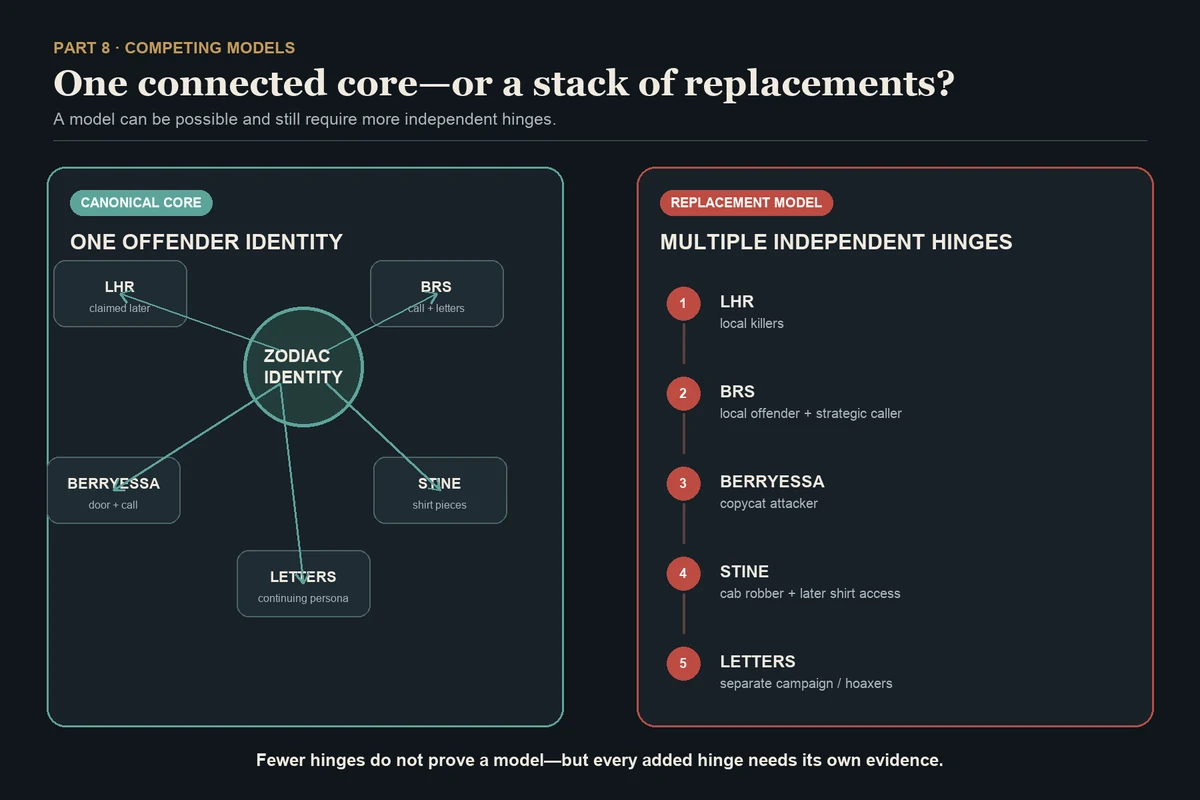
The canonical model has problems. Let us not make it prettier than it is. The behavior changes. The weapons change. The scenes change. Witness descriptions vary. Lake Herman Road is retroactive. The letter corpus gets filthy with possible hoaxes. The claimed victim count is inflated. The forensic evidence does not identify a man.
But the careful canonical model does not have to say Zodiac committed every crime he ever mentioned, wrote every disputed letter, or moved through the case like a chess engine. It only has to say that the 1969 core was linked by a real offender identity operating through crimes and communications. That model is smaller than the legend, and stronger than the fake-Zodiac collapse.
The shirt pieces are the first anchor. The Berryessa car door and Napa call are the second. The Blue Rock Springs call is the third. The July 31 letters and August follow-up tie backward into Lake Herman Road and forward into the named persona.
Once those anchors are admitted, the case does not need folklore to stand. It needs humility.
The later record should be tiered. The disputed cases should remain disputed. The late letters should be handled item by item. Toschi's controversy should matter where it actually matters: in the messy late-letter environment, not as a magic solvent poured backward over the 1969 shirt-piece correspondence.
That is where McNamara's FBI-letter point belongs. If the Bureau stopped affirmatively commenting that the same person authored later letters, that supports caution about later authorship. It does not dissolve the early evidence. It does not remove Stine's shirt from the envelope. It does not erase Berryessa's car door. It does not make the July 5 Blue Rock Springs call vanish.
The fake-Zodiac theory is useful as an acid bath for lazy certainty. It fails as a solvent for the core case.
The Myth Was Real Too
There is a temptation, after rejecting the fake-Zodiac theory, to swing too far back and make the old monster whole again. Do not. The myth was real too.
Zodiac understood that murder was only the first event. The second event was publication. A killing on a dark road could terrorize a city. A cipher in three newspapers could terrorize a region. A symbol could turn a killer into an idea. A count could keep growing even when the proof did not. A threat against school buses could make parents imagine the crime before it existed.
He did not need to kill thirteen people to make people feel like he might have. That is the ugly genius of the case.
The press helped, because of course it did. Newspapers printed the letters and ciphers because the alternative was also dangerous: ignore the man claiming murders and maybe suppress information the public or police might need. Police challenged him to prove himself; he did. Then they argued with him in public; he fed on it. Readers became an audience. The audience became part of the mechanism.
The public Zodiac grew larger than the case file almost immediately. Then later decades added more. Robert Graysmith made the case readable, cinematic, and in places too confident. The 2007 film made the dread beautiful enough to misremember. Websites preserved invaluable material while also giving suspect culture a thousand new places to breed. Forums found real sources and also invented castles out of coincidence. Modern suspect announcements learned that a press release can run faster than evidence. Every new documentary put old witnesses under new lighting, and every old recollection had to fight memory, narrative, and time.
So yes, the mythology is not a side issue. It is one of the subjects.
But a myth can grow around a real object. In fact, myths usually prefer real objects. Like coral on a reef, they need a rock to calcify around.
For the Zodiac myth, the rock is the 1969 evidence chain.
The right answer is not "believe the whole legend" or "burn the whole legend down." The right answer is tiering: core crimes and strong communications in one basket, disputed letters in another, claimed victims in another, suspect lore in another, later media memory in another. Do not let the baskets spill into each other just because the story gets more exciting that way.
That means Lake Herman Road can be vulnerable and still provisionally belong. Blue Rock Springs can have local suspect leads and still be linked by the call. Lake Berryessa can be behaviorally strange and still be anchored by the car door and Napa call. Presidio Heights can look like robbery and still be Zodiac through the shirt. Riverside can be highly disputed-case relevant and still not confirmed.
The same rule applies to the names and letters. Allen can be suspicious and still not identified. Doerr can be interesting and still not present. Gaikowski can have internet heat and still lack a scene bridge. Poste can be announced and still unsupported. Late letters can be disputed and still not impeach the early core. That is not hedging. That is the only honest shape the record has.
The Verdict
So what finding can the inquest sustain?
Not that Arthur Leigh Allen was Zodiac. Not that Paul Doerr was Zodiac. Not that Richard Gaikowski was Zodiac. Not that Gary Francis Poste was Zodiac. Not that every claimed victim belongs to the count, every letter bearing the Zodiac flavor came from one hand, the police record is clean and complete, or the press merely reported the story instead of helping manufacture its public shape. And not that Lake Herman Road is as strongly anchored as Stine or Berryessa.
The finding is narrower:
The best current reading of the evidence supports an unknown offender operating as Zodiac through the core 1969 chain, with the strongest anchors in the Stine shirt-piece correspondence, the Berryessa car-door writing and Napa call, the Blue Rock Springs phone call, and the July/August 1969 letters linking backward to Lake Herman Road.
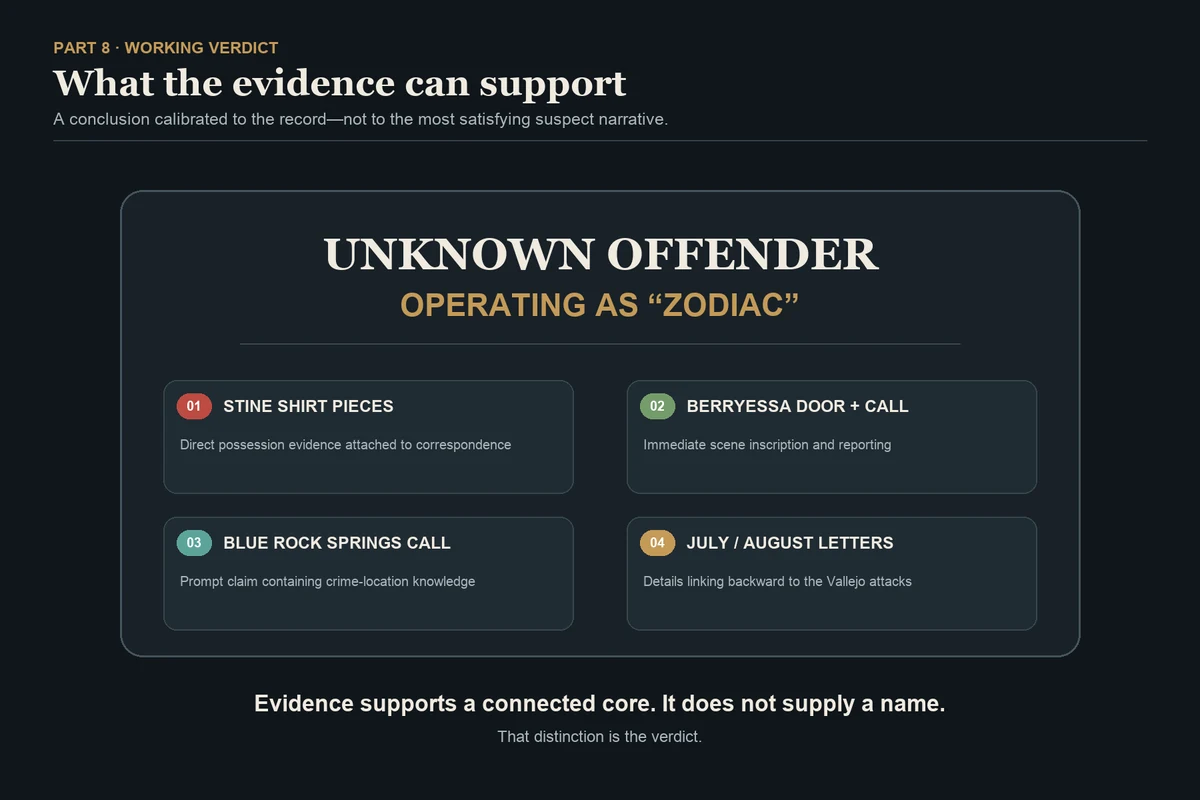
The named suspects do not meet the evidence. The fake-Zodiac theory does not dissolve the evidence. The mythology is larger than the file, but the file is still real.
This may be unsatisfying because it does not give us a face. It does not let the reader close the tab feeling that history finally got mugshot resolution. It leaves the center empty.
But the empty center is the case.
Zodiac was not powerful because he was a genius. Spare me that old costume. He was powerful because he found the place where violence, publicity, police uncertainty, and public imagination touched. He killed, then wrote. He wrote, then watched. He learned that a murderer could become bigger by withholding himself than by revealing himself.
That is why the case still irritates. It does not merely ask who committed the murders. It asks how much of a person can be reconstructed from acts, words, and traces when the name never arrives. The answer, after eight parts, is more than nothing and less than enough.
We can see the outline. We can see the methods change and the voice persist. We can see the proof where it is proof and the fog where it is fog. We can name the victims. We can separate the confirmed from the claimed. We can stop giving weak suspects a crown. We can stop pretending every skeptical objection is a demolition charge.
What we cannot do is write a name where the evidence has left a blank. That blank is not permission for fantasy. It is the wound in the record.
Why The Case Still Walks
The Zodiac case still walks because it sits in an awful middle state. It is not cold enough to forget. It is not solved enough to rest.
There are physical materials that may still matter if they can be tested reliably. There are letters and envelopes whose handling histories deserve more care than internet certainty usually gives them. There are fingerprints and palm prints whose value depends on whether they truly came from the offender. There are old police files still hidden in boxes, court records that may clarify source claims, and interviews that need to be separated from memory theater.
Future forensics may yet change the room, but only if the source discipline changes with it.
A DNA headline without chain of custody is not a solution. A new suspect without scene evidence is not a breakthrough. A handwriting opinion without context is not a verdict. A source note without the source is not proof. A documentary quote is not a police report. A clipping lead is not a solved case. A pseudonym is not harmless if the reader cannot tell it is a pseudonym.
That is the lesson hiding under the whole series: the Zodiac case punishes hunger.
If you need Allen to be the man, the evidence will embarrass you. If you need Doerr to unlock the letters, the scenes will stop you. If you need Gaikowski's voice to carry the case, the source quality will drag you back. If you need Poste to be a modern solved-case triumph, the public evidence will not cooperate. If you need McNamara's fake-Zodiac thesis to flatten the canonical five into unrelated crimes, the bridges will get in the way.
And if you need the old legend intact, the file will refuse that too. The real case is smaller, stranger, and more stubborn.
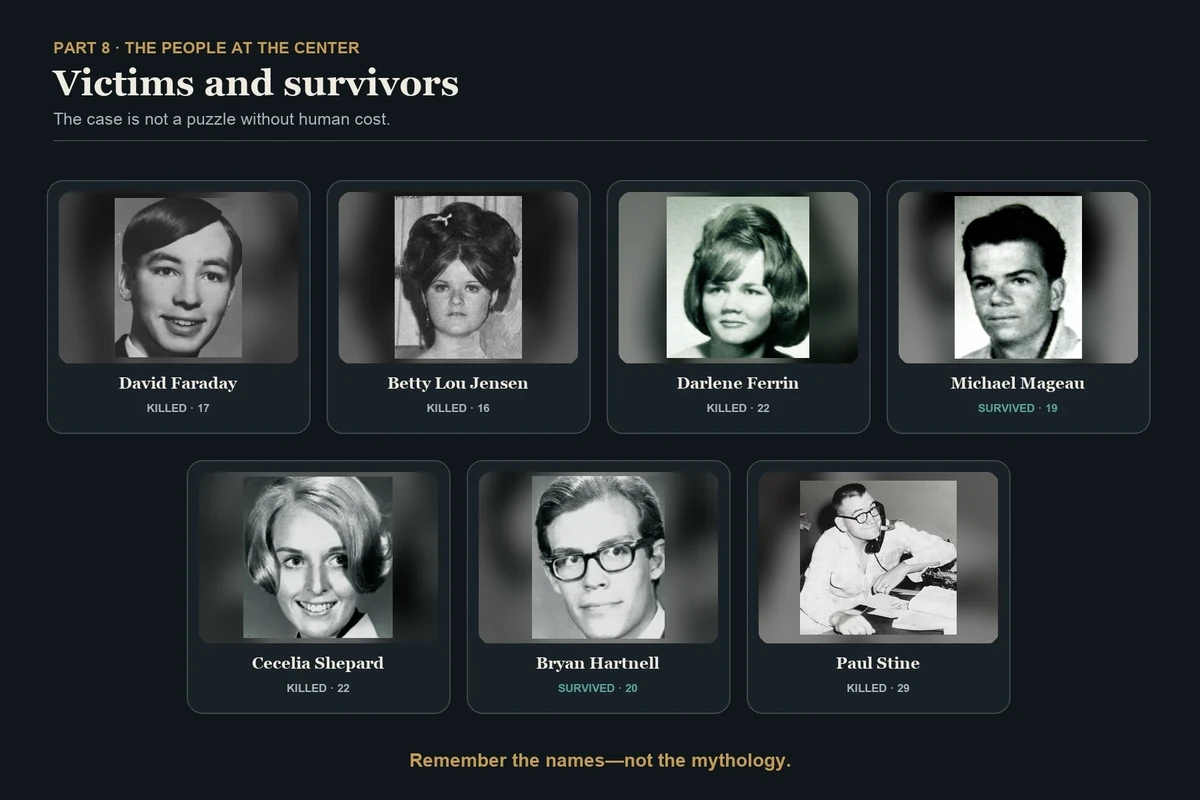
David Faraday and Betty Lou Jensen were murdered on a dark road. Darlene Ferrin was killed and Michael Mageau survived in a parked car. Cecelia Shepard was stabbed to death and Bryan Hartnell survived beside a lake. Paul Stine was shot in his cab and his shirt was torn into evidence. Letters followed. Calls followed. A symbol followed. A name followed.
The name was not the killer's. It was the mask. The man behind it remains unidentified. That is not the ending anyone wants, but it is the ending the record gives us: a smaller Zodiac than the legend, a stronger Zodiac than the skeptics can erase, and a ghost still walking because the evidence points to him without ever turning on the light.
So the final question is not "Which famous suspect do you like?" It is better, colder, and harder:
When the truth is enough to haunt us, but not enough to name him, what do we owe the people he attacked?
At least this: do not let the missing name swallow the names the record still gives us. David Faraday. Betty Lou Jensen. Darlene Ferrin. Michael Mageau. Cecelia Shepard. Bryan Hartnell. Paul Stine.
Discussion
Thoughtful, good-faith discussion is welcome.
Loading comments…