

There is a familiar way to ask whether the American Revolution was justified. We begin with taxation, representation, soldiers in Boston, the shots at Lexington, and the grievances in the Declaration of Independence. We weigh British provocations against colonial complaints. Then, somewhere near the end, we add a paragraph about Romans 13.
That order is backwards for a Christian inquiry. The first question is not whether Parliament behaved badly. It is whether the colonists were bound before God to remain subject even when they believed Parliament and the king had violated the constitution. Scripture does not merely advise political prudence. It commands submission to governing authorities, payment of their dues, honor for the emperor, prayer for rulers, and a peaceable manner of life (Romans 13:1–7Chapter 13, verse 1: 13:1Let every soul be subject unto the higher powers. For there is no power but of God: the powers that be are ordained of God. Chapter 13, verse 2: 13:2Whosoever therefore resisteth the power, resisteth the ordinance of God: and they that resist shall receive to themselves damnation. Chapter 13, verse 3: 13:3For rulers are not a terror to good works, but to the evil. Wilt thou then not be afraid of the power? do that which is good, and thou shalt have praise of the same: Chapter 13, verse 4: 13:4For he is the minister of God to thee for good. But if thou do that which is evil, be afraid; for he beareth not the sword in vain: for he is the minister of God, a revenger to execute wrath upon him that doeth evil. Chapter 13, verse 5: 13:5Wherefore ye must needs be subject, not only for wrath, but also for conscience sake. Chapter 13, verse 6: 13:6For for this cause pay ye tribute also: for they are God’s ministers, attending continually upon this very thing. Chapter 13, verse 7: 13:7Render therefore to all their dues: tribute to whom tribute is due; custom to whom custom; fear to whom fear; honour to whom honour.; 1 Peter 2:13–17Chapter 2, verse 13: 2:13Submit yourselves to every ordinance of man for the Lord’s sake: whether it be to the king, as supreme; Chapter 2, verse 14: 2:14Or unto governors, as unto them that are sent by him for the punishment of evildoers, and for the praise of them that do well. Chapter 2, verse 15: 2:15For so is the will of God, that with well doing ye may put to silence the ignorance of foolish men: Chapter 2, verse 16: 2:16As free, and not using your liberty for a cloke of maliciousness, but as the servants of God. Chapter 2, verse 17: 2:17Honour all men. Love the brotherhood. Fear God. Honour the king.; 1 Timothy 2:1–4Chapter 2, verse 1: 2:1I exhort therefore, that, first of all, supplications, prayers, intercessions, and giving of thanks, be made for all men; Chapter 2, verse 2: 2:2For kings, and for all that are in authority; that we may lead a quiet and peaceable life in all godliness and honesty. Chapter 2, verse 3: 2:3For this is good and acceptable in the sight of God our Saviour; Chapter 2, verse 4: 2:4Who will have all men to be saved, and to come unto the knowledge of the truth.). Any Christian judgment of the Revolution must answer those commands.
So let us put the question plainly: was the American Revolution a sin?
My answer is no. More than that, I will argue that the Revolution was just. By “the Revolution” in that principal verdict, I mean the authorized political act by which the colonies dissolved allegiance to Britain and established independent governments. That act reached public expression in July 1776, when the Continental Congress declared that the colonies were free and independent states and claimed the powers belonging to that new condition.1, operative paragraph
The biblical standard is not exhausted by asking whether one verse expressly says “revolution.” The act must violate neither Scripture's express commands nor their good and necessary consequences; it must also answer the positive duties Scripture lays upon rulers, public officers, neighbors, and subjects. That is why submission and protection, nonvengeance and public justice, lawful office and lawful obedience must be examined together.
This is a conclusion, not a patriotic password. It stands only if a chain of arguments stands with it. Civil submission must remain a genuine duty. The office must be distinguished from a sinful command, righteous disobedience from a private right to make war, and public title from good intentions. The colonial constitutional case must survive the strongest British answer. Arms, independence, and duty then carry separate burdens: who acted, by what authority, under which conditions, and toward whom?
If any load-bearing link fails, the verdict must change.
What Judgment Is Being Made?
The phrase “the American Revolution” can name too much at once. It can include eleven years of controversy, thousands of decisions, a long war, local coercion, military campaigns, new governments, the Declaration, the alliance with France, Loyalist exile, and the conduct of innumerable individuals. No single moral verdict can do honest work at that scale.
We therefore need separate questions.
Was resistance to a particular order permissible? Was the decision to use armed force justified? Was a particular military operation necessary and proportionate? Did a convention, legislature, or congress possess public authority? Was independence justified in July 1776? Did an officer issue a lawful command? Did a particular man owe obedience to it? Was the war then conducted justly?
These questions belong together without merging. A just resort to arms cannot cleanse everything done after the shooting begins, and a just Declaration cannot baptize earlier reprisals. Patriot punishment of dissenters remains answerable on its own terms. So does the institutional decision to defend the colonies and dissolve allegiance. Moral judgment must follow the actor, act, authority, object, date, and available alternatives.
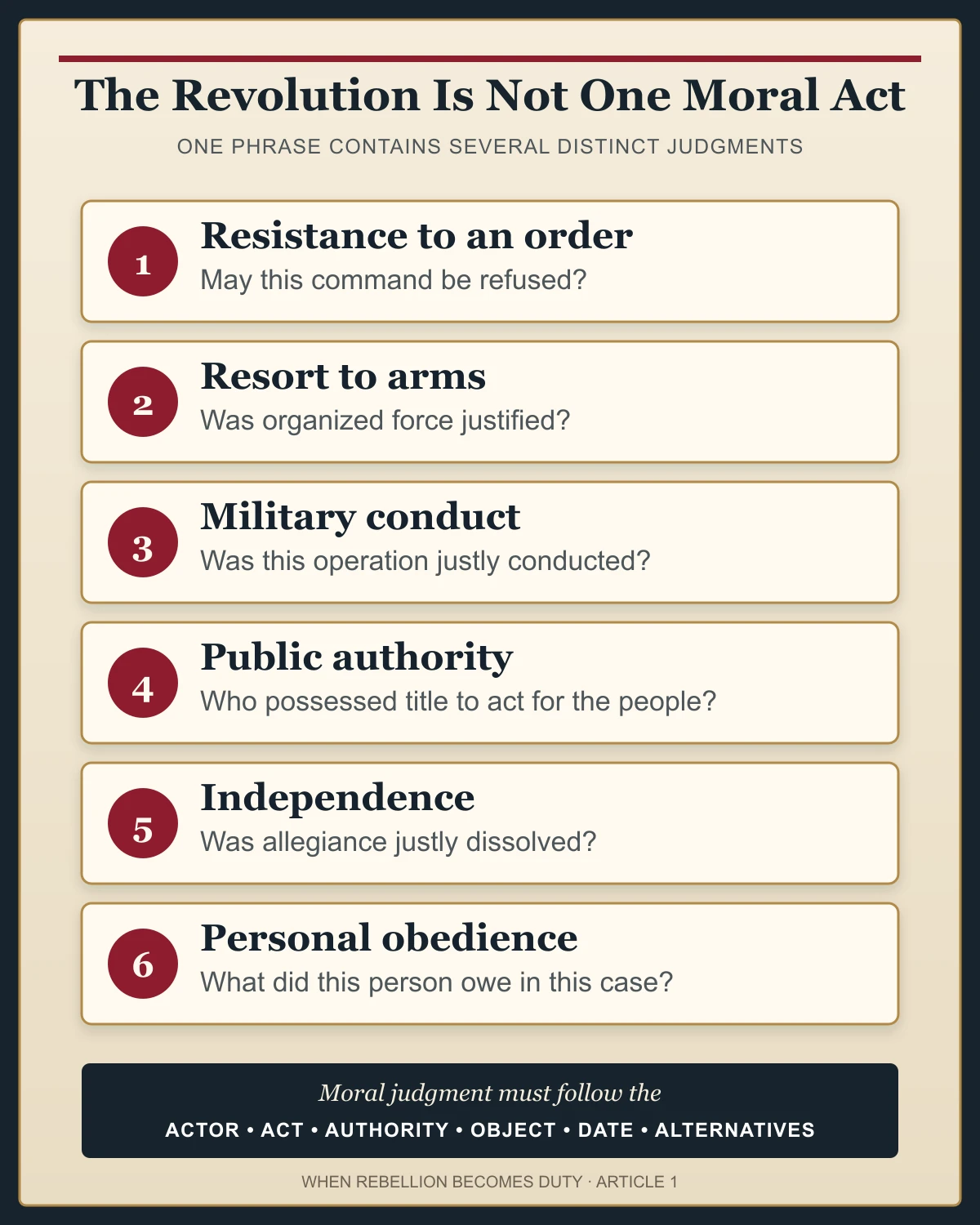
Separating those judgments is not an escape hatch built to protect a favorite outcome. It is ordinary moral reasoning. We do not decide whether a court had jurisdiction by asking whether every bailiff behaved well. We do not decide whether a defensive war had just cause by pretending misconduct within it did not matter. We test the institutional act and the particular wrongs without making either disappear into the other.
The central verdict is therefore narrow enough to be tested and broad enough to matter: the political dissolution of allegiance and establishment of independent governments was just. Later articles will give distinct judgments on the resort to arms and on hard cases that expose the limits of the Patriot cause.
The Case Against the Thesis
The objection is formidable. Paul did not write Romans 13 under a friendly Christian republic. Peter did not tell comfortable citizens to honor a harmless ceremonial monarch. The apostles addressed believers living under pagan imperial power. If their commands survived Rome, why should a dispute over an English constitution release British colonists from them?
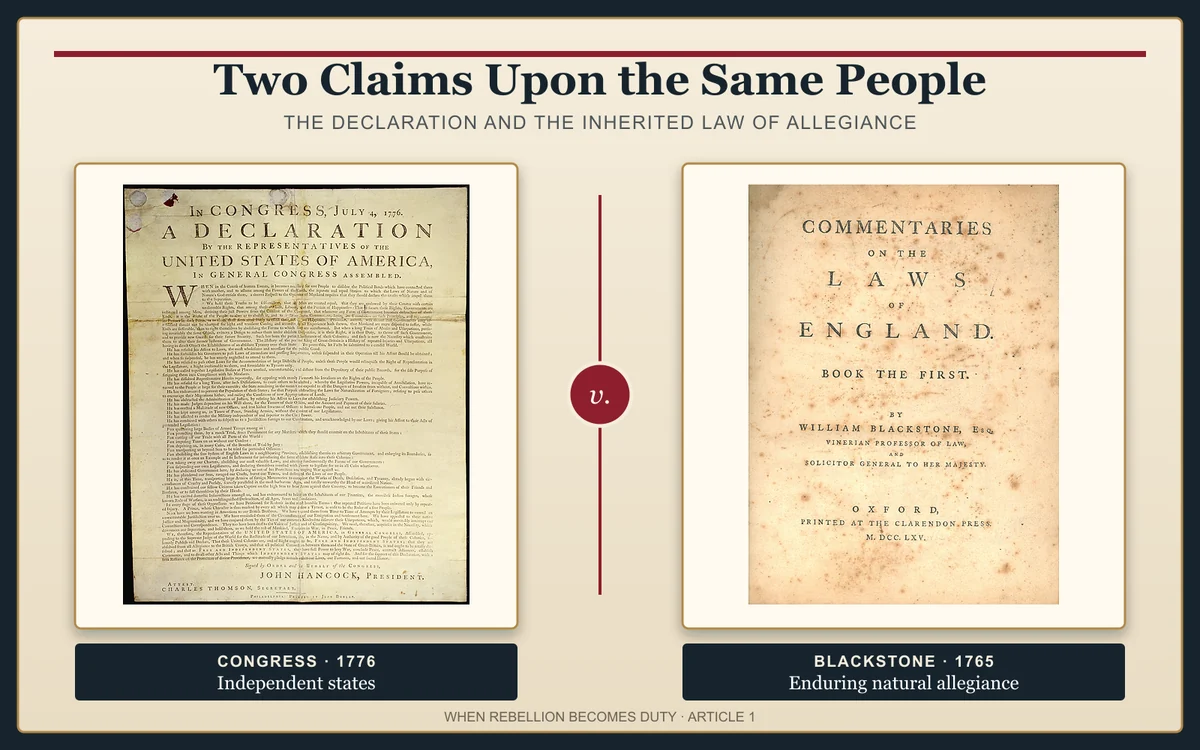
British law also did not leave the matter vague. William Blackstone described allegiance as the bond owed in return for royal protection, but he also treated natural allegiance as enduring and not subject to unilateral cancellation by the subject.2, book 1, chap. 10, printed 354–358 On the ordinary legal account, taking arms against the king was treason. The colonists could not make it lawful merely by writing a declaration after the fact.
Nor did eighteenth-century Christians speak with one Patriot voice. Anglican Loyalists appealed to Scripture, law, order, oath, and the horrors of civil war. Quakers and other peace churches challenged the sword itself. Some people who condemned parliamentary policy still judged resistance unlawful or ruinous. If we tell the story as though serious Christianity naturally led to independence, we falsify both the theology and the history.
There is a final danger. An argument may begin with a favored conclusion, narrow its definitions, gather friendly sources, and then claim impartiality. The proper answer is not a performance of neutrality. I did not begin this inquiry without a thesis, and I do not end it without one. Honesty requires naming the conditions under which that thesis would fail, admitting the strongest counterevidence, and changing the conclusion if the chain breaks.
That is the compact of this series.
Lawful in Which Sense?
The word lawful will cause trouble unless we discipline it early. An act may violate the positive law enforced by a government and still be morally justified under a higher standard. That claim is dangerous because every rebel can make it. It is also unavoidable, because Scripture itself contains acts of righteous disobedience to human commands.
We will not solve the danger by pretending the categories are identical. When British authorities called the Patriots rebels and traitors, they made a serious positive-law claim. The answer cannot be, “They were not rebels because they were right.” Nor can the moral answer be settled merely by repeating, “The law called them rebels.” A sound judgment must first state the ordinary British legal title and then ask whether constitutional breach, public authority, necessity, and moral duty justified departure from it.
The same care applies to the word magistrate. A committee is not a magistrate because it resists. A congress does not acquire jurisdiction by quoting a European theologian. Colonial institutions must be examined through charters, elections, legislative continuity, local recognition, military commissions, popular instructions, and later constituent acts. If they lacked the relevant authority, good theology cannot manufacture it.
Permission Is Not Yet Duty
The title of this series makes a stronger claim than permission. There are at least four steps between “this resistance is not forbidden” and “this person must fight.”
First, a public act may be morally permitted. Second, prudence may make one lawful course better than another. Third, an office may impose a duty on a magistrate, delegate, or military commander to protect a community. Fourth, a valid command may impose a corresponding duty on a subordinate or subject.
Those levels cannot be collapsed. A Virginia delegate, a Massachusetts militia officer, a Pennsylvania associator, and a New York dissenter did not necessarily stand in the same relation to the same authority. Even when a cause is just, conscience, jurisdiction, service terms, competing claims, and the moral character of a particular order remain relevant.
The eventual duty argument is therefore both stronger and more bounded than a slogan. Public protectors can become obligated to use necessary lawful means within their office. Subjects can become obligated to obey valid public commands within an actual relation of authority. In July 1776, properly authorized political bodies were obligated to complete a separation made necessary by the collapse of protection and the conditions of war. None of this means that every resident was bound to endorse every Patriot measure or that conscience disappeared when Congress spoke.
A Christian Argument, Not a Sacred National Story
This series will give Christian ideas substantial weight. Ministers preached political sermons. Churches and civil institutions participated in public fasts. Biblical arguments circulated in print. Revolutionary leaders heard, read, repeated, and contested Christian claims. Loyalists and peace churches used the same public sphere to resist Patriot reasoning.
Christian influence will be traced through named people, arguments, and institutions: who quoted or heard an argument, where it circulated, which institutions adopted it, and how its moral vocabulary entered public debate. That history was not exclusively Christian. Theological, constitutional, economic, and strategic reasoning often traveled together.
The moral verdict also cannot rest on success. Victory did not make the American cause just. The later Constitution did not retroactively authorize every provisional body. The good achieved by the United States does not cancel sins committed in its birth. If the Revolution was just, it was just because the responsible actors possessed adequate authority, acted for a just cause with a right governing intention, exhausted or reasonably lost lesser remedies, used proportionate means with a reasonable prospect, and finally dissolved allegiance under conditions that warranted it.
How the Argument Will Proceed
The first movement of the series establishes the biblical case. Romans 13 will be heard as a command, not explained away as an embarrassing proof text. First Peter, Titus, First Timothy, Jesus' tribute saying, and the trial before Pilate will make the Christian posture cumulative: submission, ordinary obedience, honor, prayer, public good, peaceable witness, and willingness to suffer. Only then will the biblical duty to refuse sin be introduced... and the gap between refusal and public force kept open.
The second movement asks whether Christian political thought ever supplied a responsible bridge across that gap. The answer will pass through early Christian disputes about soldiering, Augustine and Aquinas on public vocation and just war, Reformation resistance arguments, the English Civil Wars, and the Revolution of 1688. That history will not be used as an apostolic substitute. It will show how Christians attempted to reason from Scripture to office, law, common good, protection, and duty... and where their theories failed to restrain force.
The third and fourth movements reconstruct the British constitution and the colonists' long effort to remain within it. Oaths, allegiance, protection, charters, taxation, representation, Parliament, the king, sermons, Loyalist arguments, and peace-church objections belong here. The constitutional dispute must be stated in a form a serious defender of parliamentary sovereignty could recognize.
The final movements follow the crisis from petition to bloodshed, the Olive Branch Petition, the king's proclamation and speech, the Prohibitory Act, foreign auxiliaries, Common Sense, colonial instructions, and the Declaration. Only after authority, cause, remedies, intention, proportion, and prospect have been tested will the series answer whether taking up arms was just, whether independence was just, and when either became duty.
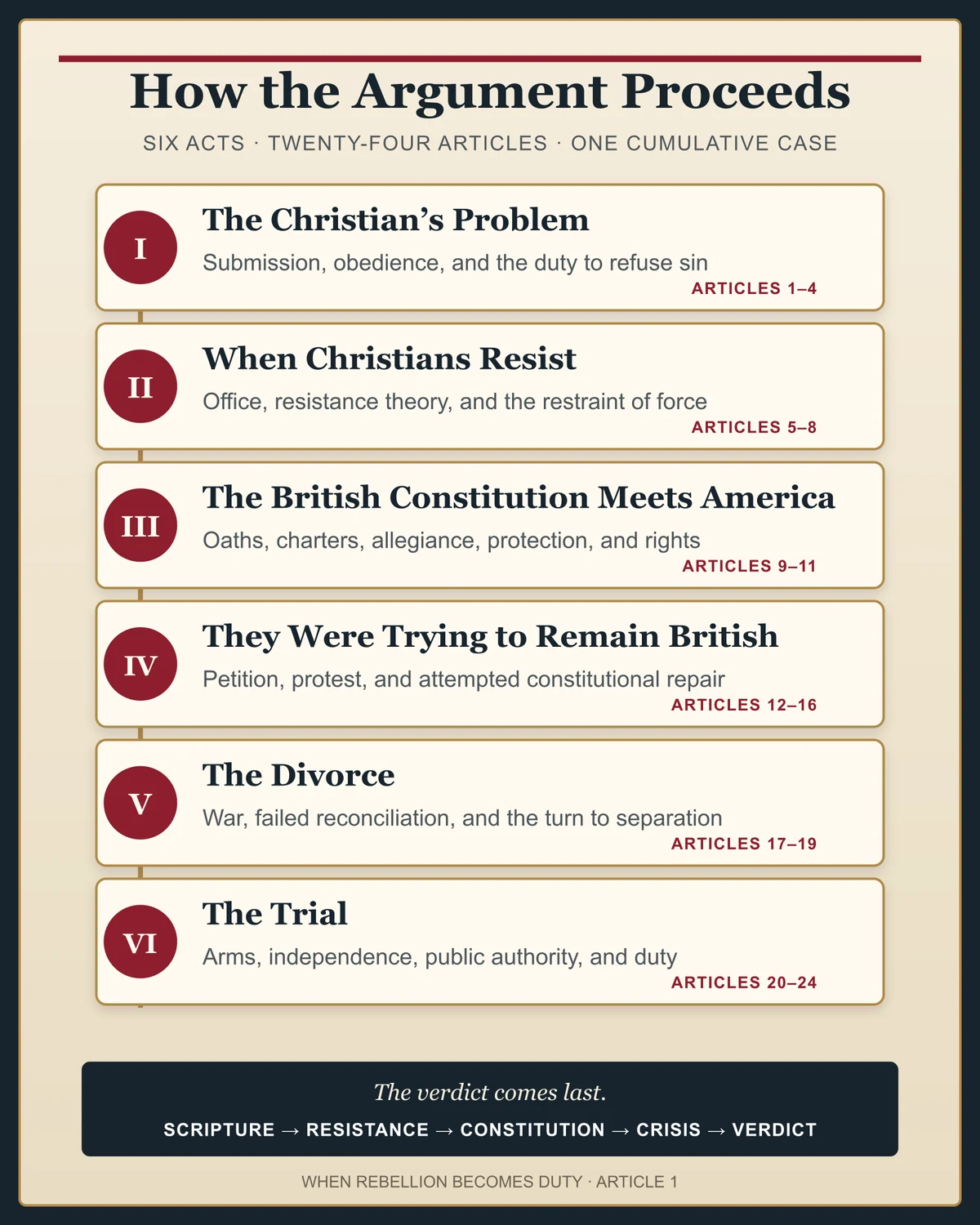
That order prevents the verdict from deciding its own premises. It also means the reader need not accept every link at once. Each link can be tested in sequence, and later conclusions may not borrow authority from propositions not yet established.
That is a hard case to make. It is also the case I believe the evidence makes.
We begin, then, where the Patriots' easiest defenders often do not. Before we ask when rebellion becomes duty, we must hear the command that makes rebellion such a grave possibility: “Let every soul be subject” (Romans 13:1Let every soul be subject unto the higher powers. For there is no power but of God: the powers that be are ordained of God.).
Discussion
Thoughtful, good-faith discussion is welcome.
Loading comments…