

We Must Obey God Rather Than Men
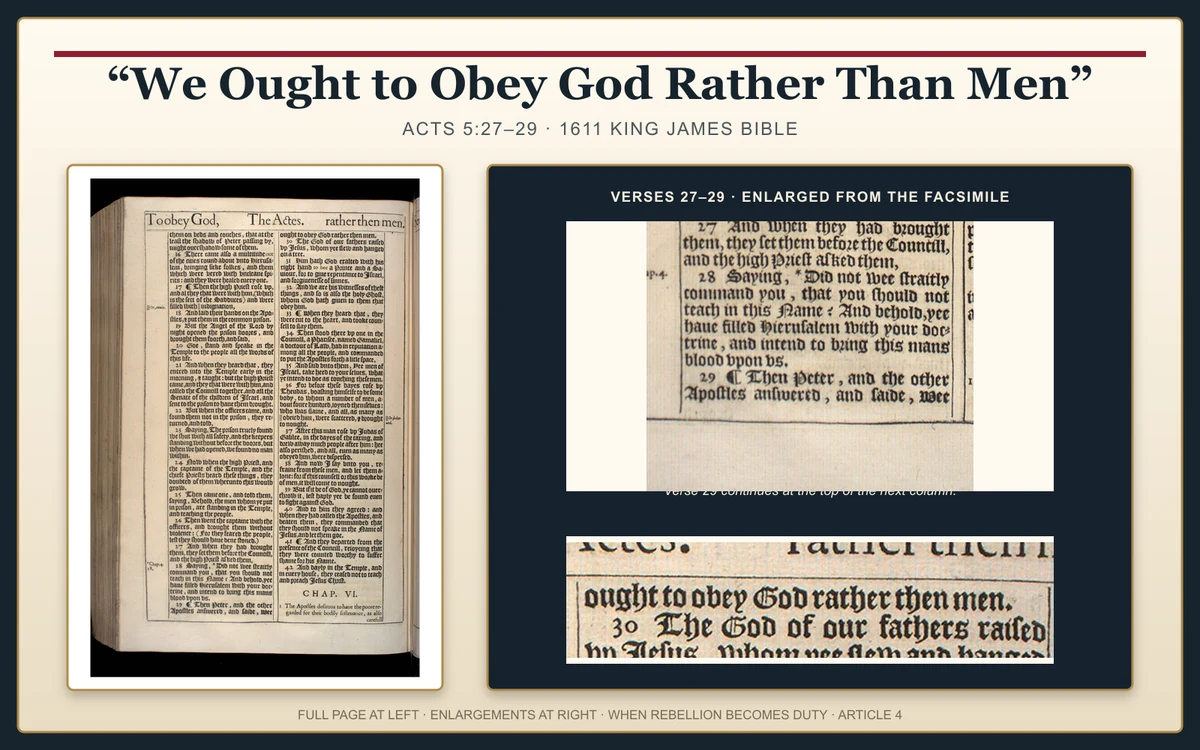
The apostles had received an order from the recognized authorities in Jerusalem: stop teaching in the name of Jesus. They refused. Peter and the apostles answered that they must obey God rather than men (Acts 5:27–29Chapter 5, verse 27: 5:27And when they had brought them, they set them before the council: and the high priest asked them, Chapter 5, verse 28: 5:28Saying, Did not we straitly command you that ye should not teach in this name? and, behold, ye have filled Jerusalem with your doctrine, and intend to bring this man’s blood upon us. Chapter 5, verse 29: 5:29Then Peter and the other apostles answered and said, We ought to obey God rather than men.).
The sentence is not a general declaration of political independence. It is a clear limit on human command. When an authority requires what God forbids or forbids what God requires, obedience to God takes priority.
That principle prevents submission from becoming idolatry. It does not yet tell us who may use force.
Scripture's Refusing Servants
The pattern appears long before Acts. Pharaoh ordered the Hebrew midwives to kill newborn sons. They feared God and did not do what Egypt's king commanded (Exodus 1:15–21Chapter 1, verse 15: 1:15And the king of Egypt spake to the Hebrew midwives, of which the name of the one was Shiphrah, and the name of the other Puah: Chapter 1, verse 16: 1:16And he said, When ye do the office of a midwife to the Hebrew women, and see them upon the stools; if it be a son, then ye shall kill him: but if it be a daughter, then she shall live. Chapter 1, verse 17: 1:17But the midwives feared God, and did not as the king of Egypt commanded them, but saved the men children alive. Chapter 1, verse 18: 1:18And the king of Egypt called for the midwives, and said unto them, Why have ye done this thing, and have saved the men children alive? Chapter 1, verse 19: 1:19And the midwives said unto Pharaoh, Because the Hebrew women are not as the Egyptian women; for they are lively, and are delivered ere the midwives come in unto them. Chapter 1, verse 20: 1:20Therefore God dealt well with the midwives: and the people multiplied, and waxed very mighty. Chapter 1, verse 21: 1:21And it came to pass, because the midwives feared God, that he made them houses.). When Pharaoh called them to account, they said that the Hebrew women gave birth before the midwives arrived. Scripture does not tell us whether their answer was false. What the text expressly commends is their fear of God and their refusal to carry out Pharaoh's murderous command.
Nebuchadnezzar commanded public worship of his image. Shadrach, Meshach, and Abednego refused, even while acknowledging the king and accepting the prospect of the furnace (Daniel 3). Darius's decree forbade petitions to any god or man other than the king. Daniel continued his established prayer and endured the legal penalty (Daniel 6).
The apostles likewise refused a particular suppressive command. They did not deny that the council occupied an office. They testified, continued their mission, and suffered beating. Elsewhere Paul used his Roman citizenship, required public acknowledgment after unlawful treatment, and appealed to Caesar (Acts 16:35–39Chapter 16, verse 35: 16:35And when it was day, the magistrates sent the serjeants, saying, Let those men go. Chapter 16, verse 36: 16:36And the keeper of the prison told this saying to Paul, The magistrates have sent to let you go: now therefore depart, and go in peace. Chapter 16, verse 37: 16:37But Paul said unto them, They have beaten us openly uncondemned, being Romans, and have cast us into prison; and now do they thrust us out privily? nay verily; but let them come themselves and fetch us out. Chapter 16, verse 38: 16:38And the serjeants told these words unto the magistrates: and they feared, when they heard that they were Romans. Chapter 16, verse 39: 16:39And they came and besought them, and brought them out, and desired them to depart out of the city.; Acts 22:22–29Chapter 22, verse 22: 22:22And they gave him audience unto this word, and then lifted up their voices, and said, Away with such a fellow from the earth: for it is not fit that he should live. Chapter 22, verse 23: 22:23And as they cried out, and cast off their clothes, and threw dust into the air, Chapter 22, verse 24: 22:24The chief captain commanded him to be brought into the castle, and bade that he should be examined by scourging; that he might know wherefore they cried so against him. Chapter 22, verse 25: 22:25And as they bound him with thongs, Paul said unto the centurion that stood by, Is it lawful for you to scourge a man that is a Roman, and uncondemned? Chapter 22, verse 26: 22:26When the centurion heard that, he went and told the chief captain, saying, Take heed what thou doest: for this man is a Roman. Chapter 22, verse 27: 22:27Then the chief captain came, and said unto him, Tell me, art thou a Roman? He said, Yea. Chapter 22, verse 28: 22:28And the chief captain answered, With a great sum obtained I this freedom. And Paul said, But I was free born. Chapter 22, verse 29: 22:29Then straightway they departed from him which should have examined him: and the chief captain also was afraid, after he knew that he was a Roman, and because he had bound him.; Acts 25:10–12Chapter 25, verse 10: 25:10Then said Paul, I stand at Cæsar’s judgment seat, where I ought to be judged: to the Jews have I done no wrong, as thou very well knowest. Chapter 25, verse 11: 25:11For if I be an offender, or have committed any thing worthy of death, I refuse not to die: but if there be none of these things whereof these accuse me, no man may deliver me unto them. I appeal unto Cæsar. Chapter 25, verse 12: 25:12Then Festus, when he had conferred with the council, answered, Hast thou appealed unto Cæsar? unto Cæsar shalt thou go.). Refusal, endurance, and legal appeal could coexist.
These narratives differ in setting and method. They should not be flattened into one procedure. Together they establish the governing limit: a creature's authority cannot cancel the Creator's command.
Which Commands Must Be Refused?
The principle is clearest when the conflict is direct. The midwives are told to kill. The three Judeans are told to worship an image. Daniel is forbidden to pray. The apostles are forbidden to speak the message Christ commissioned them to proclaim. In each case the human order either commands evil or forbids a duty owed to God.
That clarity should not be transferred casually to every disputed policy. A command may be foolish, harsh, uneven, unconstitutional, or harmful without requiring the commanded person to commit a sin. Such defects can support petition, appeal, political correction, or another authority's intervention; they do not automatically create an Acts 5 duty of personal noncompliance. The person claiming that obedience itself would be sinful bears a real burden to identify the divine duty or prohibition involved.
Indirect participation can make the judgment harder. An order may not command the final evil act yet require material assistance without which it cannot be done. The midwives' case shows that refusing cooperation with a murderous policy can be part of fearing God. But remoteness, knowledge, intention, office, and available alternatives matter. “Obey God” is not a device for naming every political disagreement a crisis of conscience; it is a command to judge one's actual participation truthfully.
What Refusal Can Include
Disobedience is not always theatrical confrontation. Depending on the duty and circumstances, faithful refusal may involve speaking openly, continuing a forbidden good work, withholding cooperation, protecting a threatened person, fleeing, appealing, or accepting a penalty. The means must answer the actual wrong.
Scripture offers more than the false choice between total compliance and overthrow. The apostles leave one jurisdiction and preach elsewhere. Paul invokes law. The midwives frustrate a murderous policy. Daniel continues ordinary worship. These examples also expose the danger hidden by passive language: a person commanded to deliver an innocent neighbor to death may not satisfy the duty to God merely by declining to swing the sword himself. Love of neighbor can require protection. The remaining question is what means a person may lawfully use from his or her place.
Refusal may also be shared without becoming governmental. A family, church, guild, congregation, or group of officials may together decline an unlawful demand. Cooperation can make protection more effective and public witness more visible. Numerical size, however, does not by itself confer jurisdiction to punish the ruler, command nonmembers, levy war, or establish a successor government. Corporate conscience and public sovereignty are not synonyms.
That limit matters historically. Colonial nonimportation, committee enforcement, militia organization, and legislative interposition were not one moral act merely because each opposed imperial policy. Withholding one's own cooperation, pressuring a neighbor, seizing public power, and commanding armed force require different kinds of authority and justification.
Calvin's Hard Boundary
John Calvin states the limit at the end of an unusually demanding discussion of obedience. Private persons, he argues, must not infer from a ruler's vice that they have been appointed public avengers. Even wicked rulers may occupy a divinely ordered office. Yet if a ruler commands against God, obedience must be refused, whatever the cost.1, IV.20.29–32
The order of Calvin's argument is helpful. He does not use divine authority to erase civil authority. Nor does he use civil authority to erase obedience to God. He also does not allow the justified refusal of a sinful command to become an automatic private commission to punish the commander.
Calvin's exact political conclusions remain disputable. The logical distinction remains sound. Moral permission to withhold compliance answers one question: may I do what the authority commands? Coercive jurisdiction answers another: may I compel, disable, depose, or punish the authority? A “no” to the first is not automatically a “yes” to the second.
Why Acts 5 Is Not a Revolution Text
The principle that we must obey God rather than men is general: no human authority can require disobedience to God. In Acts, the apostles apply it to Christ's command that they continue their witness. They neither announce a right of popular sovereignty nor organize an army, depose the council, or transfer its jurisdiction to themselves.
The priority rule is clear; the public remedy remains unassigned. An armed-resistance rule also requires premises about the protection of neighbors, the public vocation of force, the authority of a resisting actor, necessity, and proportionality.
This is not a timid qualification added to avoid controversy. It is the difference between moral agency and political office. Every Christian must obey God. Not every Christian holds the same authority to judge, command, arrest, or wage war.
The Neighbor Complicates Nonresistance
The strongest challenge to this distinction arises when obedience assists grave harm. Suppose an official commands participation in murder or religious persecution. Refusal protects the conscience of the commanded person, but what about the intended victim? If I can prevent the evil, does love of neighbor require more than clean hands?
Sometimes it does. Scripture's commands to rescue the threatened, defend the weak, do justice, and preserve life prevent a purely private ethic in which my only concern is whether I personally perform the forbidden act (Psalm 82:1–4Chapter 82, verse 1: 82:1God standeth in the congregation of the mighty; he judgeth among the gods. Chapter 82, verse 2: 82:2How long will ye judge unjustly, and accept the persons of the wicked? Selah. Chapter 82, verse 3: 82:3Defend the poor and fatherless: do justice to the afflicted and needy. Chapter 82, verse 4: 82:4Deliver the poor and needy: rid them out of the hand of the wicked.; Proverbs 24:11–12Chapter 24, verse 11: 24:11If thou forbear to deliver them that are drawn unto death, and those that are ready to be slain; Chapter 24, verse 12: 24:12If thou sayest, Behold, we knew it not; doth not he that pondereth the heart consider it? and he that keepeth thy soul, doth not he know it? and shall not he render to every man according to his works?; Proverbs 31:8–9Chapter 31, verse 8: 31:8Open thy mouth for the dumb in the cause of all such as are appointed to destruction. Chapter 31, verse 9: 31:9Open thy mouth, judge righteously, and plead the cause of the poor and needy.). But the duty to protect does not make every means available to every person. A private neighbor may warn, hide, shelter, testify, flee with the endangered, or use force within the moral limits of immediate defense. A magistrate, judge, sheriff, or military officer may possess public powers the private person does not.
Necessity can affect what action is permitted. It does not by magic create an office, a constituency, or jurisdiction over a whole political community.
Prevention Is Not the Same as Punishment
One further distinction keeps the argument from becoming artificial. A private person may sometimes use proportionate means to prevent immediate grave harm without claiming power to punish the wrongdoer or govern the community. Pulling a victim away, blocking a blow, hiding a person marked for unjust seizure, or assisting escape does not necessarily amount to assuming the magistrate's office.
Punishment is different. It looks backward as well as forward, declares public wrong, and deliberately imposes a sanction through an authority responsible for the legal order. Deposition and war go further still. They alter or defend public relations on behalf of a community.
This helps explain why the refusal/force gap is real without being absolute. Not every defensive use of force is a revolution, and not every act that frustrates an official command is an attempt to govern. But organized armed resistance to the state cannot be justified merely as a larger version of one person blocking an immediate assault. Scale, duration, command, effects on third parties, and claimed public authority change the moral object.
Rival Commands and Conscience
The American crisis would eventually place ordinary people under competing orders. A royal governor might command one course, a provincial congress another, and a local committee enforce a third. Conscience could not answer the case by selecting the command it preferred. The person had to judge which body possessed authority, whether the command was lawful, and whether the required act itself was just.
That judgment could be difficult without being optional. “I was obeying orders” cannot justify an intrinsically wrongful act. “I followed conscience” cannot manufacture jurisdiction or excuse careless judgment. A Christian subject owes conscientious obedience precisely because civil duty is lived before God.
The distinctions among doubtful commands, plainly sinful commands, and lawful commands issued by defensible successor authorities remain essential. The first rule is clear: no human office may require sin, and no appeal to divine obedience may silently grant the resister every public power he needs.
The Pacifist Challenge
Peace-church Christians press the opposite side of the argument. They can affirm disobedience to sinful commands while denying that Christ authorizes his followers to take up the sword at all. The examples we have just examined often strengthen their case. The faithful refuse and suffer. Jesus rebukes Peter's sword. His servants do not fight to prevent the Passion. The early church's relationship to military service is disputed, but a significant nonviolent witness cannot be treated as an eccentric footnote.
The Reformed and broader just-war traditions answer by distinguishing the church's mission from the magistrate's public vocation. They point to the centurions who are not told simply to abandon service, the public sword of Romans 13, Old Testament protection duties, and the possibility that love of neighbor can require coercive defense. That answer stands or falls on its Scriptural case; the state's customary use of force cannot make Christian participation righteous.
The peace-church objection remains live at every stage. A historical finding that Patriot magistrates claimed Christian reasons will not answer it. A constitutional title will not answer it. Public coercive protection is compatible with Christian discipleship only if it accords with the positive commands and necessary consequences of Scripture, not merely because a Protestant tradition said so.
Refusal, Resistance, and Force
We can now arrange the categories without confusing them.
A sinful command must be disobeyed. Resistance in a broad sense may include any action that frustrates or opposes the command. Coercive resistance adds the deliberate use or threat of force. Political resistance acts upon public authority or institutions. Armed resistance organizes lethal force against an opposing power. Independence dissolves a prior relation and establishes a new political order.
Each step adds a burden. One cannot move from “this command is sinful” to “this government has no authority,” from there to “I may use force,” and from there to “my neighbors must follow me” without defending the intervening claims.
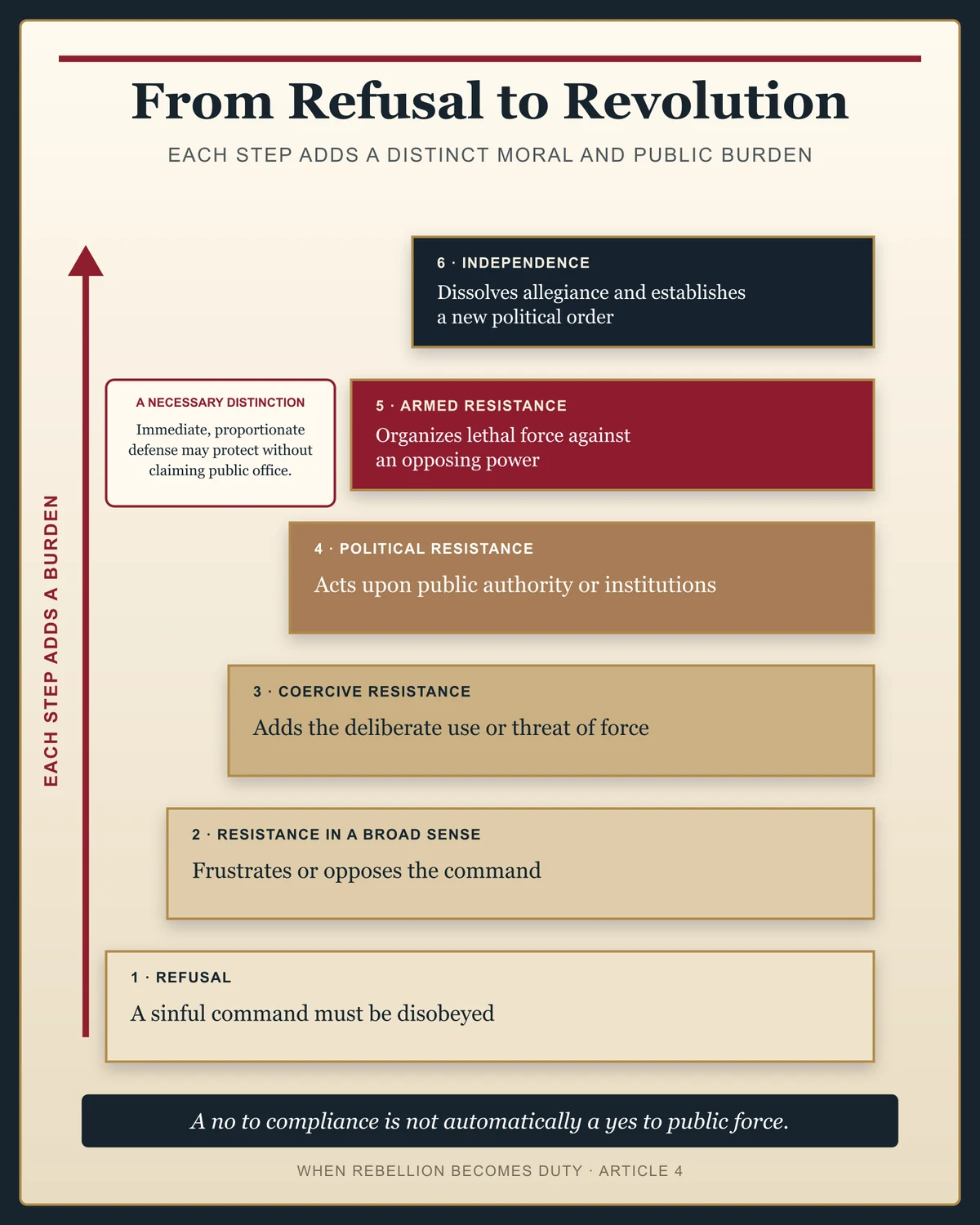
The American controversy will eventually require all of them. Colonial bodies did not merely decline one command. They organized militias, assumed public powers, issued military orders, and finally declared allegiance dissolved. If those actions were just, their justification must be more than the apostolic right to say no.
The Christian can and sometimes must disobey. He may have to bear punishment without retaliation. He may also have duties toward a threatened neighbor. But public force remains institutionally unassigned. To find a possible bearer of that sword, we must ask how Christians before the Reformation understood tyranny, sedition, war, and public remedy.
Discussion
Thoughtful, good-faith discussion is welcome.
Loading comments…