

Peter compresses Christian political allegiance into four short commands:
Honour all men. Love the brotherhood. Fear God. Honour the king.
The order is instructive. The emperor receives honor. He does not receive the fear assigned to God. Christians are free, but their freedom is not a covering for evil; they are servants of God. Their submission to human institutions is “for the Lord's sake,” not because the emperor has become lord (1 Peter 2:13–17Chapter 2, verse 13: 2:13Submit yourselves to every ordinance of man for the Lord’s sake: whether it be to the king, as supreme; Chapter 2, verse 14: 2:14Or unto governors, as unto them that are sent by him for the punishment of evildoers, and for the praise of them that do well. Chapter 2, verse 15: 2:15For so is the will of God, that with well doing ye may put to silence the ignorance of foolish men: Chapter 2, verse 16: 2:16As free, and not using your liberty for a cloke of maliciousness, but as the servants of God. Chapter 2, verse 17: 2:17Honour all men. Love the brotherhood. Fear God. Honour the king.).
Civil authority is thereby bounded, not dissolved. Peter does not tell socially vulnerable Christians that divine lordship excuses contempt for pagan rule. He tells them to submit and to do good.
Submission as Witness
First Peter addresses believers who live as sojourners and exiles among their neighbors. They face slander and the prospect of unjust suffering. Peter's answer is a visible manner of life: abstain from destructive desires, conduct yourselves honorably, do good, and be ready to suffer without retaliation (1 Peter 2:11–12Chapter 2, verse 11: 2:11Dearly beloved, I beseech you as strangers and pilgrims, abstain from fleshly lusts, which war against the soul; Chapter 2, verse 12: 2:12Having your conversation honest among the Gentiles: that, whereas they speak against you as evildoers, they may by your good works, which they shall behold, glorify God in the day of visitation.; 1 Peter 3:8–17Chapter 3, verse 8: 3:8Finally, be ye all of one mind, having compassion one of another, love as brethren, be pitiful, be courteous: Chapter 3, verse 9: 3:9Not rendering evil for evil, or railing for railing: but contrariwise blessing; knowing that ye are thereunto called, that ye should inherit a blessing. Chapter 3, verse 10: 3:10For he that will love life, and see good days, let him refrain his tongue from evil, and his lips that they speak no guile: Chapter 3, verse 11: 3:11Let him eschew evil, and do good; let him seek peace, and ensue it. Chapter 3, verse 12: 3:12For the eyes of the Lord are over the righteous, and his ears are open unto their prayers: but the face of the Lord is against them that do evil. Chapter 3, verse 13: 3:13And who is he that will harm you, if ye be followers of that which is good? Chapter 3, verse 14: 3:14But and if ye suffer for righteousness’ sake, happy are ye: and be not afraid of their terror, neither be troubled; Chapter 3, verse 15: 3:15But sanctify the Lord God in your hearts: and be ready always to give an answer to every man that asketh you a reason of the hope that is in you with meekness and fear: Chapter 3, verse 16: 3:16Having a good conscience; that, whereas they speak evil of you, as of evildoers, they may be ashamed that falsely accuse your good conversation in Christ. Chapter 3, verse 17: 3:17For it is better, if the will of God be so, that ye suffer for well doing, than for evil doing.).
Civil submission belongs inside that witness. The emperor and governors are named as the public authorities before whom Christian conduct will be seen. Peter describes rulers by the familiar function of punishing wrongdoers and praising those who do good. That description is normative; the rest of the letter prevents us from treating it as an empirical guarantee. Christians may do good and suffer for it.
Peter's phrase often rendered “every human institution” has a real lexical range: institution, ordinance, created order, or human creature have all been argued. That debate should not obscure what follows. Peter immediately names the emperor and governors sent through him, so the civil application is secure. What remains especially important is the reason: submission is “for the Lord's sake.” The emperor is obeyed inside a prior allegiance, not as the source of it.
The chain Peter describes is also concrete. The emperor stands above governors within the civil order; governors are sent to punish wrongdoing and praise good conduct; Christians answer by doing good. Yet Peter's readers may still suffer unjustly. The passage can therefore recognize an actual hierarchy without pretending that each superior performs his office faithfully. It teaches Christians how to live within the relation while leaving the ruler's conduct answerable to the Lord for whose sake submission is given.
Craig Keener reads 1 Peter 2:13–17Chapter 2, verse 13: 2:13Submit yourselves to every ordinance of man for the Lord’s sake: whether it be to the king, as supreme; Chapter 2, verse 14: 2:14Or unto governors, as unto them that are sent by him for the punishment of evildoers, and for the praise of them that do well. Chapter 2, verse 15: 2:15For so is the will of God, that with well doing ye may put to silence the ignorance of foolish men: Chapter 2, verse 16: 2:16As free, and not using your liberty for a cloke of maliciousness, but as the servants of God. Chapter 2, verse 17: 2:17Honour all men. Love the brotherhood. Fear God. Honour the king. within Peter's larger movement from public witness through household relationships and unjust suffering. In that reading, the civil instruction is joined to a Christian answer to slander: honorable conduct rather than retaliation.1, pp. 20–23 That literary setting is essential. A political reading that stops at verse 17 before Christ's suffering example has severed the command from its moral atmosphere.
Peter soon speaks to servants enduring unjust treatment. Christ committed no sin, returned no abuse, made no threat, and entrusted himself to the one who judges justly (1 Peter 2:18–25Chapter 2, verse 18: 2:18Servants, be subject to your masters with all fear; not only to the good and gentle, but also to the froward. Chapter 2, verse 19: 2:19For this is thankworthy, if a man for conscience toward God endure grief, suffering wrongfully. Chapter 2, verse 20: 2:20For what glory is it, if, when ye be buffeted for your faults, ye shall take it patiently? but if, when ye do well, and suffer for it, ye take it patiently, this is acceptable with God. Chapter 2, verse 21: 2:21For even hereunto were ye called: because Christ also suffered for us, leaving us an example, that ye should follow his steps: Chapter 2, verse 22: 2:22Who did no sin, neither was guile found in his mouth: Chapter 2, verse 23: 2:23Who, when he was reviled, reviled not again; when he suffered, he threatened not; but committed himself to him that judgeth righteously: Chapter 2, verse 24: 2:24Who his own self bare our sins in his own body on the tree, that we, being dead to sins, should live unto righteousness: by whose stripes ye were healed. Chapter 2, verse 25: 2:25For ye were as sheep going astray; but are now returned unto the Shepherd and Bishop of your souls.). The passage cannot be made into a general approval of slavery or a claim that injustice becomes good when it is endured faithfully. It does make nonretaliation and trust in God's judgment central to Christian witness.
Any later account of resistance must pass through that pattern. It may not turn injury into hatred, treat vengeance as courage, or use the public good as a verbal disguise for private payback.
Obedience, Gentleness, and Mercy
Titus adds an important word. Christians are to be reminded to be subject to rulers and authorities and to obey, to be ready for every good work, to malign no one, avoid quarrels, and show gentleness to all (Titus 3:1–2Chapter 3, verse 1: 3:1Put them in mind to be subject to principalities and powers, to obey magistrates, to be ready to every good work, Chapter 3, verse 2: 3:2To speak evil of no man, to be no brawlers, but gentle, shewing all meekness unto all men.). The command is not left as a cold rule of civic compliance. It is grounded in memory: believers themselves were once foolish and disobedient, and God's kindness and mercy saved them (Titus 3:3–8Chapter 3, verse 3: 3:3For we ourselves also were sometimes foolish, disobedient, deceived, serving divers lusts and pleasures, living in malice and envy, hateful, and hating one another. Chapter 3, verse 4: 3:4But after that the kindness and love of God our Saviour toward man appeared, Chapter 3, verse 5: 3:5Not by works of righteousness which we have done, but according to his mercy he saved us, by the washing of regeneration, and renewing of the Holy Ghost; Chapter 3, verse 6: 3:6Which he shed on us abundantly through Jesus Christ our Saviour; Chapter 3, verse 7: 3:7That being justified by his grace, we should be made heirs according to the hope of eternal life. Chapter 3, verse 8: 3:8This is a faithful saying, and these things I will that thou affirm constantly, that they which have believed in God might be careful to maintain good works. These things are good and profitable unto men.).
Andrew Errington's treatment of this passage rightly joins political conduct to the gospel-shaped generosity of the paragraph. Submission, courtesy, and good works arise from remembered mercy rather than fear alone.2, pp. 486–489
This makes Christian obedience both more concrete and more demanding. We may not preserve the word submission while emptying it of ordinary compliance. Nor may we obey with the slanderous, quarrelsome spirit Titus forbids. The passage contains no express resistance exception. Limits on sinful compliance must be established from the wider canon.
It also supplies no rule for armed interposition. It addresses the church's ordinary conduct under rulers. Any defense of a magistrate's responsibility to interpose requires an additional argument; it cannot be inserted into Titus's sentence.
Pray for Kings
First Timothy directs Christians to offer supplications, prayers, intercessions, and thanksgivings for everyone, expressly including kings and all who are in high position. The desired result is a quiet and tranquil life in godliness and dignity (1 Timothy 2:1–2Chapter 2, verse 1: 2:1I exhort therefore, that, first of all, supplications, prayers, intercessions, and giving of thanks, be made for all men; Chapter 2, verse 2: 2:2For kings, and for all that are in authority; that we may lead a quiet and peaceable life in all godliness and honesty.).
Prayer honors rulers without flattering them. A king prayed for is neither a devil beyond grace nor a god beyond judgment. He stands among the human beings who need the mercy and rule of the one God. The paragraph moves from public peace to God's saving will and the one mediator, Jesus Christ (1 Timothy 2:3–7Chapter 2, verse 3: 2:3For this is good and acceptable in the sight of God our Saviour; Chapter 2, verse 4: 2:4Who will have all men to be saved, and to come unto the knowledge of the truth. Chapter 2, verse 5: 2:5For there is one God, and one mediator between God and men, the man Christ Jesus; Chapter 2, verse 6: 2:6Who gave himself a ransom for all, to be testified in due time. Chapter 2, verse 7: 2:7Where unto I am ordained a preacher, and an apostle, (I speak the truth in Christ, and lie not;) a teacher of the Gentiles in faith and verity.).
Pancha Wiguna Yahya's focused study traces that movement: rulers are named within the call to pray for all, peace serves faithful public life, and the paragraph widens into the church's mission.3, pp. 61–74 The church does not pray for tranquility because comfort is its highest good. It seeks room for godly life and witness.
That point cuts two ways. Political chaos is not morally romantic. Peace under an imperfect ruler can be a great good. Yet the ruler remains beneath the one God and the one mediator. Prayer does not ratify every policy; it places the office and officeholder under divine government.
The desired quiet life is not political anesthesia. Paul connects public peace to godliness, dignity, and God's saving purpose. Stable government can protect space in which families, churches, work, mercy, and witness flourish. That is one reason disorder is a moral cost rather than merely an inconvenience to be balanced against revolutionary enthusiasm.
Prayer also changes the Christian's posture toward an unjust ruler. To pray for a king is to seek his repentance, wisdom, and faithful exercise of office, not merely his defeat. A later magistrate may still have to restrain him, and a subject may have to refuse him. Neither action is Christian if it abandons the desire for the ruler's true good and a peaceable public order.
Render to Caesar
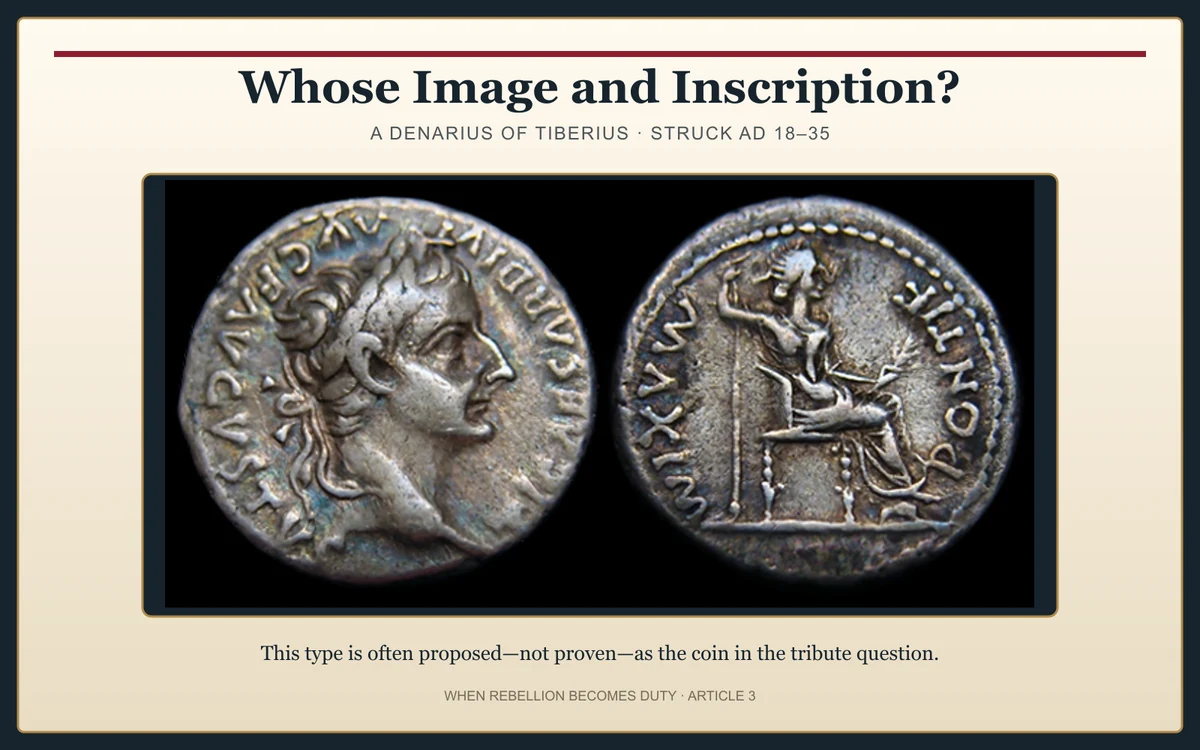
Jesus' opponents attempted to make tribute a trap. If he endorsed the Roman tax, he risked alienating hearers who resented imperial domination. If he rejected it, his words could become evidence against him. Jesus asked for a denarius and drew attention to Caesar's image and inscription. His answer is recorded in Mark 12:17:
And Jesus answering said unto them, Render to Cæsar the things that are Cæsar’s, and to God the things that are God’s. And they marvelled at him.
The saying recognizes a civil due. It does not hand Christians an obvious tax revolt. The verb is imperative, and the immediate object is a Roman tribute. That fact bears directly on “no taxation without representation.” Political objection does not by itself prove that payment is biblically void.
The second clause prevents the first from becoming absolute. Caesar is not God, and what belongs to God cannot be rendered to Caesar. Warren Carter's close reading also warns against making the displayed coin exhaust the plural “things” under discussion. His broader imperial reconstruction is debatable, but the central conclusion is sound: Jesus neither canonizes the whole Roman order nor announces that Caesar is owed nothing.4, pp. 2–7
The aphorism does not provide a modern map of church and state. It does not enumerate every divine and civil claim. It establishes a real but bounded civil due within God's superior ownership.
Pilate's Authority and Pilate's Guilt
Jesus' trial brings the tension into one scene. Pilate claims authority to release or crucify him. Jesus answers that Pilate could have no authority over him unless it had been given from above (John 19:10–11Chapter 19, verse 10: 19:10Then saith Pilate unto him, Speakest thou not unto me? knowest thou not that I have power to crucify thee, and have power to release thee? Chapter 19, verse 11: 19:11Jesus answered, Thou couldest have no power at all against me, except it were given thee from above: therefore he that delivered me unto thee hath the greater sin.). The governor's power is therefore both real and derivative.
Pilate's authority remains real while his judgment becomes wicked. He repeatedly finds no case against Jesus, yet yields to pressure and hands an innocent man over to death. Jesus' reference to “greater sin” allocates guilt; it does not erase Pilate's. Christian Gers-Uphaus's comparison of John with other ancient portraits clarifies the conjunction: Pilate possesses the operative legal power of a Roman governor, depends upon a higher political order, and uses his power culpably.5, pp. 20–22
That conjunction supplies a necessary distinction within the word lawful. Pilate's authority is legally and politically real; his judgment is morally evil. The injustice does not require us to pretend that a private mob, rather than the governor, issued the sentence. Nor does recognition of his office require us to call the sentence just. Positive title, moral obligation, and culpable exercise can be distinguished in one event.
The American case faces the same kind of distinction at a different scale. A governor may hold a genuine commission and still give an unjust order. A rival public body may have moral reason to resist without acquiring authority merely from the governor's wrongdoing. John's scene does not settle that succession question. It prevents either side from solving it by making formal office or moral criticism do all the work.
John also records Jesus saying that his kingdom is not from this world. If it were, his servants would fight to prevent his being handed over (John 18:36Jesus answered, My kingdom is not of this world: if my kingdom were of this world, then would my servants fight, that I should not be delivered to the Jews: but now is my kingdom not from hence.). In its immediate setting, the statement cannot be softened into a general compliment to spiritual priorities. Jesus' followers do not secure his messianic kingship with swords or prevent the Passion by force.
The verse does not alone decide whether every Christian use of public force is forbidden. That conclusion would require a wider argument. It does decisively forbid recruiting violence to rescue Jesus from his appointed suffering or to advance his kingdom as though it arose from worldly force.
Endurance Is Not Inaction
The cumulative posture can be misunderstood in two directions. One turns submission into political quietism: pray, obey, endure, and ask no public questions. The other praises resistance while treating endurance as weakness. First Peter permits neither move.
Doing good under slander is active Christian witness. Prayer for rulers is an action directed toward their good and the peace of society. Rendering dues, showing gentleness, refusing false speech, and accepting suffering rather than committing evil are forms of disciplined agency. They may leave an unjust official apparently victorious in the short term, but they refuse to let the official determine the believer's conduct.
At the same time, endurance does not declare the injustice righteous. Peter can call suffering unjust and still command faithfulness within it. John can recognize Pilate's authority and expose his guilt in the same narrative. The New Testament's capacity to hold those truths together matters whenever an office must be distinguished from its abuse.
This is also why Christian political action must be judged by manner as well as object. A cause may be described as protective while being prosecuted with malice, rumor, humiliation, or indiscriminate punishment. Nothing in a lesser-magistrate theory cancels the commands to do good and refuse reviling.
No Hidden Forfeiture Clause
The companion texts sharpen a negative conclusion. The ruler's failure supplies no automatic forfeiture clause, no private grant of coercive jurisdiction, and no timetable by which patient suffering turns into armed resistance.
The texts instead establish the ends and limits within which any later inference must operate. Civil claims are real. They are not ultimate. Christians seek peace. They do not purchase it with disobedience to God. Authority is received. Its recipient remains guilty for unjust judgment. Faithful suffering may be obligatory. It is not proof that the persecutor has acted justly.
If a public duty to resist exists, it must arise from additional biblical principles and an actual public vocation. It cannot be smuggled into the word honor.
The Weight of the Whole Posture
We can now state the strongest nonresistance case more fully. Christians are to submit and ordinarily obey, honor the emperor, pray and give thanks for rulers, pay civil dues, seek peace, do good, refuse retaliation, and follow Christ in unjust suffering. Jesus' own kingdom was not defended by his servants' swords. None of the passages we have examined announces an armed resistance exception.
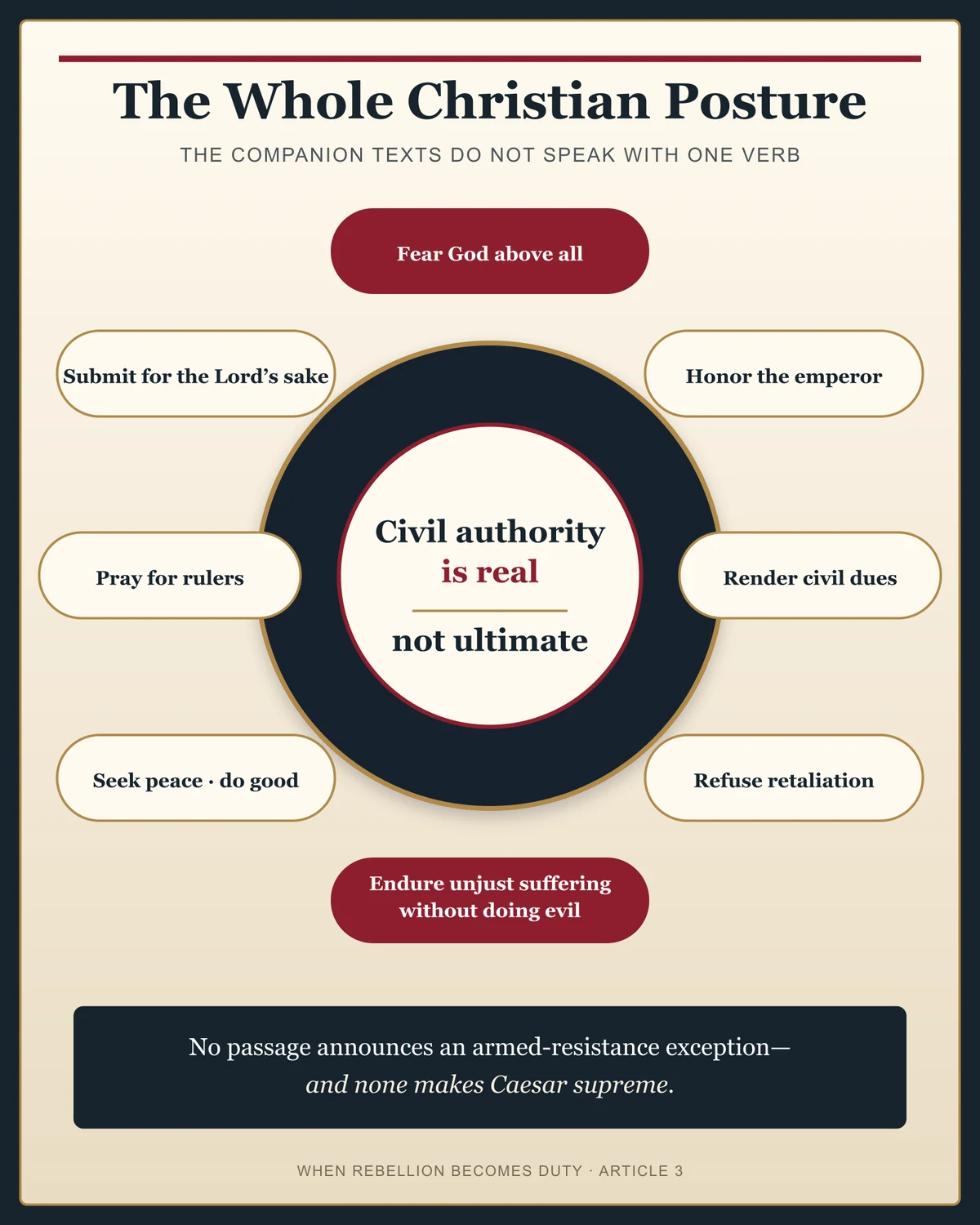
That is not a small obstacle waiting to be removed. It is the permanent Christian posture within which every later claim must live.
The same texts also refuse civil ultimacy. Christians submit for the Lord's sake, fear God above the emperor, pray beneath the one mediator, render God's things to God, and recognize Pilate's authority as received and morally answerable. Unjust suffering is not transformed into justice by faithful endurance.
The next question is therefore unavoidable. What happens when an authority does not merely govern badly but commands what God forbids? The Christian may have to say no. But saying no will not yet place the sword in his hand.
Discussion
Thoughtful, good-faith discussion is welcome.
Loading comments…