

Romans 13 does not begin with a footnote about tyrants.
It begins with a command to every person. Christians are to be subject to the governing authorities because authority is ordered by God. Resistance to that order invites judgment. The ruler is God's servant, charged to commend good and punish wrong. Submission is required not only because rulers can punish, but for conscience. Taxes, revenue, fear, and honor make the duty concrete (Romans 13:1–7Chapter 13, verse 1: 13:1Let every soul be subject unto the higher powers. For there is no power but of God: the powers that be are ordained of God. Chapter 13, verse 2: 13:2Whosoever therefore resisteth the power, resisteth the ordinance of God: and they that resist shall receive to themselves damnation. Chapter 13, verse 3: 13:3For rulers are not a terror to good works, but to the evil. Wilt thou then not be afraid of the power? do that which is good, and thou shalt have praise of the same: Chapter 13, verse 4: 13:4For he is the minister of God to thee for good. But if thou do that which is evil, be afraid; for he beareth not the sword in vain: for he is the minister of God, a revenger to execute wrath upon him that doeth evil. Chapter 13, verse 5: 13:5Wherefore ye must needs be subject, not only for wrath, but also for conscience sake. Chapter 13, verse 6: 13:6For for this cause pay ye tribute also: for they are God’s ministers, attending continually upon this very thing. Chapter 13, verse 7: 13:7Render therefore to all their dues: tribute to whom tribute is due; custom to whom custom; fear to whom fear; honour to whom honour.).
Nothing in that paragraph permits us to treat civil government as an unfortunate nuisance that Christians may obey when convenient. Nor does Paul say that authority becomes real only when a ruler is wise, just, orthodox, or popular. A Christian account of the American Revolution must start by allowing the text to close off easy roads.
The Command in Its Moral Setting
Paul's discussion does not drop into the letter from nowhere. Romans 12 calls believers to transformed lives, sincere love, patience in tribulation, hospitality, blessing of persecutors, peace so far as it depends on them, and refusal of private vengeance. They are not to repay evil for evil. They are to leave vengeance to God, feed an enemy, and overcome evil with good (Romans 12:9–21Chapter 12, verse 9: 12:9Let love be without dissimulation. Abhor that which is evil; cleave to that which is good. Chapter 12, verse 10: 12:10Be kindly affectioned one to another with brotherly love; in honour preferring one another; Chapter 12, verse 11: 12:11Not slothful in business; fervent in spirit; serving the Lord; Chapter 12, verse 12: 12:12Rejoicing in hope; patient in tribulation; continuing instant in prayer; Chapter 12, verse 13: 12:13Distributing to the necessity of saints; given to hospitality. Chapter 12, verse 14: 12:14Bless them which persecute you: bless, and curse not. Chapter 12, verse 15: 12:15Rejoice with them that do rejoice, and weep with them that weep. Chapter 12, verse 16: 12:16Be of the same mind one toward another. Mind not high things, but condescend to men of low estate. Be not wise in your own conceits. Chapter 12, verse 17: 12:17Recompense to no man evil for evil. Provide things honest in the sight of all men. Chapter 12, verse 18: 12:18If it be possible, as much as lieth in you, live peaceably with all men. Chapter 12, verse 19: 12:19Dearly beloved, avenge not yourselves, but rather give place unto wrath: for it is written, Vengeance is mine; I will repay, saith the Lord. Chapter 12, verse 20: 12:20Therefore if thine enemy hunger, feed him; if he thirst, give him drink: for in so doing thou shalt heap coals of fire on his head. Chapter 12, verse 21: 12:21Be not overcome of evil, but overcome evil with good.). After Romans 13's discussion of rulers and dues, Paul returns to love of neighbor as the fulfillment of the law (Romans 13:8–10Chapter 13, verse 8: 13:8Owe no man any thing, but to love one another: for he that loveth another hath fulfilled the law. Chapter 13, verse 9: 13:9For this, Thou shalt not commit adultery, Thou shalt not kill, Thou shalt not steal, Thou shalt not bear false witness, Thou shalt not covet; and if there be any other commandment, it is briefly comprehended in this saying, namely, Thou shalt love thy neighbour as thyself. Chapter 13, verse 10: 13:10Love worketh no ill to his neighbour: therefore love is the fulfilling of the law.).
That frame matters. It forbids a reading in which Christians use civil theory to baptize wrath, retaliation, or contempt. Any argument for public defense must remain under the commands to love enemies and overcome evil with good. The public character of an act does not make hatred righteous.
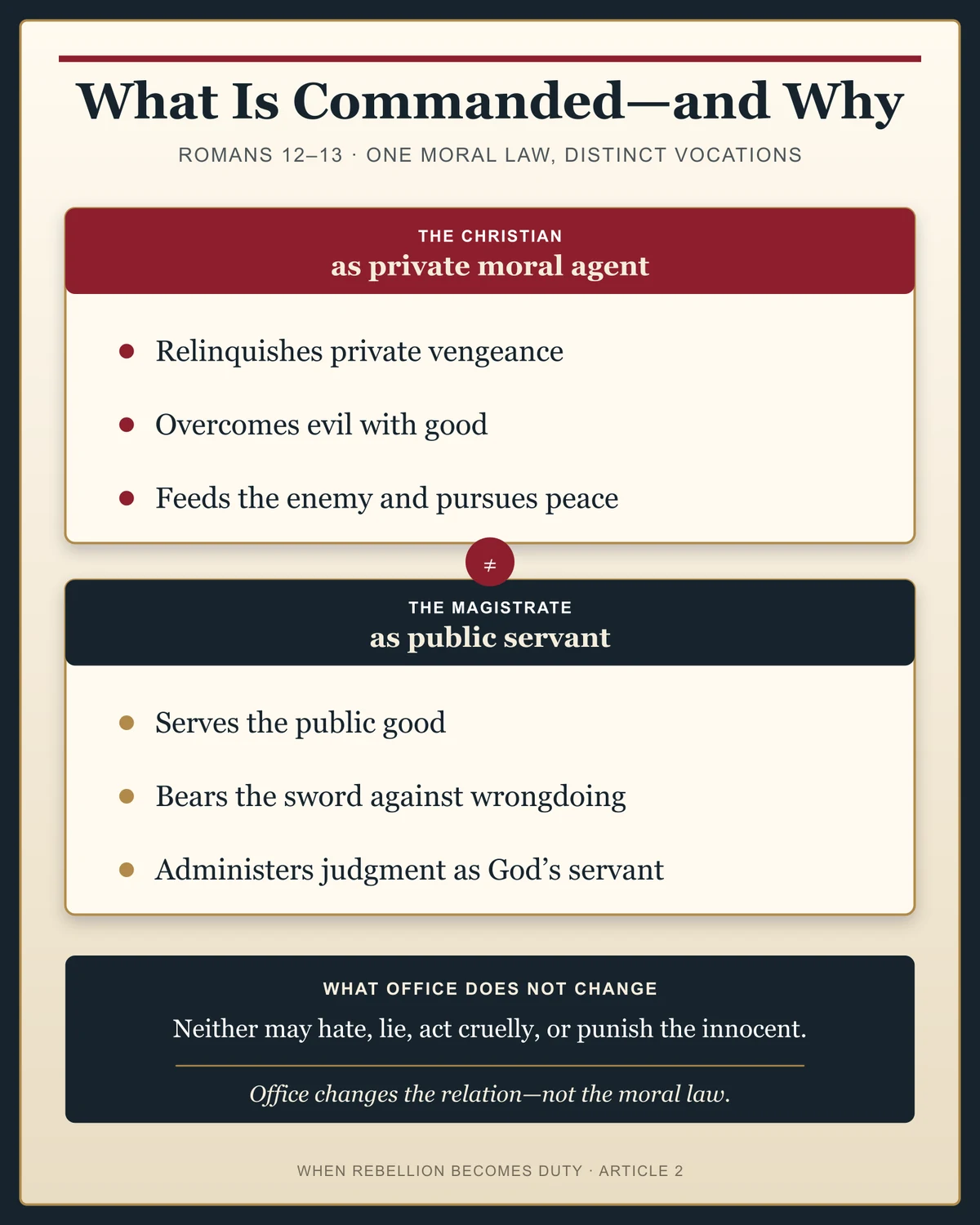
The frame also illuminates the sword. In Romans 12, the Christian addressed as a private moral agent relinquishes vengeance. In Romans 13, the ruler is described as God's servant and an avenger who bears the sword against the wrongdoer. The contrast supports a real role distinction. Public punishment is not simply private revenge performed by a person with a title.
The distinction concerns object and vocation, not two moral codes. The public official does not receive permission to hate, lie, act cruelly, or punish the innocent. He remains under the command to love and overcome evil with good. What changes is the good entrusted to his care and the means lawfully attached to that office. A judge restraining a violent offender and a private enemy seeking revenge may perform outwardly similar acts while acting through morally different relations.
Paul does not here command Christians to seek coercive office or explain every permissible use of its force. He does establish a decisive premise: private vengeance and public restraint are not moral synonyms. The identity of a rightful officeholder, the treatment of rival authorities, and the conditions of resistance remain open; the public purpose of coercive authority does not.
What Submission Requires
The command is not merely to feel respectful. Paul repeats the necessity of subjection and then names practices by which it is displayed. Taxes and revenue cost money. Fear and honor order public conduct. Conscience places the duty before God rather than reducing it to calculation about whether the magistrate can catch us.
This is why the common move – “Paul commands submission, not obedience” – cannot carry the weight sometimes placed upon it. The words are not identical, but submission that never reaches conduct is empty. The New Testament elsewhere can join submission and obedience explicitly (Titus 3:1Put them in mind to be subject to principalities and powers, to obey magistrates, to be ready to every good work,). Romans 13 itself includes payment and public dues. A person who says “I submit” while systematically refusing every lawful command has not solved the problem with a lexical distinction.
Yet submission is not identical to compliance with every command. Scripture cannot require a human authority to be obeyed against God while also praising those who refuse commands that require sin. The limit comes from God's superior claim and the wider canon, not from an exception clause hidden inside Romans 13. That difference will matter when we turn from submission to sinful commands.
For now, the correct formulation is demanding: Christians ordinarily owe governing authorities an obedient posture expressed in concrete dues. Compliance ends where a command requires disobedience to God. Even there, submission may continue through respectful speech, appeal, nonretaliation, or acceptance of punishment. Righteous refusal does not by itself erase office.
Conscience does not soften that demand into private sovereignty. Paul says submission is necessary because of conscience, not that conscience releases each person whenever obedience feels troubling. Conscience recognizes God's ordering of public authority and therefore binds the Christian when evasion would be convenient. It can also forbid participation in what God condemns. In neither direction is conscience a synonym for preference.
The result closes two evasions at once. Official form cannot make sin a duty, because the ruler remains God's servant. Conscientious disagreement cannot make every command optional, because the subject remains under authority. The moral work lies in judging the act, the authority, and the superior divine obligation without converting one's own judgment into a new public office.
The Ordinance and the Officeholder
Paul says that authority is ordered by God. He does not say that every desire of every officeholder is God's ordinance. The distinction between office and abuse is unavoidable because the paragraph describes the ruler's public function: a servant for good and an avenger against wrongdoing. A ruler who punishes innocence or rewards evil acts contrary to that function.
But this moral evaluation is not an automatic forfeiture device. If every misuse erased authority, no government would survive its first unjust judgment. If every grave misuse erased authority at the private subject's declaration, the command to submit would depend upon the very person being commanded. Paul's language will not bear that reduction.
John Calvin's commentary is useful precisely because he refuses both moves. He reads Romans 13 as a severe restraint on contempt and sedition, including under wicked rulers, while distinguishing God's ordinance of magistracy from the vices by which a ruler disorders it.1, commentary on Romans 13:1–4 That is not the only Christian reading, and Calvin's sixteenth-century account does not decide Paul's meaning. It does, however, demonstrate that a resistance tradition need not begin by making submission easy.
Modern interpretation ranges widely. Some readings emphasize Paul's practical concern for a vulnerable church; others his theology of ordered authority; still others the passage's relation to empire, eschatology, or contemporary political abuse. An open scholarly treatment by Ishanesu Gusha, written from a different political setting, places the paragraph inside Romans 12–13 and distinguishes the divine institution and end of government from every act of a particular regime.2, pp. 4–7 The modern application is separable from the more modest point: literary context and office-purpose belong in the reading, but neither supplies a private license to depose.
Written Under Rome
Paul addressed Christians under an empire, not citizens of a modern liberal democracy. Roman government could be violent, unequal, idolatrous, and oppressive. The Christian confession that Jesus is Lord placed the emperor beneath a higher authority. Paul himself would eventually suffer under Roman power.
That setting makes the command more serious, not less. We cannot say that submission applies only to governments that already satisfy our theory of legitimacy. Nor can we infer that because Rome was unjust, every later dispute with an unjust policy is morally equivalent to apostolic life under Rome.
Historical reconstructions of the paragraph's immediate occasion remain contested. Tax unrest, memories of expulsion from Rome, Jewish-Christian relations, and the church's public reputation may help explain why Paul spoke as he did. None is necessary to establish what Paul affirmatively says. Paul grounds submission in God's ordering of authority, conscience, the public function of rule, and concrete dues.
Taxes, Fear, and Honor
Paul's list of dues prevents political theology from remaining abstract. “For for this cause pay ye tribute also,” he says, describing the authorities as God's public servants attending to their work. Then comes the comprehensive command: tax to whom tax is due, revenue to whom revenue, fear to whom fear, honor to whom honor (Romans 13:6–7Chapter 13, verse 6: 13:6For for this cause pay ye tribute also: for they are God’s ministers, attending continually upon this very thing. Chapter 13, verse 7: 13:7Render therefore to all their dues: tribute to whom tribute is due; custom to whom custom; fear to whom fear; honour to whom honour.).
The passage does not say that every levy is correctly assessed or that rulers cannot tax unjustly. It does make payment the ordinary Christian posture. A future colonial argument cannot proceed from “the tax was disputed” to “the tax was not due before God.” It must show why the body imposing the tax lacked the claimed jurisdiction, why resistance was directed to constitutional preservation rather than ordinary aversion to payment, and why lawful remedies had failed.
Fear and honor matter as well. Political disagreement does not authorize dehumanization. Christians may expose injustice and still speak truthfully about the office and the person who occupies it. Honor is not flattery; it cannot require calling evil good. But the ease with which opposition turns rulers into caricatures is itself a test of whether Romans 12–13 is governing our politics.
Patriot and Loyalist rhetoric both failed this test at points. Patriot writers attributed a unified malicious design to actors whose motives and powers differed. Loyalists described constitutional protest as mere lawlessness. The command to honor does not decide between them, but it rules out winning by false witness.
When Authorities Compete
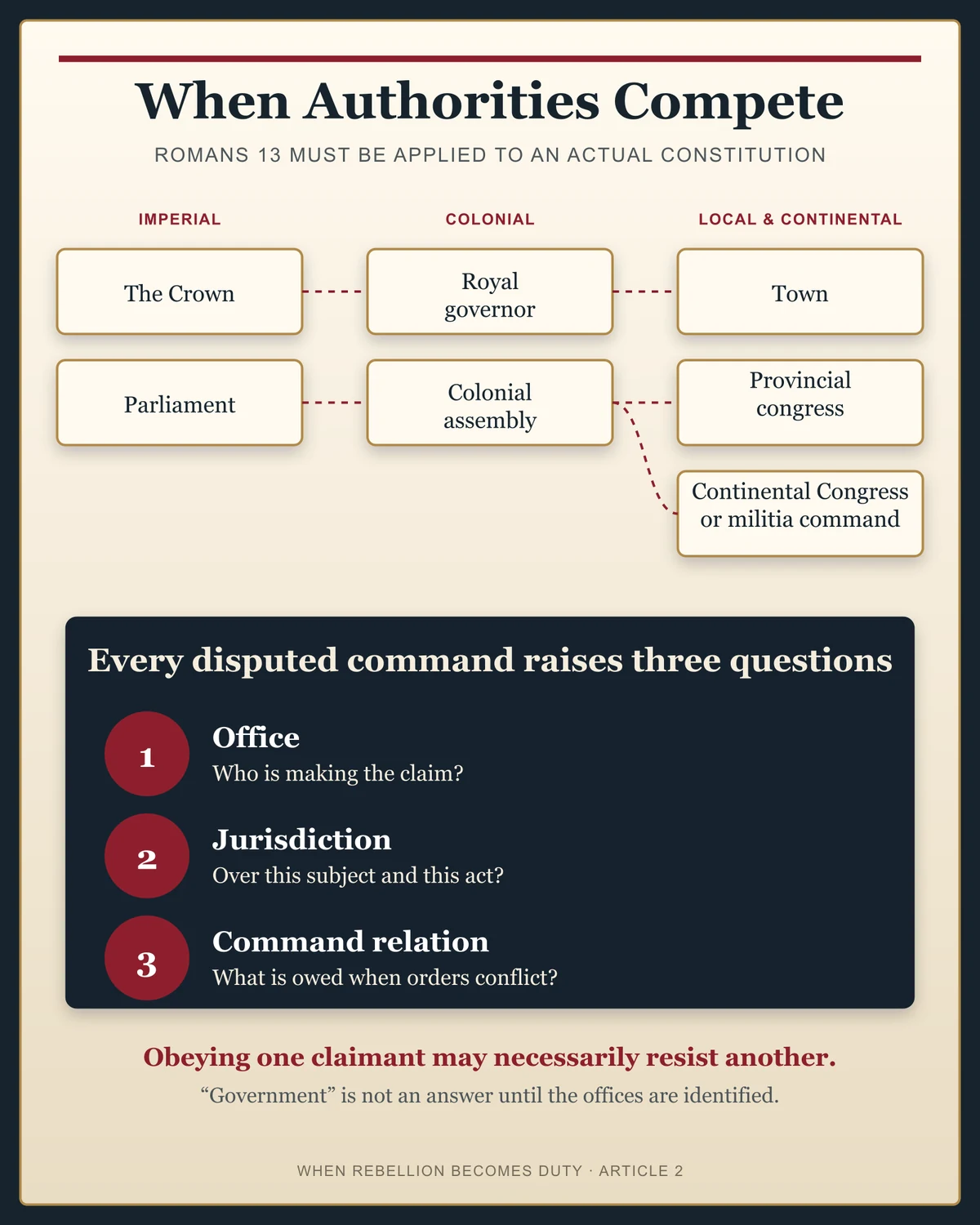
Romans 13 speaks of governing authorities in the plural, but it does not offer a manual for a divided constitution. In the imperial crisis, a colonist might face the Crown, Parliament, a royal governor, a colonial assembly, a town, a provincial congress, the Continental Congress, and a militia command. The question was not always “authority or no authority.” It could be “which authority has jurisdiction over this act, and what is owed when public claims conflict?”
The plural does not itself endorse federalism, interposition, or whichever local body stands closest to the subject. It simply prevents application from ending with the abstract word government. Real political orders contain offices with differentiated powers. A governor may command a militia without possessing every legislative power; an assembly may tax without commanding every army; a town may administer local duties without deciding imperial war. To submit rightly, a subject sometimes has to know which authority is asking for what.
That inquiry becomes especially severe when two claimants issue incompatible orders. Obeying either necessarily resists the other. Romans 13 does not name the rightful eighteenth-century claimant, but neither does it permit the reader to describe only one side as “authority” before the constitutional case has been tried. The command intensifies the need to identify office, jurisdiction, and command relation accurately.
Paul's command does not become irrelevant in that setting. It becomes harder to apply. The party claiming obedience must identify an office and lawful scope. The party refusing must do more than invoke conscience. The constitutional case must reconstruct those claims institution by institution. For now, Romans 13 forbids us to equate the most convenient authority with the only real one.
The Strongest Nonresistance Reading
A serious critic may now say: “You have already lost. Paul commands universal submission under pagan empire, condemns resistance to God's ordinance, and offers no tyranny exception. Your later qualifications will be imported from political theory.”
Part of that objection should simply be conceded. Romans 13 does not teach a lesser-magistrate doctrine. It does not authorize armed resistance. It does not say that a ruler's injustice hands public coercive authority to a private person. Any argument that quotes the ruler's duty to serve good and then leaps directly to revolution has skipped the central institutional question.
But the objection claims too much if it turns submission into the moral approval of every official act, or if it makes a human command supreme over God. The ruler is called God's servant, not God. The public sword is entrusted for a moral end, not made morally autonomous. The wider canon contains commands and examples in which obedience to God requires refusal of human authority. And the public office described here has obligations of its own.
Those observations do not yet justify coercive resistance. They establish that Romans 13 is a foundation for Christian political reasoning, not the whole building.
What the Patriots Do Not Yet Have
At this point the Patriots have no biblical warrant to take up arms. They do not acquire one by calling Parliament tyrannical. They do not acquire one by showing that taxation was irritating, that soldiers behaved brutally, or that ministers misread the constitution. Romans 13 keeps the presumption on the side of order, public authority, and concrete obedience.
The paragraph also binds rulers. If magistracy is a divine service for good, officials cannot appeal to God's ordinance as though office were personal ownership. A magistrate who punishes good and protects wrongdoing contradicts the described purpose of his office even if he does not thereby vanish from it. The unresolved question is whether another public authority can be charged to act when a superior attacks the common good.
That question must wait. Romans 13 leaves us with a ruler bounded beneath God, a subject genuinely commanded to submit, a public sword distinct from private vengeance, and no direct resistance rule.
Nor is Romans 13 alone. Peter tells Christians to honor the emperor. Paul tells them to pray for kings. Jesus tells questioners to render Caesar his due, and he acknowledges Pilate's authority while standing under an unjust sentence. The cumulative weight is heavier than one disputed paragraph.
Discussion
Thoughtful, good-faith discussion is welcome.
Loading comments…