
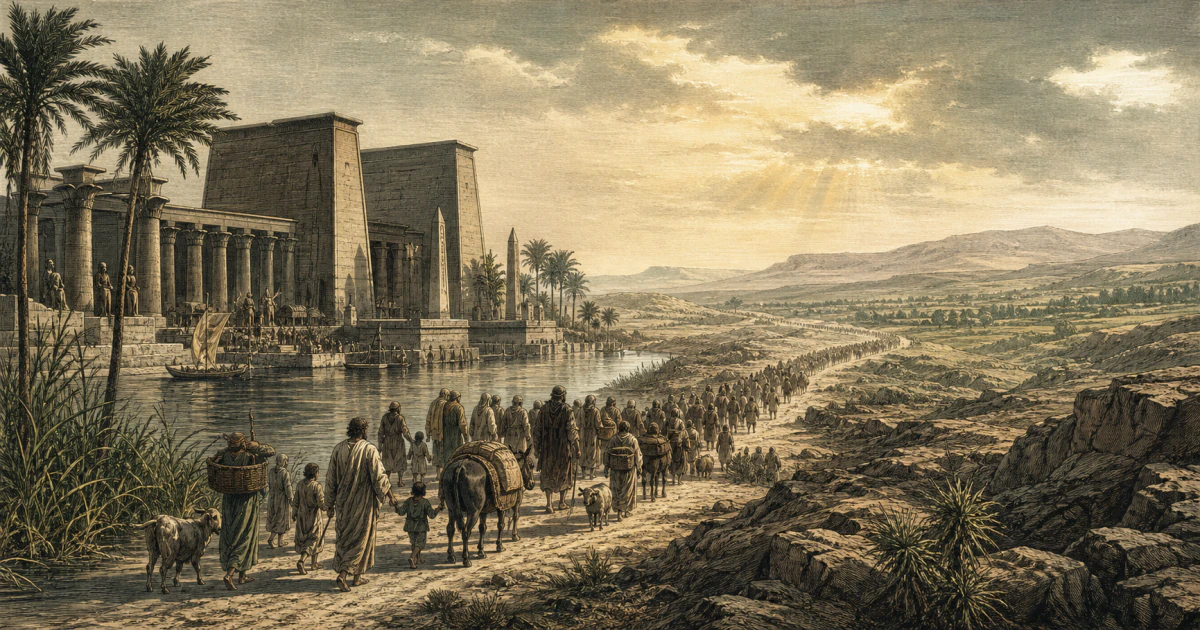
Scripture Gets the Gavel
There are two very different ways to begin a series on the Exodus. One begins with Egyptian king lists, archaeological strata, radiocarbon ranges, textbook chronologies, and the usual scholarly weather report. It asks where an Exodus might fit after Egypt has already arranged the room.
The other begins with the Bible. That is the way this series is going to proceed.
Egyptian history is not useless, archaeology is not an enemy, and chronology is not a distraction. All three matter very much. But if Scripture gives us chronological information, then Scripture is not one witness among equals. It is the controlling witness.
The artifact is a witness, not the judge. The inscription is a witness, not the judge. The reconstructed regnal chart is a witness, not the judge.
Scripture gets the gavel.
The Bible Says
The key text is not hidden in a genealogy or smuggled into a footnote. It is sitting in the historical narrative of Kings:
And it came to pass in the four hundred and eightieth year after the children of Israel were come out of the land of Egypt, in the fourth year of Solomon’s reign over Israel, in the month Zif, which is the second month, that he began to build the house of the LORD.
That is a remarkably specific sentence. It gives an event: Solomon began to build the house of the LORD. It gives a regnal year: the fourth year of Solomon's reign. It gives a month: Zif, the second month. Then it ties that event to another event: Israel's departure from Egypt, in the four hundred and eightieth year after the Exodus.
It reads like a chronological notice. That does not mean every question has already been answered, but it does mean the burden of proof should rest on the reading that asks us not to take it chronologically.
The verse does not name the Pharaoh. It does not tell us which reconstruction of Egyptian chronology to use. It does not require us to add every number in Judges end to end as though the book were a modern spreadsheet. Those are separate questions, and some of them are difficult.
What the verse gives us is a clock. Once the Bible gives us a clock, the first question is not, "What date would Egyptology prefer?" The first question is, "What happens if we let the biblical text do what it appears to be doing?"
I am writing from the conviction that the Holy Spirit inspired the Scriptures, that the Scriptures are true, and that when Scripture speaks chronologically, we should not quietly demote that speech because a different reconstruction would be tidier without it. That conviction does not remove the work of interpretation. It establishes who governs that work.
This matters because the Exodus debate contains two disagreements that are easily muddled together. One concerns authority: does the biblical text govern the reconstruction, or may another reconstruction overrule it? The other concerns interpretation: is 1 Kings 6:1And it came to pass in the four hundred and eightieth year after the children of Israel were come out of the land of Egypt, in the fourth year of Solomon’s reign over Israel, in the month Zif, which is the second month, that he began to build the house of the LORD. giving elapsed chronology, a symbolic figure, or some other kind of historical total?
The first question establishes our method. Part 2 will take up the second.
What Egypt Can Tell Us
Before anyone reaches for the smelling salts, this is not an anti-history argument.
Egyptian chronology is the result of enormous and careful scholarly labor. Historians work with royal sequences, regnal totals, inscriptions, king lists, synchronisms with other kingdoms, astronomical records, archaeology, and other surviving evidence. Yet those materials did not arrive as one pristine wall chart labeled in modern BC dates.
They have to be interpreted and assembled.
William Ward's survey of Egyptian chronology illustrates the problem well. Regnal lengths, possible coregencies, the interpretation of astronomical notices, and the use of later king lists such as Manetho's can all affect an absolute chronology.1, pp. 53–56, 62–63 The UCLA Encyclopedia of Egyptology is similarly candid about its own working table: its editors call many of the rounded dates a simplification or a particular view, and they label dates before 664 BC approximate.2
That does not mean Egyptian chronology is arbitrary. Some sequences and dates are much firmer than others. It means that the phrase "Egyptian chronology says" can conceal a great deal of interpretation. We still have to ask which chronology, which evidence, and which assumptions produced the date being invoked.
This series will therefore use Egyptian evidence after the Bible sets the clock. We will test the conventional 18th Dynasty chronology, a higher 18th Dynasty reconstruction, and Ramesside proposals against the same biblical requirements. The higher placement is not a private calendar invented for this series. Earlier dates for the 18th Dynasty have appeared in published chronological models, including models built from alternate readings of the astronomical evidence.3, pp. 191–195 Whether those readings deserve preference is a real historical question that we will address when the Egyptian timetable enters the argument.
My reason for testing the high chronology is straightforward: in my judgment, it accommodates the biblical sequence substantially better than the alternatives examined here. That is an openly stated selection principle. I did not choose it to produce one desired Pharaoh and then reverse-engineer the rest. I chose it because it appears to fit the chronology Scripture supplies, and then I followed the sequence to see which rulers stood in the necessary places.
That sequence matters more than any isolated resemblance. Moses must be born in the right reign. He must flee at forty. The king he fled must die before he returns. Moses must return at eighty. The Exodus Pharaoh must then meet the requirements of the plague and succession narratives. A model that handles one moment neatly while creating trouble everywhere else has more explaining to do.
That is how historical evidence will be used here. Not as decoration for a conclusion already protected from examination, and not as a veto held over Scripture, but as testimony tested against the whole biblical sequence.
The Curmudgeon Says
Here is where the discussion often goes crooked. Someone begins with 1 Kings 6:1And it came to pass in the four hundred and eightieth year after the children of Israel were come out of the land of Egypt, in the fourth year of Solomon’s reign over Israel, in the month Zif, which is the second month, that he began to build the house of the LORD. and says, "The Bible gives us a chronological notice." Someone else responds, "But the archaeology does not fit that."
"The archaeology" then becomes a very large umbrella. Under it may be excavation layers, Egyptian regnal chronology, the place name Ramesses, theories about Israelite settlement, and a preference for a thirteenth-century Exodus under Ramesses II. Those are not one argument. Each has its own evidence, assumptions, and possible answers.
Nor is every alternative reading simply an attempt to escape Scripture. Serious defenders of the Old Testament have argued that the 480 years should be understood as an era figure, a generational scheme, or a selected total drawn from the biblical periods. We will let that case speak in its own voice before deciding whether it succeeds.
But no objection gets to enter the room wearing the crown before the text has been heard. If 1 Kings 6:1And it came to pass in the four hundred and eightieth year after the children of Israel were come out of the land of Egypt, in the fourth year of Solomon’s reign over Israel, in the month Zif, which is the second month, that he began to build the house of the LORD. anchors the temple foundation to Solomon's fourth year, the second month, and the 480th year after the Exodus, its chronological force must be taken seriously. Setting that force aside requires an argument from the text and the wider biblical chronology. A convenient Pharaoh is not enough.
That is the difference between using Egyptian evidence and enthroning it.
This series will use Egyptian evidence gladly. It will also distinguish fact from inference, published reconstruction from personal judgment, and an interesting fit from proof. We are going to ask Egypt many questions.
We are simply not going to ask Egypt for permission to believe Kings.
The Bible gives us a clock. Next, we let the clock do its work.
Coming Up
Part 2 does the math: the 480th year, Solomon's fourth year, Moses at eighty, Moses at forty, and why 1446 BC is not a number pulled from a theological hat.
Discussion
Thoughtful, good-faith discussion is welcome.
Loading comments…