
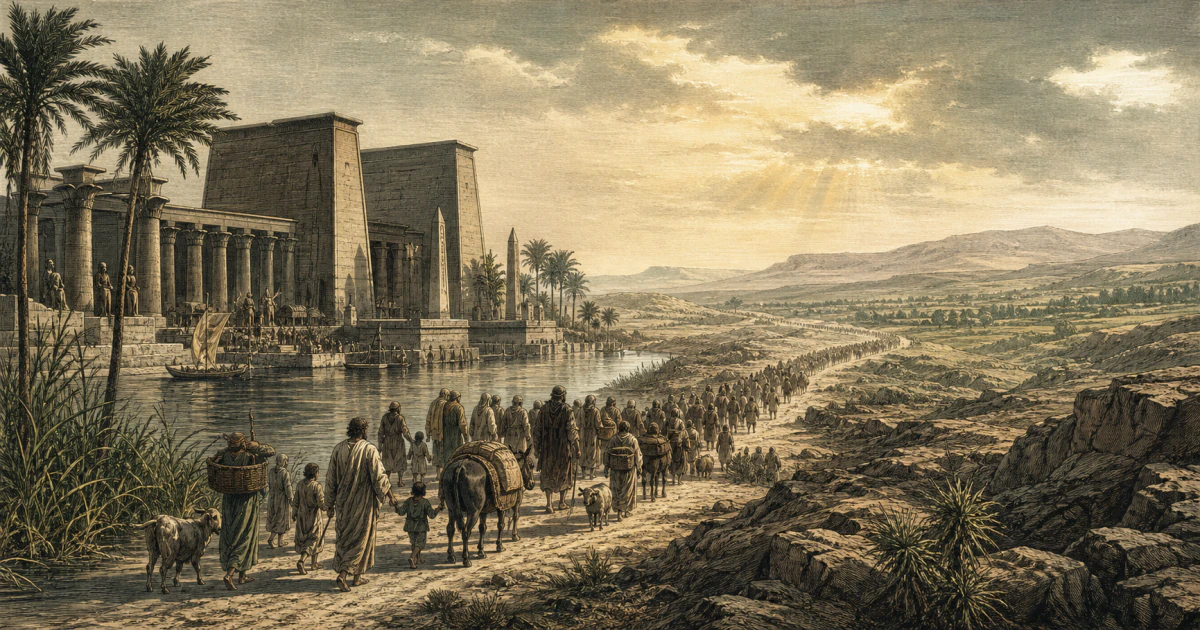
480 Years Means 480 Years
In Part 1, I argued that Scripture gets the gavel. That sounds noble enough in the abstract. Now it has to do some work.
The early Exodus argument begins with one unusually precise chronological notice:
And it came to pass in the four hundred and eightieth year after the children of Israel were come out of the land of Egypt, in the fourth year of Solomon’s reign over Israel, in the month Zif, which is the second month, that he began to build the house of the LORD.
There it is. Solomon's fourth year. The second month. The beginning of temple construction. The 480th year after the Exodus.
If that is real chronology, the Exodus belongs around 1446 BC. Not because Amenhotep II is waiting in the wings and we want him on stage. Not because a chart told us to squint until the dates lined up. The biblical date must be established before an Egyptian candidate is allowed to audition.
So let us do the arithmetic, then deal with the reason some serious interpreters decline to do it this way.
From Solomon To The Exodus
The temple foundation is normally placed around 967/966 BC. That absolute date is itself a historical calculation. It is built by working backward through the kings of Israel and Judah, using their regnal notices and external anchors such as the Assyrian records involving Ahab and Jehu. Jack Finegan places Solomon's fourth year in 968/967 BC, while Andrew Steinmann places its spring month in 967 BC.1, §424; 2, pp. 37–38
This produces a small counting wrinkle, but not a meaningful disagreement about the Exodus date.
One familiar presentation starts with spring 966 BC and adds 480 years to reach 1446 BC. Steinmann starts with spring 967 BC and reads "the 480th year" as an ordinal expression. If the Exodus year is the first year in the count, then 479 years have elapsed when the 480th year begins. Thus 967 + 479 also reaches 1446 BC.2, pp. 37–38
That distinction keeps the title of this article honest. "480 years means 480 years" does not require us to pretend that the first day of the 480th year comes after 480 full years have passed. It means that 1 Kings 6:1And it came to pass in the four hundred and eightieth year after the children of Israel were come out of the land of Egypt, in the fourth year of Solomon’s reign over Israel, in the month Zif, which is the second month, that he began to build the house of the LORD. is supplying real chronology rather than a decorative number. The ordinal wording and the elapsed count fit together.
The result that matters for this series is the same: the Exodus belongs around 1446 BC.
Moses Enters The Calculation
Once the Exodus date is set, Scripture gives us the major age markers in Moses' life.
Moses was eighty when he and Aaron spoke to Pharaoh:
And Moses was fourscore years old, and Aaron fourscore and three years old, when they spake unto Pharaoh.
Stephen tells us that Moses was forty when he went out to his brethren:
And when he was full forty years old, it came into his heart to visit his brethren the children of Israel.
Then forty more years passed before the burning bush:
And when forty years were expired, there appeared to him in the wilderness of mount Sina an angel of the Lord in a flame of fire in a bush.
Exodus adds one more detail that will later become a major test of the Pharaoh candidates:
And it came to pass in process of time, that the king of Egypt died: and the children of Israel sighed by reason of the bondage, and they cried, and their cry came up unto God by reason of the bondage.
Put those notices together and the working sequence is straightforward. Moses' birth falls around 1526 BC, his flight around 1486 BC, and his return and the Exodus around 1446 BC. During the second forty-year span, the king from whom Moses fled dies.
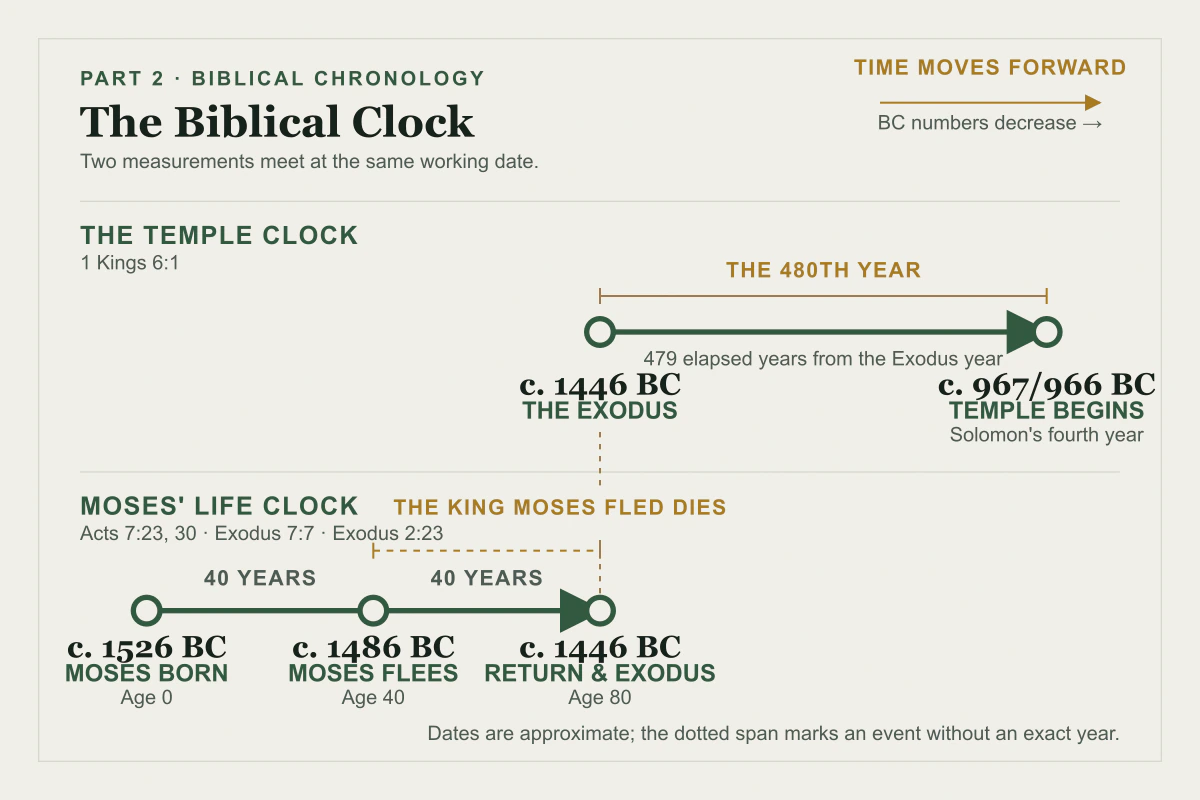
This is more than an early-date feeling. It is a sequence with pressure points. The king Moses fled must be reigning around 1486 BC and must die before Moses returns. The Exodus Pharaoh must be reigning around 1446 BC. Those requirements will eventually filter the Egyptian candidates, but the filter comes from Scripture before it comes from a king list.
But What If 480 Is Not Elapsed Chronology?
The strongest objection deserves more than a shrug. K. A. Kitchen, who argues forcefully for the historical reliability of the Old Testament, does not treat the 480 years as a simple elapsed total. He observes that the periods reported from the Exodus through the judges and into the monarchy cannot all be laid end to end inside 480 years. Judges includes regional events and overlapping rulers, so a naive addition of every number produces a much larger aggregate.3, pp. 159–160
Kitchen proposes two possible explanations for the 480. It could be an era figure made from twelve full generations of forty years, with the real generations averaging roughly twenty-two to twenty-five years. He cautions that this origin "should not be lightly dismissed." Or the 480 could be a selected biblical total, especially the years of Israelite activity and peace, with the periods of foreign oppression excluded. His table reaches 480 by that second route after restoring Saul's damaged regnal figure and supplying five years for Joshua and the elders.3, pp. 307–308; 3, p. 309, table 28
That is a serious attempt to account for the biblical data, not an announcement that numbers no longer matter. It has real strengths. Forty plainly carries literary and theological weight in Scripture. Judges need not describe one uninterrupted national sequence. Ancient writers did not arrange chronological material according to every modern convention. We should not dismiss any of those points simply because a literal reading is more convenient for our preferred date.
I still find Kitchen's alternatives less persuasive than the chronological reading.
First, the problem with adding every period in Judges does not require us to make 1 Kings 6:1And it came to pass in the four hundred and eightieth year after the children of Israel were come out of the land of Egypt, in the fourth year of Solomon’s reign over Israel, in the month Zif, which is the second month, that he began to build the house of the LORD. non-chronological. Regional judges and foreign oppressions may overlap within the 480-year span. A chronological notice can measure real time across a history whose internal events are not all consecutive.
Second, the text does not say "twelve generations." The forty-year generation is inferred and then used to replace the apparent chronological force of the verse. Steinmann also points out that Numbers 32:13And the LORD’s anger was kindled against Israel, and he made them wander in the wilderness forty years, until all the generation, that had done evil in the sight of the LORD, was consumed. describes the rebellious Exodus generation dying during forty years of wandering; it does not define forty years as the normal distance from father to son.2, p. 47
Third, the selected-total proposal requires choices that 1 Kings 6:1And it came to pass in the four hundred and eightieth year after the children of Israel were come out of the land of Egypt, in the fourth year of Solomon’s reign over Israel, in the month Zif, which is the second month, that he began to build the house of the LORD. does not announce. Foreign oppressions are removed, other periods are retained, a damaged number is restored, and five years are supplied for Joshua and the elders. That may produce a possible total. It does not read like the natural explanation of a verse that already tells us what it is measuring: the 480th year after Israel came out of Egypt.
Finally, look again at the local setting. The verse anchors the number to Solomon's fourth regnal year, the second month, and the beginning of temple construction. 2 Chronicles 3:2And he began to build in the second day of the second month, in the fourth year of his reign. gives the second day of that second month. 1 Kings 6:37–38Chapter 6, verse 37: 6:37In the fourth year was the foundation of the house of the LORD laid, in the month Zif: Chapter 6, verse 38: 6:38And in the eleventh year, in the month Bul, which is the eighth month, was the house finished throughout all the parts thereof, and according to all the fashion of it. So was he seven years in building it. dates the temple's foundation and completion by regnal year and month. The surrounding material is not shy about chronology.
That is a great deal of chronological furniture for a number we are supposed to remove from elapsed history.
The 480 may have theological shape. Scripture often does more than one thing at once. Yet theological meaning does not cancel historical meaning, and the text gives no signal that its chronological notice has ceased to be chronological.
Another Clock On The Wall
Jephthah adds supporting pressure, though I would not make him carry the whole early-date case.
While Israel dwelt in Heshbon and her towns, and in Aroer and her towns, and in all the cities that be along by the coasts of Arnon, three hundred years? why therefore did ye not recover them within that time?
Kitchen regards Jephthah's three hundred years as political rhetoric rather than a serious chronological datum. Steinmann treats it more favorably while still allowing that Jephthah may be speaking in a rhetorically rounded number.3, p. 209; 2, pp. 38–39
I would not use the verse to calculate an Exodus date to the year. Jephthah is making a historical claim in a dispute over territory, not publishing a regnal table. Even as a round number, however, three hundred years of Israelite possession fits comfortably within the early chronology and presses against sharply compressed thirteenth-century reconstructions.
It is not the clock that sets the room. It is another clock on the wall, and it is pointing in the same general direction.
The Curmudgeon Says
The choice before us is not between "literal math" and "people who do not believe the Bible." Kitchen's case alone should cure us of that lazy framing. The real question is which reading best explains the form of the text and the wider biblical data.
I find the chronological reading substantially more natural. 1 Kings 6:1And it came to pass in the four hundred and eightieth year after the children of Israel were come out of the land of Egypt, in the fourth year of Solomon’s reign over Israel, in the month Zif, which is the second month, that he began to build the house of the LORD. tells us the event being dated, the regnal year, the month, and the earlier event from which its 480th year is counted. The alternative readings ask us to translate that notice into a generational symbol or a selected subtotal without the verse telling us to do so.
Could such a reading be constructed? Yes. Has it displaced the plain chronological force of the passage? I do not believe it has.
So the working dates stand: Moses born around 1526 BC, fleeing around 1486 BC, and returning at the time of the Exodus around 1446 BC. We have not yet identified a Pharaoh. We have done something more basic.
We have told every proposed Pharaoh when he must report for duty.
Coming Up
Part 3 handles the objection everyone reaches for first: "But Exodus says Ramesses."
Discussion
Thoughtful, good-faith discussion is welcome.
Loading comments…