
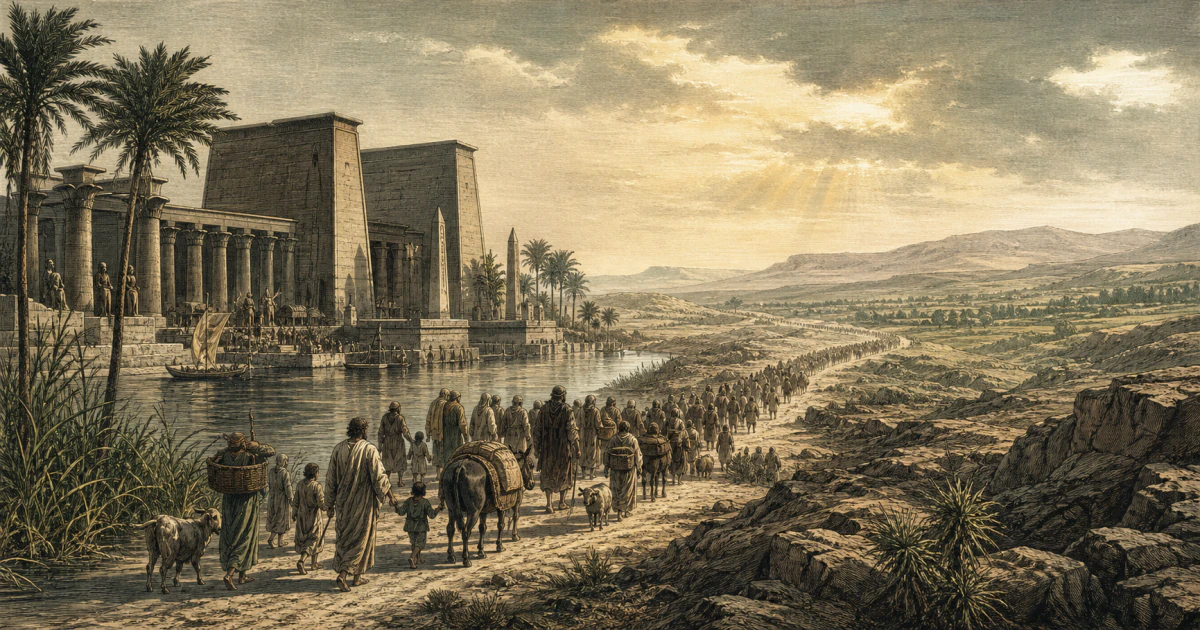
The Ramesses Problem
Now we come to the objection everyone knows is coming. If the Exodus happened around 1446 BC, why does Exodus mention Raamses?
Therefore they did set over them taskmasters to afflict them with their burdens. And they built for Pharaoh treasure cities, Pithom and Raamses.
There it is. Raamses. The King James Version (KJV) uses that spelling in Exodus, while Genesis has Rameses. Egyptologists commonly write the royal city as Pi-Ramesses or Pi-Ramesse. We are discussing the same name problem, not three different cities created by English spelling conventions.
The objection is serious because Pi-Ramesses was the Ramesside royal residence in the eastern Delta. James Hoffmeier argues that Rameses in Exodus 1:11Therefore they did set over them taskmasters to afflict them with their burdens. And they built for Pharaoh treasure cities, Pithom and Raamses., Exodus 12:37And the children of Israel journeyed from Rameses to Succoth, about six hundred thousand on foot that were men, beside children., and Numbers 33:3And they departed from Rameses in the first month, on the fifteenth day of the first month; on the morrow after the passover the children of Israel went out with an high hand in the sight of all the Egyptians. makes best geographical sense as Pi-Ramesses at Qantir. He also argues that the name fits either a memory preserved from the time when the city flourished or writing that took place during that period.1, p. 65
That gives the late-date inference real force. If the Israelites built the city named for Ramesses II, then their oppression seems to belong in the Ramesside period. Move the oppression there, and a thirteenth-century Exodus appears to follow.
It is a clean argument. It simply is not the only way to account for the text.
The name Raamses creates a question, not a verdict.
The Bible Says
The first control is chronological. 1 Kings 6:1And it came to pass in the four hundred and eightieth year after the children of Israel were come out of the land of Egypt, in the fourth year of Solomon’s reign over Israel, in the month Zif, which is the second month, that he began to build the house of the LORD. places the beginning of Solomon's temple in the 480th year after the Exodus. Parts 1 and 2 explained why I believe that notice gives us real chronology and points to an Exodus around 1446 BC. Exodus 1:11 must be read with that datum rather than used to make it disappear.
The second control comes from the name itself. Genesis uses Rameses in the story of Joseph:
And Joseph placed his father and his brethren, and gave them a possession in the land of Egypt, in the best of the land, in the land of Rameses, as Pharaoh had commanded.
That is long before Moses on every proposed Exodus chronology and long before Ramesses II on every normal Egyptian chronology. If the mere appearance of Rameses dates a narrated event to the Ramesside period, the problem begins in Genesis before Exodus 1:11 ever gets a turn.
The most natural explanation is that Rameses can identify an older place or region by a name familiar to later readers. That does not move Joseph into the thirteenth century. It helps the reader locate where Joseph settled his family.
Scripture does this elsewhere. Genesis 14:14And when Abram heard that his brother was taken captive, he armed his trained servants, born in his own house, three hundred and eighteen, and pursued them unto Dan. says Abram pursued his enemies as far as Dan, while Judges 18:29And they called the name of the city Dan, after the name of Dan their father, who was born unto Israel: howbeit the name of the city was Laish at the first. explains that the city had formerly been called Laish. Genesis itself calls a city Bethel while telling us that its earlier name was Luz (Genesis 28:19And he called the name of that place Beth-el: but the name of that city was called Luz at the first.). It identifies Kirjatharba as Hebron (Genesis 23:2And Sarah died in Kirjath-arba; the same is Hebron in the land of Canaan: and Abraham came to mourn for Sarah, and to weep for her.), and Joshua 14:15And the name of Hebron before was Kirjath-arba; which Arba was a great man among the Anakims. And the land had rest from war. again explains that Kirjatharba was the earlier name.
Andrew Steinmann gathers these examples as evidence of later toponymic updating and applies that possibility directly to Rameses in Genesis and Exodus.2, chap. 3, ‘Late-Date Theory for the Exodus’
This is not a desperate rule invented for one inconvenient verse. Readers routinely locate older events with later names. If I say the English founded Jamestown near modern Williamsburg, I have not transported Williamsburg back to 1607. I have oriented the reader.
The same explanation fits both biblical uses of Rameses. Genesis names the region where Jacob's family settled. Exodus names the store city Israel built. A recognizable place name can tell us where those events occurred without, by itself, telling us when they occurred.
What The Geography Actually Shows
Granting that biblical Rameses points to the Qantir area does not require us to pretend the eastern Delta sprang into existence under Ramesses II.
The names need to be kept straight.
Avaris is the ancient city identified with Tell el-Dabʿa. It was the Hyksos capital and remained important to the history of the eastern Delta before the Ramesside period.
Peru-nefer was an important New Kingdom naval base. Manfred Bietak argues that it should also be located at Tell el-Dabʿa, where the enormous harbour, Thutmosid palace precinct, chronology, and stratigraphy fit that identification. He notes significant storage facilities and military camps there during the early 18th Dynasty, followed by the New Kingdom palace.3, pp. 57–61
Qantir lies about two kilometers north of Tell el-Dabʿa. Bietak locates the Ramesside palace there and identifies Pi-Ramesses with Qantir. The Ramesside residence was therefore established immediately beside the older Avaris and Peru-nefer site-region rather than on an unrelated patch of Delta mud.3, pp. 62–64

That relationship matters. The geography gives us continuity across changing royal uses and changing names. It does not tell us that Avaris and Pi-Ramesses were simply the same city under interchangeable labels, and it does not prove that Israelites occupied either site. It does show why a later reader could recognize this connected region by its famous Ramesside name.
This also lets us grant the strongest part of Hoffmeier's case. Biblical Rameses may indeed point to the real Pi-Ramesses/Qantir geography. A later-name explanation does not require a fictional place, a geographical blunder, or a second undiscovered city called Ramesses. It distinguishes the location identified by the name from the date of the event narrated there.
That distinction is the heart of the answer.
What The Answer Does Not Prove
An updated place name is a reasonable reading. It is not an archaeological identification card for Israel.
Bietak's work does not say that the early 18th Dynasty storage facilities were built by Hebrews. Avaris does not prove the 1446 date. The connection between Avaris, Peru-nefer, and Pi-Ramesses does not make every occupational layer part of the Exodus story. Those would be much larger claims requiring much more evidence.
Our conclusion is narrower:
- The Bible already uses Rameses for Joseph's much earlier settlement.
- The Bible elsewhere uses recognizable later place names for earlier events.
- The real eastern Delta geography connects the older Avaris and Peru-nefer setting with the later Pi-Ramesses residence nearby.
- Therefore, Raamses in Exodus 1:11Therefore they did set over them taskmasters to afflict them with their burdens. And they built for Pharaoh treasure cities, Pithom and Raamses. does not by itself date the oppression or the Exodus to Ramesses II.
That does not make the Ramesside reading impossible. It removes the claim that the place name settles the date before the rest of Scripture is heard.
The Curmudgeon Says
I understand why the Ramesses objection has staying power. It is concrete. It is easy to explain. It has a famous Pharaoh attached to it. It gives the late-date case the full Yul Brynner treatment: bald head, booming voice, absolute certainty. Impressive on screen. Less decisive on the page.
Hoffmeier is right to insist that the biblical writer knew real Egyptian geography. I find that argument helpful. Where I part company with the late-date inference is the jump from this is the place to therefore this must be the century.
Genesis 47:11 stands in the middle of that jump with its arms folded.
If Joseph's family can be located in "the land of Rameses" without living under Ramesses II, then Exodus 1:11 cannot make Ramesses II the Pharaoh of the oppression merely by using the same name. The explicit biblical clock still has to govern the place name, and the Egyptian geography is perfectly capable of bearing a later recognizable label.
Raamses remains evidence to interpret. It has simply lost its veto.
Coming Up
Part 4 moves from cities to kings and asks which reign fits the crisis at Moses' birth.
Discussion
Thoughtful, good-faith discussion is welcome.
Loading comments…