
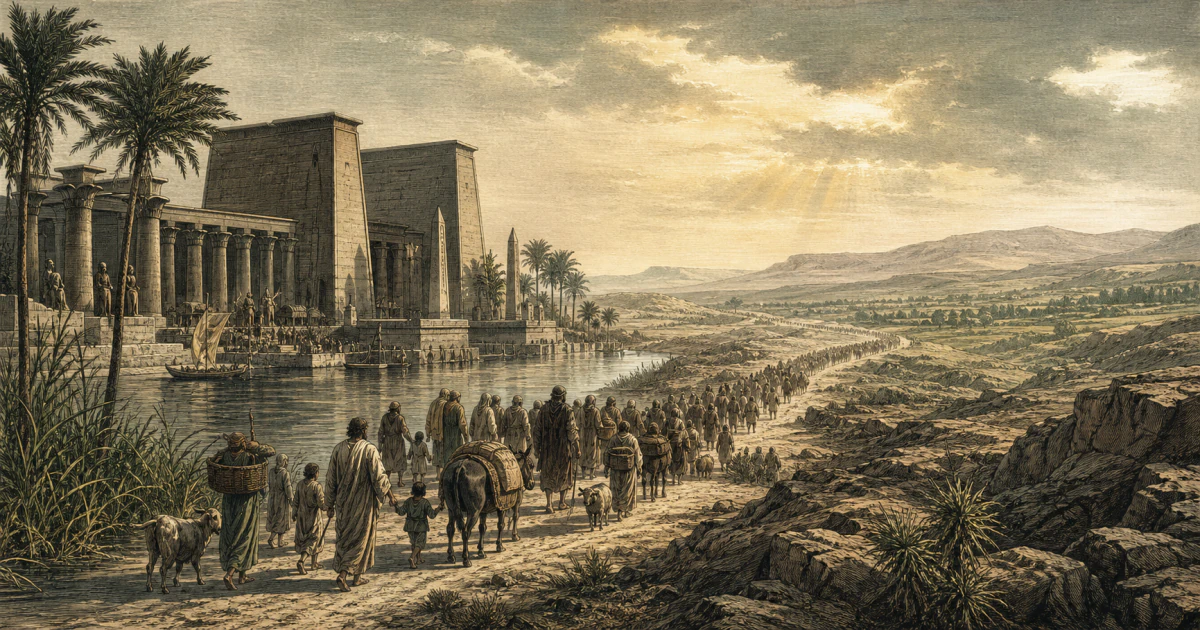
Pharaoh's Daughter
The last article placed the birth of Moses around 1526 BC and, under the high 18th Dynasty chronology used in this series, placed Thutmose I on the throne. Now Exodus leads us across the palace and down to the river.
There we meet one of the most consequential unnamed women in Scripture.
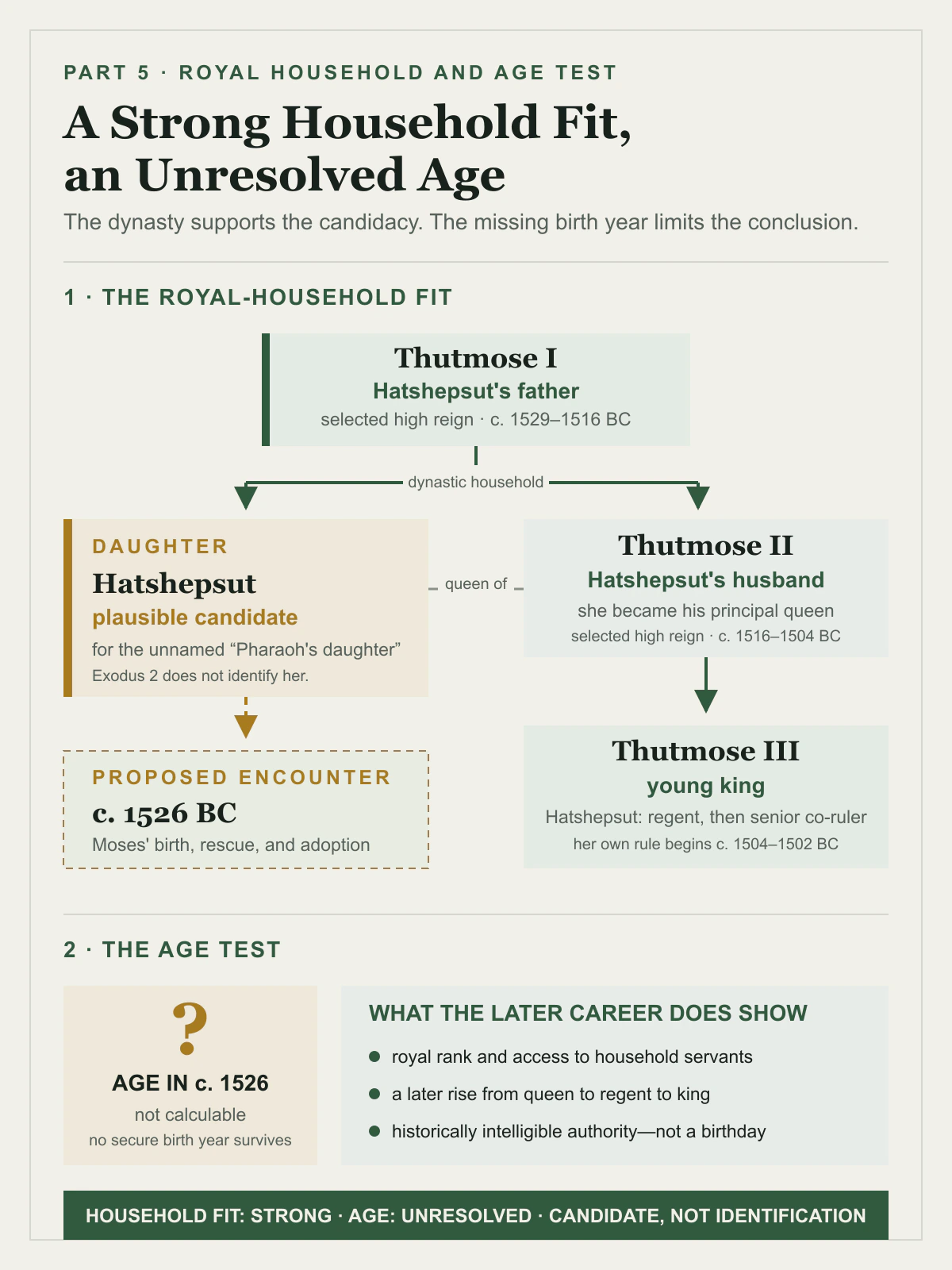
If Thutmose I is the Pharaoh of the male-child crisis, Hatshepsut is the obvious royal daughter to examine. She was his daughter, she belonged to the court our chronology has placed around Moses, and her later career reveals an extraordinary capacity to wield royal authority. That combination makes her a strong royal-household candidate.
It does not put her name into Exodus 2. The distinction matters, but we only need to make it once before looking carefully at the fit.
The Bible Says
Exodus begins the story in a Hebrew home. Moses is born to parents from the tribe of Levi, hidden for three months, and then placed in a small ark among the reeds while his sister watches from a distance.
Chapter 2, verse 1: 2:1And there went a man of the house of Levi, and took to wife a daughter of Levi. Chapter 2, verse 2: 2:2And the woman conceived, and bare a son: and when she saw him that he was a goodly child, she hid him three months. Chapter 2, verse 3: 2:3And when she could not longer hide him, she took for him an ark of bulrushes, and daubed it with slime and with pitch, and put the child therein; and she laid it in the flags by the river’s brink. Chapter 2, verse 4: 2:4And his sister stood afar off, to wit what would be done to him.
The river had been made an instrument of Pharaoh's death sentence. Moses' mother entrusts her son to that river in a vessel made to preserve life. Then Pharaoh's daughter arrives.
Chapter 2, verse 5: 2:5And the daughter of Pharaoh came down to wash herself at the river; and her maidens walked along by the river’s side; and when she saw the ark among the flags, she sent her maid to fetch it. Chapter 2, verse 6: 2:6And when she had opened it, she saw the child: and, behold, the babe wept. And she had compassion on him, and said, This is one of the Hebrews’ children. Chapter 2, verse 7: 2:7Then said his sister to Pharaoh’s daughter, Shall I go and call to thee a nurse of the Hebrew women, that she may nurse the child for thee? Chapter 2, verse 8: 2:8And Pharaoh’s daughter said to her, Go. And the maid went and called the child’s mother. Chapter 2, verse 9: 2:9And Pharaoh’s daughter said unto her, Take this child away, and nurse it for me, and I will give thee thy wages. And the woman took the child, and nursed it. Chapter 2, verse 10: 2:10And the child grew, and she brought him unto Pharaoh’s daughter, and he became her son. And she called his name Moses: and she said, Because I drew him out of the water.
The scene gives us more than a title and a basket. Pharaoh's daughter recognizes that the child is Hebrew. Her compassion is therefore informed compassion. She does not rescue him because she mistakes him for an Egyptian child.
She also possesses the freedom and authority to act. She sends a servant, accepts the nurse proposed by Moses' sister, promises wages, receives the child when he has grown, adopts him as her son, and names him. Exodus does not explain the palace procedure behind those actions. It simply presents a royal woman whose decision takes effect.
At the same time, Moses never becomes an Egyptian child whose Hebrew past has been erased. His sister stands beside the river. His own mother nurses him. The princess herself identifies him as Hebrew. Later, when Moses is grown, he goes out to "his brethren" (Exodus 2:11And it came to pass in those days, when Moses was grown, that he went out unto his brethren, and looked on their burdens: and he spied an Egyptian smiting an Hebrew, one of his brethren.). Hebrews says that he refuses to be called the son of Pharaoh's daughter and chooses affliction with the people of God (Hebrews 11:24–26Chapter 11, verse 24: 11:24By faith Moses, when he was come to years, refused to be called the son of Pharaoh’s daughter; Chapter 11, verse 25: 11:25Choosing rather to suffer affliction with the people of God, than to enjoy the pleasures of sin for a season; Chapter 11, verse 26: 11:26Esteeming the reproach of Christ greater riches than the treasures in Egypt: for he had respect unto the recompence of the reward.).
The adoption is real. So is the Hebrew identity that survives it.
That gives us a useful profile. We are looking for a daughter of the Pharaoh in the Moses-birth window, a woman situated within the royal household and able to make an effective decision there. We are not looking for someone who can replace Moses' named Hebrew family or turn him into a different man.
Why Hatshepsut Enters The Conversation
Hatshepsut was a daughter of Thutmose I and later made her relationship to him central to her royal legitimacy. She became the principal queen of Thutmose II, acted as regent for the young Thutmose III, and then assumed the status and titles of a king ruling alongside him. The Metropolitan Museum of Art describes her movement from queen to regent and then senior co-ruler as one of the defining features of her career.1
That later career does not prove what she did at the river. It does establish that we are dealing with a major royal daughter in precisely the dynasty under examination, not a name borrowed from a list because she happens to be famous.
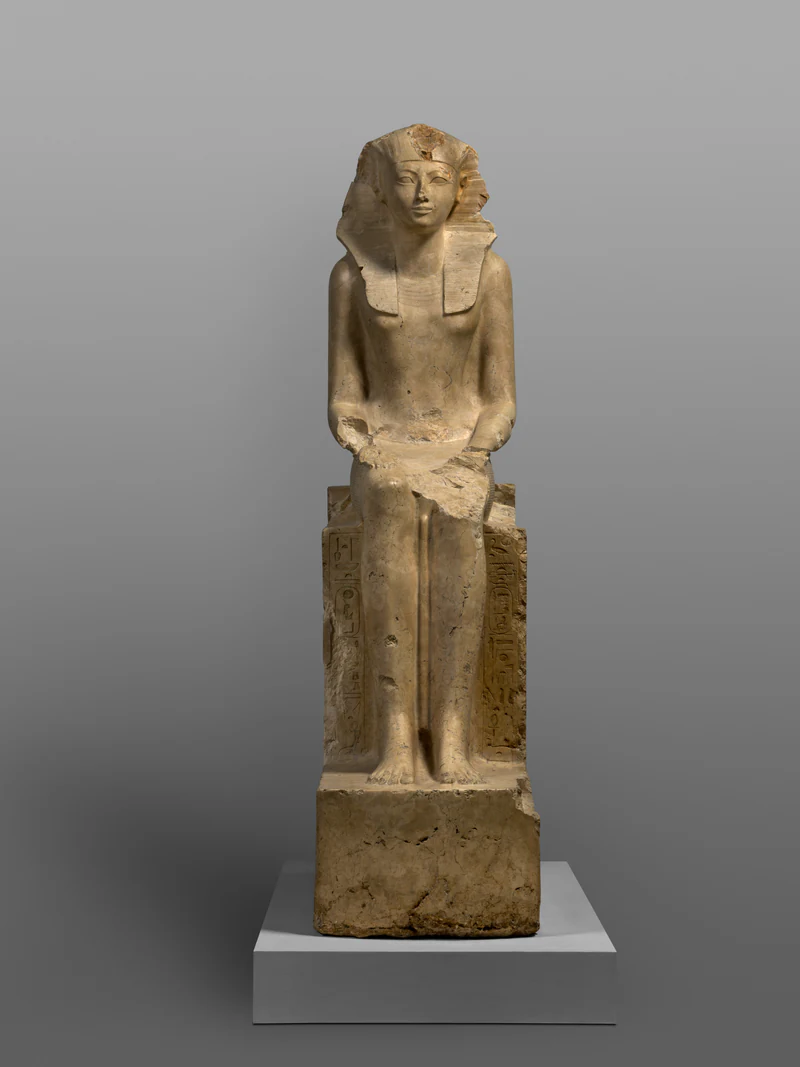
Hatshepsut in kingly form during her later joint reign with Thutmose III.
The date alignment depends on which Egyptian chronology we use. The Met conventionally dates Hatshepsut's reign to about 1473–1458 BC.1 Those dates do not place her reign near Moses' birth around 1526, although a reign date is not a birth date. Under the high reconstruction defended in Part 4, Thutmose I reigns around 1529–1516, Thutmose II around 1516–1504, and the beginning of Hatshepsut's own rule is placed around 1504–1502, depending on how that beginning is counted.2, chap. 2 and appendix 1
That sequence places Moses' birth inside the reign of Hatshepsut's father and allows her later rise to unfold during the first forty years of Moses' life. The candidate therefore emerges from the same timetable that selected Thutmose I. We did not first choose Hatshepsut and then rearrange the dynasty around her.
The profile fit is also striking. Exodus presents a royal daughter with attendants, compassion, discretion, and enough household authority to adopt the very sort of child Pharaoh had condemned. Hatshepsut's later career shows a woman capable of operating within royal power at an exceptional level. Her inscriptions and monuments repeatedly connected her authority to her father Thutmose I; a Met object record summarizes that she revered him and grounded her legitimacy in his supposed appointment of her as king.3
None of that tells us what she thought about Hebrew infants. It does make the kind of agency visible in Exodus 2 historically intelligible within this royal house.
The Hardest Question: How Old Was She?
This is where the evidence refuses to be as tidy as the family tree.
We do not possess a secure birth year for Hatshepsut. Moving the reigns into a high chronology does not manufacture one. The sequence makes it possible to place her in Thutmose I's household at the required time, and her later position requires that she mature before becoming queen and ruler, but those facts do not tell us her exact age in 1526 BC.
That matters because the woman in Exodus does more than notice a basket. She directs servants, commissions a nurse, promises wages, and ultimately adopts the child. Those actions establish effective royal authority. They do not establish a modern minimum age for exercising it.
Modern readers may instinctively picture an independently established adult woman because she commands attendants and arranges payment. Exodus never says that. A royal daughter could possess rank over servants and speak with the authority of Pharaoh's household while much younger than the woman we may first imagine. The promise, "I will give thee thy wages," does not require us to picture the princess personally keeping the accounts any more than a king's command requires him to perform the labor himself.
The text does not tell us whether she was married, give her age, or explain whether anyone else in the household ratified her decision. We therefore should not use her actions to manufacture a precise age floor that Scripture does not supply.
So the age question cannot presently confirm the identification. Neither does our evidence produce a conflict that rules Hatshepsut out, and the authority visible in Exodus 2 does not by itself create one. We have a chronological and family fit whose exact age component remains unresolved.
That is a more precise conclusion than either extreme. "Hatshepsut was Thutmose I's daughter" is not enough to prove the case. "We cannot calculate her birthday" is not enough to dismiss it. The responsible judgment is that she belongs in the correct household window and develops into exactly the sort of unusually authoritative royal woman that makes the scene plausible, while one biographical control we would very much like to possess is missing.
Providence Inside Pharaoh's House
The identification is fascinating, but the passage is not chiefly interested in satisfying our curiosity about an Egyptian name.
Pharaoh commands that every Hebrew son be thrown into the river (Exodus 1:22And Pharaoh charged all his people, saying, Every son that is born ye shall cast into the river, and every daughter ye shall save alive.). A daughter of Pharaoh's own house goes to that river, sees a condemned Hebrew son, and preserves him. She pays the child's mother to nurse him. She then brings him into the household from which the death sentence came.
The decree remains Pharaoh's. The irony belongs to God.
The future deliverer of Israel is preserved through the compassion of Pharaoh's daughter, sustained by Pharaoh's resources, and raised within reach of Pharaoh's court. The king who means to prevent a deliverer from arising unwittingly helps shelter and educate him.
Whether the princess was Hatshepsut or another royal daughter, that theological reversal stands. Identifying Hatshepsut would give the woman a historical name. It would not improve upon the providence already visible in the text.
The Curmudgeon Says
Hatshepsut is not a decorative celebrity appearance. Under the chronology we are testing, she is a daughter of our birth-crisis Pharaoh, present in the right royal household, with a later career that makes the authority of the basket scene unusually easy to imagine. I find that a remarkable fit.
Its limit is equally plain. Scripture does not name her, and history has not preserved the birth date we need to test her exact age at the river. The fit is therefore suggestive rather than demonstrative.
Some parts of this series will carry more chronological weight because Scripture gives us harder controls: a king must die before Moses returns, an Exodus Pharaoh must occupy a particular year, and a paternal firstborn must be absent from the succession. Pharaoh's daughter gives us fewer handles.
But fewer handles do not mean no fit. Hatshepsut belongs in the conversation, and she belongs there for reasons stronger than fame.
Coming Up
Part 6 asks what it meant for Moses to be educated in the Egyptian court, and why Egypt has not handed us a personnel file with his name helpfully underlined.
Discussion
Thoughtful, good-faith discussion is welcome.
Loading comments…