
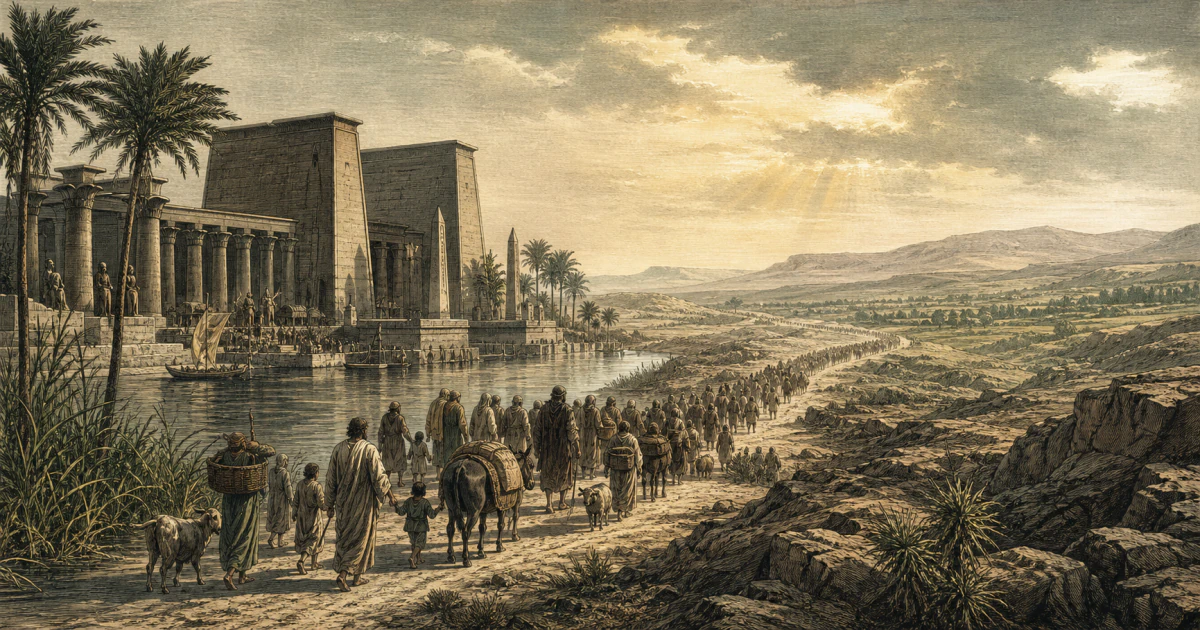
Moses In The Egyptian Court
The basket scene does not end with Moses safely returned to his mother. It ends with Moses becoming the son of Pharaoh's daughter.
That adoption places a Hebrew child inside the royal household. Stephen later tells us what followed: Moses was educated in Egyptian wisdom and became mighty in words and deeds. He was not a vague palace ornament, waiting in a corridor until the burning bush made him useful. Egypt formed him for an elite life.
Then he rejected the identity Egypt offered him.
This article asks what the biblical claim requires, what the Egyptian setting makes plausible, and how much weight we should put on the absence of a surviving record naming Moses. It also gives Senenmut just enough time onstage to explain why I do not think he is Moses.
The Bible Says
Exodus gives us the adoption in one compressed sentence:
And the child grew, and she brought him unto Pharaoh’s daughter, and he became her son. And she called his name Moses: and she said, Because I drew him out of the water.
Acts expands the court background:
Chapter 7, verse 20: 7:20In which time Moses was born, and was exceeding fair, and nourished up in his father’s house three months: Chapter 7, verse 21: 7:21And when he was cast out, Pharaoh’s daughter took him up, and nourished him for her own son. Chapter 7, verse 22: 7:22And Moses was learned in all the wisdom of the Egyptians, and was mighty in words and in deeds.
Stephen's language is substantial. Moses was "learned in all the wisdom of the Egyptians" and "mighty in words and in deeds." We need not turn "all" into a modern course catalogue, but neither should we reduce it to basic literacy. Stephen depicts Egyptian formation joined to public capability.
Exodus then records the rupture. When Moses is grown, he goes out to his Hebrew brethren, sees an Egyptian beating one of them, kills the Egyptian, and hides him in the sand (Exodus 2:11–12Chapter 2, verse 11: 2:11And it came to pass in those days, when Moses was grown, that he went out unto his brethren, and looked on their burdens: and he spied an Egyptian smiting an Hebrew, one of his brethren. Chapter 2, verse 12: 2:12And he looked this way and that way, and when he saw that there was no man, he slew the Egyptian, and hid him in the sand.). Pharaoh learns of it and seeks to kill Moses, so Moses flees to Midian (Exodus 2:15Now when Pharaoh heard this thing, he sought to slay Moses. But Moses fled from the face of Pharaoh, and dwelt in the land of Midian: and he sat down by a well.).
Hebrews explains the choice beneath that crisis:
Chapter 11, verse 24: 11:24By faith Moses, when he was come to years, refused to be called the son of Pharaoh’s daughter; Chapter 11, verse 25: 11:25Choosing rather to suffer affliction with the people of God, than to enjoy the pleasures of sin for a season; Chapter 11, verse 26: 11:26Esteeming the reproach of Christ greater riches than the treasures in Egypt: for he had respect unto the recompence of the reward.
These passages do not compete. Moses truly becomes the son of Pharaoh's daughter. He truly receives Egyptian learning. He truly identifies the oppressed Hebrews as his people and refuses to make the palace his final identity.
His Egyptian formation and Hebrew allegiance are both necessary to the story.
What Egyptian Education Adds
Literacy in ancient Egypt was not a routine possession of the whole population. The Petrie Museum at University College London (UCL) summarizes it as the skill of a small proportion of Egyptians. Those trained as scribes could become administrators and middle managers, and with the right connections could rise into the high elite. The initial training included Hieratic, the cursive script used for administration and ordinary business, while more specialized sacred writing belonged to narrower circles.1
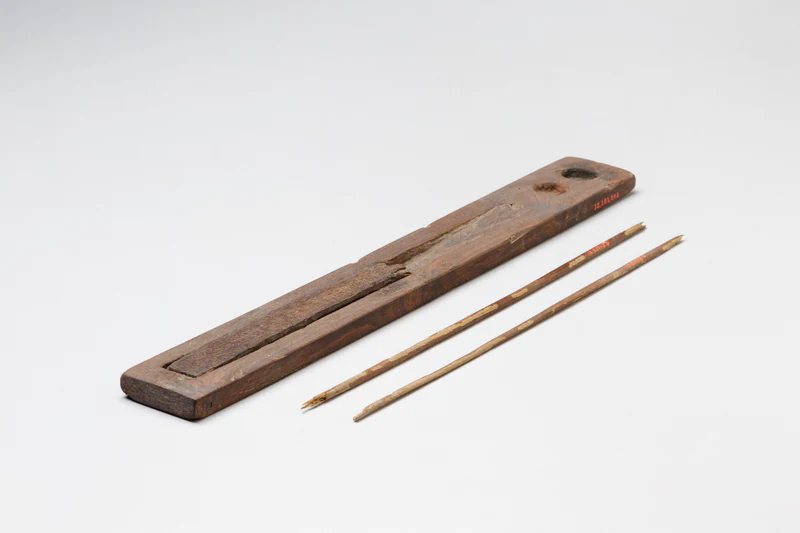
This Dynasty 18 wooden palette preserves the two ink wells and long recess used for writing equipment; the Met photograph places reed brushes beside it.
That broad picture helps us hear Acts 7:22 at the right volume. An adopted son in a royal household had access to a world of language, administration, religious knowledge, political custom, and cultivated wisdom that most Egyptians did not. Acts does not tell us which offices Moses held or which schoolroom he entered. It tells us the result: he was educated in Egyptian wisdom and capable in word and deed.
The phrase about deeds also keeps us from filing Moses away as nothing more than a scribe. Stephen presents a man of action as well as speech. His later leadership of Israel, appearances before Pharaoh, judgment of disputes, composition of covenantal material, and direction of the wilderness community do not emerge from a man without capacity. Divine calling does not require us to pretend that his earlier formation contributed nothing.
It also does not mean Egypt created the deliverer. Moses' gifts, education, failures, exile, and calling all stand under God's providence. The court supplies formation; Midian supplies forty years outside it; the burning bush supplies the commission.
Could Moses Have Written?
Older skeptical reconstructions sometimes pushed Israelite writing and the biblical law so late that a literate Moses became an anachronism. The evidence for early alphabetic writing has made that dismissal much harder to maintain.
James Hoffmeier surveys alphabetic writing before and during the Late Bronze Age and argues that Moses, or scribes associated with him, could have written in the period described by the biblical narrative. He connects that historical possibility with the Torah's own references to Moses writing.2, pp. 178–181
That does not prove Mosaic authorship by archaeology. It removes a supposed impossibility. Acts gives Moses an elite Egyptian education, and the writing environment no longer permits us to declare that a fifteenth-century Moses simply could not have written.
An Egyptian Name In A Hebrew Story
Moses' name adds another layer of Egyptian texture. Many scholars have connected it with Egyptian name elements related to birth or a child, familiar from names such as Ahmose, Thutmose, and Ramose. Hoffmeier places Moses within a wider cluster of names around the Exodus and wilderness generation that have proposed Egyptian connections, including Aaron, Miriam, Phinehas, Merari, Hori, and Hur.2, pp. 223–226
The details are debated. Egyptian consonants and Hebrew spelling do not slide together without questions, and not every proposed name derivation is equally secure. The name cannot select Hatshepsut, identify a Pharaoh, or prove an Exodus date.
Exodus itself gives the name a Hebrew explanation: Pharaoh's daughter calls him Moses because she drew him out of the water (Exodus 2:10And the child grew, and she brought him unto Pharaoh’s daughter, and he became her son. And she called his name Moses: and she said, Because I drew him out of the water.). We do not need to treat that explanation as a modern etymological footnote. Biblical naming frequently carries wordplay and theological significance. An Egyptian-sounding name with a Hebrew narrative meaning is entirely at home in the life of this particular man.
He is a Hebrew raised in Egypt. Even his name seems unwilling to let us forget either side of the tension.
Where Is The Egyptian Moses?
Now for the reasonable objection. If Moses received elite education and became mighty in words and deeds, why have we not found him in Egyptian records?
The question has force because Acts does not describe a nobody. A surviving inscription or administrative record securely tied to Moses would be important evidence. We do not possess one.
But the question becomes unfair when the absence is treated as a veto, as though Egypt left us a complete personnel archive and Moses is the one suspiciously empty folder.
UCL's survey of Egyptian writing stresses that written evidence survives unevenly. Different areas of Egyptian life have different histories of writing and preservation, surviving texts must be interpreted in their original contexts, and there are real gaps in the record.3 What has reached us reflects what ancient institutions chose to record, what materials survived, what later builders or enemies destroyed, and what archaeologists have recovered.
The biblical narrative gives us further reasons to temper our expectations.
First, an Egyptian record would identify Moses from within the court's own categories. We do not know what titles he may have held, whether he bore a longer Egyptian name, or how any surviving reference would connect to the Hebrew deliverer remembered by Israel. Guessing an Egyptian alias and then finding it in a monument would not solve the problem; it would simply create an identification that still had to be proved.
Second, Moses' Egyptian career ends in disgrace and flight. He kills an Egyptian, Pharaoh seeks his life, and he disappears into Midian for forty years. That is a narrative explanation for why his Egyptian story does not end with an honored tomb biography.
Third, if the Exodus account is true, Moses later returns as the agent of Egypt's humiliation. Royal monuments celebrate order, victory, legitimacy, piety, and the king's power. We should hardly expect a generous Egyptian commemoration of the man who confronted Pharaoh and led Egypt's labor force away.
None of those observations proves a deliberate purge of Moses' records. We have no evidence that every trace of him was systematically erased. They establish the narrower point we actually need: the lack of a surviving inscription that can be confidently labeled "Moses" is not strong enough to overturn the positive biblical claim about his court formation.
Absence can matter. Its weight depends on what evidence we should reasonably expect to survive. Here the archive is too incomplete, the identification problem too severe, and Moses' rupture with Egypt too explicit for silence to carry the whole case.
What About Senenmut?
Senenmut often enters this discussion because the temptation is obvious. He was a prominent non-royal figure in Hatshepsut's court, administered her estates, tutored her daughter Neferure, and rose to become Great Steward of Amun. The Met calls him the best known and most frequently represented member of her court.4
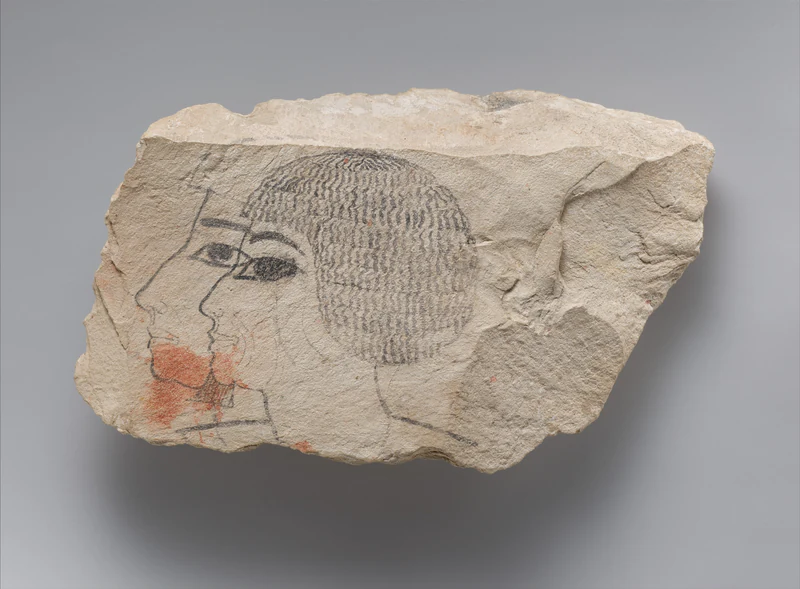
The Met identifies both ink profiles on this limestone ostracon as Senenmut.
He is an excellent example of how high a man outside the royal family could rise in Hatshepsut's world. That makes the social setting of an educated, capable Moses easier to picture.
It does not make Senenmut Moses.
Scripture names Moses' father and mother as Amram and Jochebed and places him beside his Hebrew siblings Aaron and Miriam (Exodus 6:20And Amram took him Jochebed his father’s sister to wife; and she bare him Aaron and Moses: and the years of the life of Amram were an hundred and thirty and seven years.; Numbers 26:59And the name of Amram’s wife was Jochebed, the daughter of Levi, whom her mother bare to Levi in Egypt: and she bare unto Amram Aaron and Moses, and Miriam their sister.). Senenmut appears in a different known family setting. The Met identifies Hatnefer as Senenmut's mother and Ramose as his father; their family tomb was discovered beneath Senenmut's offering chapel.5
Popular identifications try to connect Senenmut's status, career, tombs, or disappearance with Moses' life. Those parallels can sound intriguing until they are asked to carry the biblical family data. I do not find that identification persuasive, and this series gains nothing by forcing it.
Senenmut gives us a vivid picture of Hatshepsut's court world, not a secret name for Moses.
The Curmudgeon Says
The Bible is doing something richer than attaching a convenient Egyptian education to an otherwise finished hero.
Moses knows Pharaoh's world from the inside. He has received its learning and lived under its privileges. Then he chooses to bear the reproach of his people rather than enjoy the treasures of Egypt. Forty years later, he returns to the court he once knew, not as Pharaoh's daughter's son seeking a place in the household, but as the servant of the Lord demanding, "Let my people go."
That reversal is the point. Egypt trained Moses, but Egypt did not own him.
Would I enjoy an Egyptian inscription reading, "Moses was here, and later things became awkward"? Certainly. I would also appreciate a notarized list of every Exodus Pharaoh, with pronunciation marks and cross-references. Providence has not spared us the historical work.
What we possess is enough to make the biblical picture historically serious: a royal adoption, an elite educational setting, a man capable in word and deed, an Egyptian cultural texture that reaches even into personal names, and a violent rupture that ends his Egyptian career. The missing personnel file is a limitation. It is not a refutation.
The next article follows Moses into exile. Scripture gives us a new historical control there: the Pharaoh he fled must die before Moses returns.
Coming Up
Part 7 asks which long-reigning king fits Moses' forty years in Midian and dies before the return to Egypt.
Discussion
Thoughtful, good-faith discussion is welcome.
Loading comments…