
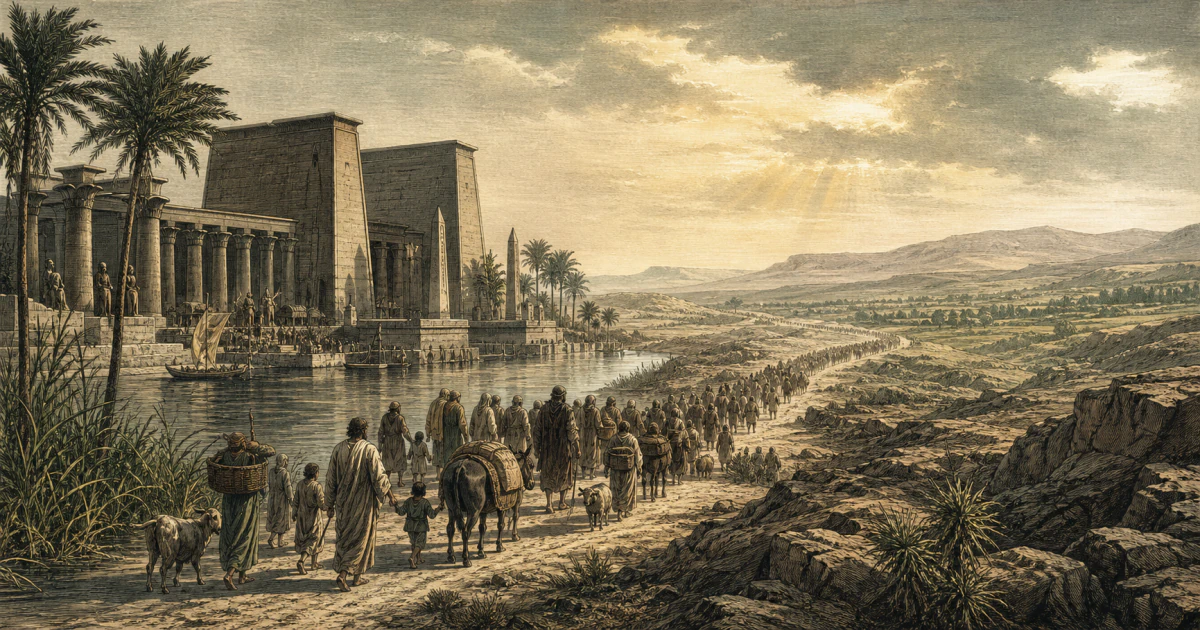
The Pharaoh of the Exodus
If the last article is right, Moses fled from Thutmose III and returned after that king died. The next place to look is the next throne. Under the high 18th Dynasty chronology defended in Part 4, Amenhotep II follows Thutmose III and is reigning when Moses returns around 1446 BC.
That makes him our leading candidate for the Pharaoh of the Exodus. Scripture does not supply his name; the chronology supplies the identification we are testing. Now the question is whether this king can face the rest of the biblical evidence without our having to rearrange it for his convenience.
One objection needs particular attention. Amenhotep II has a mummy, and the chronology leaves him reigning after the Exodus. What, then, happened to Pharaoh at the sea?
The Bible Says
The Exodus Pharaoh is introduced not by his personal name, but by his refusal:
And Pharaoh said, Who is the LORD, that I should obey his voice to let Israel go? I know not the LORD, neither will I let Israel go.
That is the theological center of the conflict. Pharaoh's labor policy has become open defiance of the Lord. The plagues answer that defiance with judgment on the king, his country, and the gods of Egypt. The question Pharaoh asks will receive a very public answer.
Moses' age fixes the chronological side:
And Moses was fourscore years old, and Aaron fourscore and three years old, when they spake unto Pharaoh.
If the Exodus belongs around 1446 BC, then Moses is standing before Pharaoh around that date. The Pharaoh of the Exodus must be reigning then.
The tenth plague then adds the firstborn issue:
And it came to pass, that at midnight the LORD smote all the firstborn in the land of Egypt, from the firstborn of Pharaoh that sat on his throne unto the firstborn of the captive that was in the dungeon; and all the firstborn of cattle.
Pharaoh rises by night and summons Moses and Aaron:
And he called for Moses and Aaron by night, and said, Rise up, and get you forth from among my people, both ye and the children of Israel; and go, serve the LORD, as ye have said.
So Pharaoh survives the tenth plague. His firstborn does not. We will press that logic in Part 9.
Then Pharaoh pursues Israel:
And the Egyptians pursued, and went in after them to the midst of the sea, even all Pharaoh’s horses, his chariots, and his horsemen.
The waters return:
And the waters returned, and covered the chariots, and the horsemen, and all the host of Pharaoh that came into the sea after them; there remained not so much as one of them.
Moses' song summarizes the defeat:
Pharaoh’s chariots and his host hath he cast into the sea: his chosen captains also are drowned in the Red sea.
That is the biblical picture. Pharaoh defies the Lord. Pharaoh loses his firstborn. Pharaoh's pursuing power is shattered at the sea. The Lord gets the glory over Pharaoh and over Egypt.
Any candidate must be tested against that story, not allowed to rewrite it.
Egypt Says
Amenhotep II was a son and successor of Thutmose III. The National Museum of Egyptian Civilization describes a king celebrated for archery and chariot driving, who campaigned abroad and built at home. His public image was that of a physically formidable ruler.1
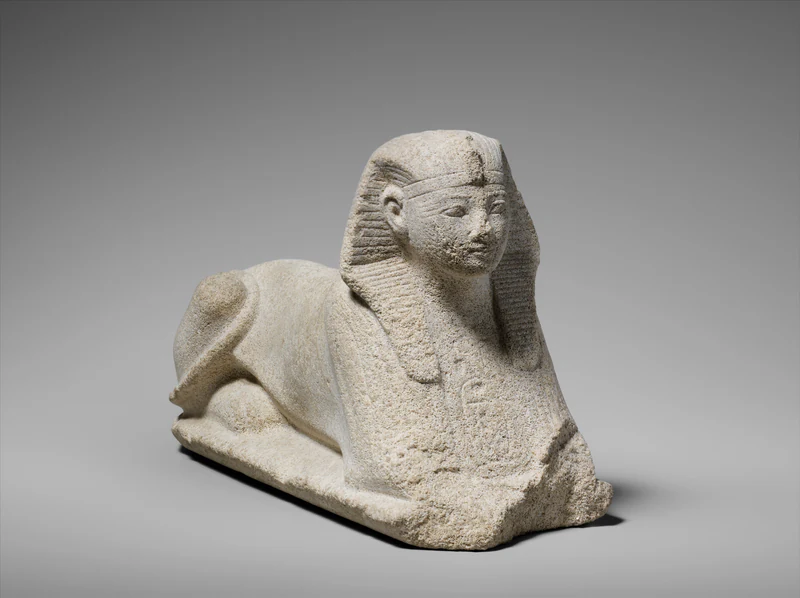
Sandstone sphinx of Amenhotep II.
The inscriptions let us hear that image in the king's own publicity. In Breasted's translation of the Karnak campaign account, Amenhotep is "like a fierce-eyed lion." The Amada and Elephantine texts combine temple building with accounts of victory, including the killing and public display of captured enemy princes.2, §783; 2, §§791–797
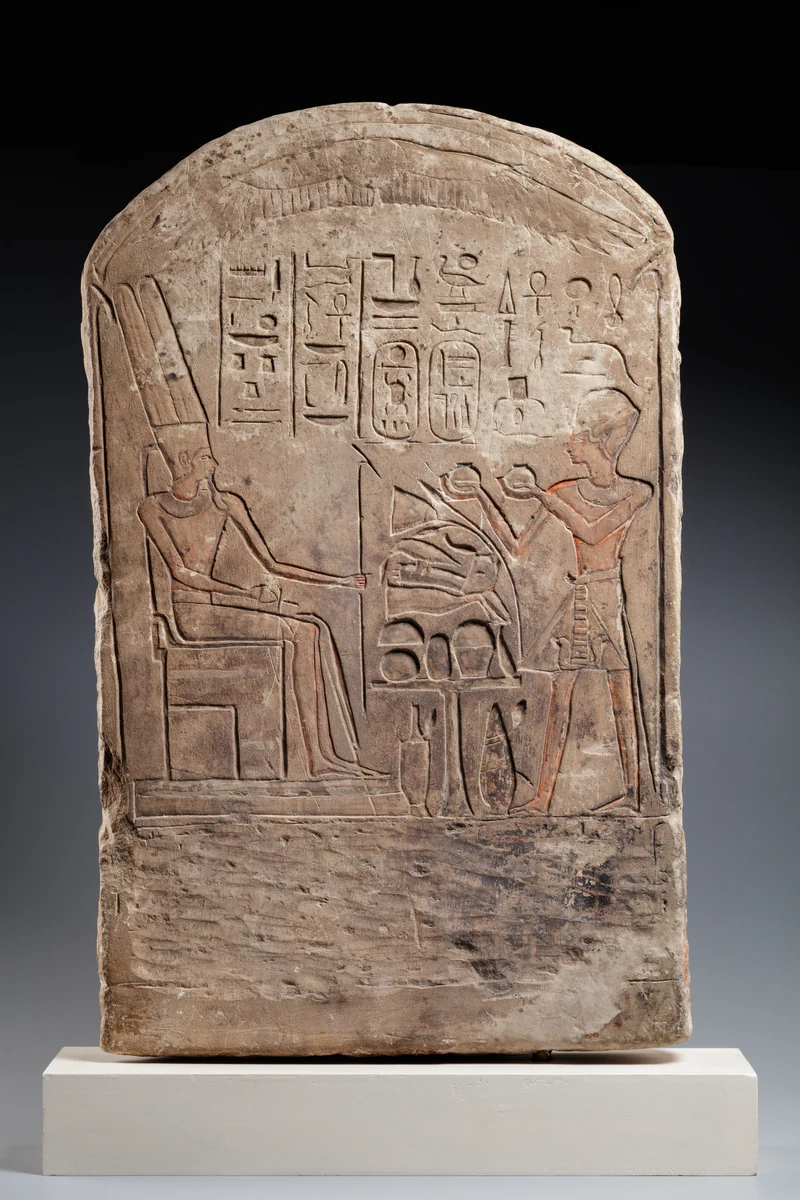
Amenhotep II stands at right offering two vessels to the enthroned god Amun. Faint pigment survives across the carved limestone scene and its inscriptions.
The Memphis Stela likewise preserves campaign records from Amenhotep II's Years 7 and 9.3 These are identifiable records against which historical proposals can be checked. They are also royal monuments intended to celebrate their king.
Why, then, do Amenhotep's campaigns appear in an Exodus argument? Some defenders of this identification see his later Year 9 campaign as possible evidence of the aftermath. Douglas Petrovich argues that its unusual season, limited reach into Canaan, and emphasis on taking people make sense as an attempt to reassert Egyptian strength and replenish the labor force lost in the Exodus. The booty list includes 3,600 people called Apiru, whom Petrovich identifies as Hebrews who had separated from the main Israelite body.4, pp. 99–106
That is a real argument, not merely a prisoner list with an Exodus label stuck on it. It connects the military and economic losses we would expect after the plagues with a particular kind of campaign, and I find it interesting as a possible piece of the cumulative fit.
I do not find the identification of these particular Apiru as Hebrews plausible. Israel has just sung that the Lord cast the horse and his rider into the sea. Pharaoh and his host have been overthrown, and Israel has been delivered from his hand. Petrovich's reconstruction then asks us to believe that 3,600 Israelites separated from Moses, entered Canaan, and were recaptured within months by the very Pharaoh whose pursuing power God had just shattered. Yet Scripture says nothing about the departure of such a large group, their capture, or this extraordinary reversal of the deliverance it has just celebrated.
Could an event go unrecorded? Certainly. But the wilderness narrative is hardly shy about recording Israel's rebellions, departures, judgments, and disasters. This would not be a minor missing detail. The proposed identification requires too much unrecorded history to make the pieces meet. I do not buy it.
Rejecting that identification does not make the campaign irrelevant. The slave-replenishment possibility does not require the Apiru to be Hebrews. A Pharaoh who had just lost an enormous enslaved population would have ample reason to seize laborers from other peoples. That lets us find the campaign's timing and emphasis on human captives interesting without buying the entire reconstruction. The stela says Amenhotep campaigned and claims an enormous body of captives. It does not say that Egypt had just lost Israel or that the raid was launched to replace Israelite labor. The campaign may therefore be an aftermath clue worth further study, but it cannot establish the identification by itself.
His chronology matters more. University College London's conventional chronology places his accession around 1428 BC, too late for a 1446 BC Exodus. On that timetable, Thutmose III is still king.5 The high reconstruction examined in Part 4 changes that alignment. It places Thutmose III's death before Moses' return and Amenhotep II in the Exodus window. That is why he is our candidate. His reputation as a warrior supplies historical context, not an independent date for the plagues.
The Mummy Problem
The museum identifies Amenhotep II's mummy as the body discovered in his own tomb, inside his quartzite sarcophagus.1 If he is the Pharaoh of the Exodus, why do we have it?
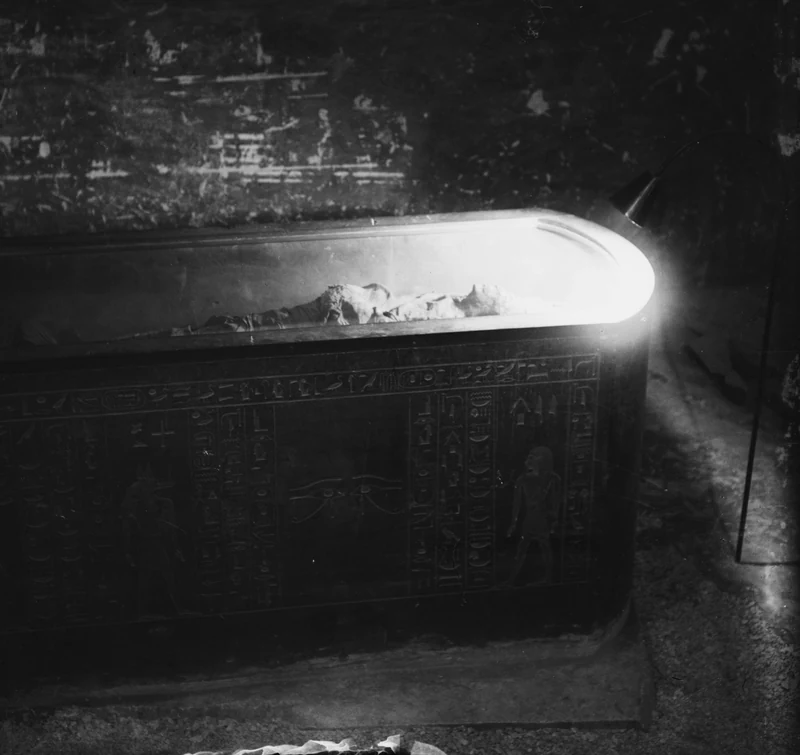
Amenhotep II's mummy rests in the king's quartzite sarcophagus inside KV35 in this photograph made around 1900.
There are actually two questions here. Could a drowned king's body have been recovered and mummified? In principle, yes; a mummy by itself does not settle the cause of death. But could a king who died at the sea continue to reign afterward? No. The high reconstructions discussed in Part 4 differ over Amenhotep II's exact endpoint, but leave him reigning well after 1446 BC. Recovering a body would not solve that chronological problem.
The identification therefore requires Pharaoh to survive the sea event. The question we must answer is whether Scripture requires his personal death there, or whether his overthrow can describe his defeat through the destruction of his pursuing army.
Exodus 14:10And when Pharaoh drew nigh, the children of Israel lifted up their eyes, and, behold, the Egyptians marched after them; and they were sore afraid: and the children of Israel cried out unto the LORD. puts Pharaoh in the pursuit. His involvement is not in doubt. But when the narrative describes entry into the sea and death in its waters, it repeatedly names his horses, chariots, horsemen, and host. The "not so much as one" in Exodus 14:28And the waters returned, and covered the chariots, and the horsemen, and all the host of Pharaoh that came into the sea after them; there remained not so much as one of them. applies to the force that entered the sea. It does not separately tell us that the king entered with them. Exodus 15:4Pharaoh’s chariots and his host hath he cast into the sea: his chosen captains also are drowned in the Red sea. explicitly names the drowned captains; Deuteronomy 11:4And what he did unto the army of Egypt, unto their horses, and to their chariots; how he made the water of the Red sea to overflow them as they pursued after you, and how the LORD hath destroyed them unto this day; recalls the destruction of Egypt's army, horses, and chariots.
Exodus 15:19For the horse of Pharaoh went in with his chariots and with his horsemen into the sea, and the LORD brought again the waters of the sea upon them; but the children of Israel went on dry land in the midst of the sea. deserves attention too. Its reference to "the horse of Pharaoh" can sound like the king's personal mount. Keil and Delitzsch understand the verse as placing Pharaoh himself at the head of the destroyed force. Gill, however, understands the horse collectively as Pharaoh's horses rather than one animal carrying the king.6, Exodus 15:19; 7, Exodus 15:19 That collective reading fits the accompanying chariots and horsemen, but it does not by itself establish that Pharaoh survived.
Psalm 136:15 is the strongest text for placing Pharaoh himself directly in the overthrow:
But overthrew Pharaoh and his host in the Red sea: for his mercy endureth for ever.
The Psalm includes Pharaoh himself in the overthrow, not merely an army detached from its ruler. The question is whether his overthrow must mean his death. The Brown–Driver–Briggs Hebrew lexicon gives the verb na'ar a range including shaking out or shaking off and connects this verse with Exodus 14:27And Moses stretched forth his hand over the sea, and the sea returned to his strength when the morning appeared; and the Egyptians fled against it; and the LORD overthrew the Egyptians in the midst of the sea..8, p. 654 That is not a lexical escape hatch: Exodus uses the same verb where the Egyptians die. Its range permits the question; it does not answer it.
The surrounding Psalm helps explain why I do not consider personal death necessary. When it reaches Sihon and Og, it expressly celebrates the Lord who "slew famous kings" (Psalm 136:18–20Chapter 136, verse 18: 136:18And slew famous kings: for his mercy endureth for ever: Chapter 136, verse 19: 136:19Sihon king of the Amorites: for his mercy endureth for ever: Chapter 136, verse 20: 136:20And Og the king of Bashan: for his mercy endureth for ever:). Pharaoh's overthrow is described differently. That difference does not prove he lived, but it leaves room to understand his defeat through the destruction of the military power with which he tried to recapture Israel. The narrative's repeated emphasis on that force gives the reading its footing.
Commentators disagree here. The Pulpit Commentary says that "the Pharaoh's death in the Red Sea is not necessarily implied." Gill reads Psalm 136:15But overthrew Pharaoh and his host in the Red sea: for his mercy endureth for ever. as including the king's drowning, despite his collective reading of the horse in Exodus 15:19For the horse of Pharaoh went in with his chariots and with his horsemen into the sea, and the LORD brought again the waters of the sea upon them; but the children of Israel went on dry land in the midst of the sea..9, Psalm 136:15; 10, Psalm 136:15 I mention both because this is an interpretive question, not something a dictionary citation can quietly settle for us.
I understand Pharaoh's overthrow as his defeat through the destruction of his pursuing army. He loses the people he claimed to own and the force he sent to recover them. That is a devastating judgment on the king even if he lives to face its consequences. Scripture does not tell us where he stood as the waters returned, and I will not supply a convenient viewing platform on the shore.
This is a necessary condition of the identification, not an incidental footnote. If the sea passages require Pharaoh's personal death, the Amenhotep II reconstruction used here fails. I do not think they require it, for the contextual reasons above. The mummy alone presents no decisive objection; the continued reign is what makes this reading consequential.
But the consequence is wider than Amenhotep II. Every candidate framework examined in this series requires its Exodus Pharaoh to survive the sea. On the conventional 18th Dynasty timetable, a 1446 BC Exodus falls during Thutmose III's reign, which continues until around 1425 BC. Our high 18th Dynasty timetable places Amenhotep II in 1446 and continues his reign afterward; Petrovich likewise places the Exodus in his ninth year and expressly concludes that he could not have died in the sea. The Ramesside dates we will examine in Part 9 fall around 1270, 1260, or 1250 BC, while Ramesses II continues to around 1213 BC.5; 4, pp. 89–90
The mummies do not distinguish these candidates either. The National Museum of Egyptian Civilization identifies preserved mummies for Thutmose III, Amenhotep II, and Ramesses II.11 Again, a preserved body alone does not establish how a man died. The continued reigns are the harder fact.
If Pharaoh must die at the sea, the objection does not merely knock Amenhotep II off the board. It clears the board. Thutmose III, Amenhotep II, and Ramesses II all continue reigning after their proposed Exodus dates. At that point, every framework examined here is wrong, and we need a different chronology or a different Pharaoh.
The Nodules
There is another detail worth considering: the raised nodules on Amenhotep II's skin. Christopher Eames reproduces a description from Grafton Elliot Smith's 1907 examination reporting small projections across the body. The same passage leaves their origin unresolved between disease and effects of embalming. I am relying here on Eames's quotation of Smith, not a new examination of the mummy.12, “What Happened?” section
We arrived at Amenhotep II through the chronology before considering his skin. That makes the observation interesting: our leading candidate also has conspicuous skin changes, while Exodus 9:8–12Chapter 9, verse 8: 9:8And the LORD said unto Moses and unto Aaron, Take to you handfuls of ashes of the furnace, and let Moses sprinkle it toward the heaven in the sight of Pharaoh. Chapter 9, verse 9: 9:9And it shall become small dust in all the land of Egypt, and shall be a boil breaking forth with blains upon man, and upon beast, throughout all the land of Egypt. Chapter 9, verse 10: 9:10And they took ashes of the furnace, and stood before Pharaoh; and Moses sprinkled it up toward heaven; and it became a boil breaking forth with blains upon man, and upon beast. Chapter 9, verse 11: 9:11And the magicians could not stand before Moses because of the boils; for the boil was upon the magicians, and upon all the Egyptians. Chapter 9, verse 12: 9:12And the LORD hardened the heart of Pharaoh, and he hearkened not unto them; as the LORD had spoken unto Moses. describes a plague of boils. I give that possible connection limited circumstantial weight. It is not a diagnosis, and neither the cause nor the date of the nodules has been established by the material used here. If they resulted from embalming, the proposed connection would disappear. Until that question is answered, they belong among the suggestive details, well below the chronological argument that brought us to this king.
The Candidate So Far
The comparison now has a clear shape:
| Biblical / chronological filter | Amenhotep II fit under high chronology |
|---|---|
| Moses returns after the previous king dies. | Amenhotep II follows Thutmose III. |
| Moses is eighty at the Exodus. | A 1446 BC Exodus falls in Amenhotep II's high-chronology reign. |
| Pharaoh survives the tenth plague. | Part 9 will ask whether Amenhotep II was himself firstborn. |
| Pharaoh's firstborn dies. | Part 9 will test what the Amenhotep II to Thutmose IV succession can and cannot show. |
| Pharaoh is overthrown in the Red Sea judgment. | Amenhotep II's continued reign is compatible only if that overthrow does not require Pharaoh's personal death. |
The Curmudgeon Says
We are no longer wandering through Egyptian history with a flashlight and a wish. The timetable has brought us to a particular king, and the hardest objection in this article has forced us back into the biblical text.
That is how this comparison ought to work. I do not need every royal boast to conceal a plague or every mark on a mummy to become a miracle. I need the candidate to fit the chronology and survive the textual tests. Under the high chronology and the reading of the sea judgment defended here, Amenhotep II does.
But there is another test, and it reaches directly into Pharaoh's family. The king who survived the tenth plague had lost his firstborn. What should we expect to find in the succession?
Coming Up
Part 9 asks whether the firstborn plague creates a sharper filter than most Exodus-Pharaoh discussions allow.
Discussion
Thoughtful, good-faith discussion is welcome.
Loading comments…