
The Firstborn Filter
The tenth plague gives us more than a date to test. It gives us a family pattern. Pharaoh survives the judgment, rises by night, and summons Moses and Aaron. His firstborn does not survive. On the paternal reading I will defend below, the king was therefore probably not his father's firstborn, and his eventual successor could not be the son struck by the plague.
That creates a two-stage historical filter:
- The Exodus Pharaoh should likely be a non-firstborn Pharaoh.
- The Exodus Pharaoh's eventual successor should be someone other than the firstborn son struck by the plague.
The Egyptian succession record does not let us reconstruct every birth, death, or change of heir. This argument does not require us to name the son who died in the tenth plague. It asks whether the available succession evidence resembles the pattern the biblical account leads us to expect, and how that pattern compares with the alternatives.
Amenhotep II and Thutmose IV offer a suggestive fit, though the evidence for the two stages is not equally strong. We have an attested earlier heir for Thutmose III. For Thutmose IV, we have a royal account of promised kingship whose implications need more care.
The Bible Says
The firstborn theme does not begin with the tenth plague. It begins earlier, when the Lord tells Moses what to say to Pharaoh:
Chapter 4, verse 22: 4:22And thou shalt say unto Pharaoh, Thus saith the LORD, Israel is my son, even my firstborn: Chapter 4, verse 23: 4:23And I say unto thee, Let my son go, that he may serve me: and if thou refuse to let him go, behold, I will slay thy son, even thy firstborn.
That is covenantal and judicial. Pharaoh has oppressed the Lord's firstborn son, Israel. If Pharaoh refuses to release Israel, the Lord will strike Pharaoh's firstborn son.
That warning becomes explicit in the final plague:
And all the firstborn in the land of Egypt shall die, from the firstborn of Pharaoh that sitteth upon his throne, even unto the firstborn of the maidservant that is behind the mill; and all the firstborn of beasts.
Then the judgment falls:
And it came to pass, that at midnight the LORD smote all the firstborn in the land of Egypt, from the firstborn of Pharaoh that sat on his throne unto the firstborn of the captive that was in the dungeon; and all the firstborn of cattle.
Pharaoh's house is explicitly included. The judgment descends from the throne to the dungeon.
But Pharaoh himself survives:
And Pharaoh rose up in the night, he, and all his servants, and all the Egyptians; and there was a great cry in Egypt; for there was not a house where there was not one dead.
And then:
And he called for Moses and Aaron by night, and said, Rise up, and get you forth from among my people, both ye and the children of Israel; and go, serve the LORD, as ye have said.
Those verses supply the two stages of the test. A king who was himself firstborn would need an explanation for his survival. A firstborn son who died could not later inherit his father's throne. The succession need not happen immediately: a surviving younger son could inherit years or decades later without changing the logic of the plague-night loss.
Why Reckon Through the Father?
The theological reason is in the warning itself. The Lord calls Israel his firstborn son, commands Pharaoh to release his son, and threatens Pharaoh's firstborn son if he refuses. The comparison is paternal from the beginning. Pharaoh's treatment of God's son brings judgment upon Pharaoh's own son. That is why I understand paternal birth order as the governing comparison here.
Scripture also gives us an explicit example of paternal firstborn reckoning across different mothers. Deuteronomy 21:15–17Chapter 21, verse 15: 21:15If a man have two wives, one beloved, and another hated, and they have born him children, both the beloved and the hated; and if the firstborn son be hers that was hated: Chapter 21, verse 16: 21:16Then it shall be, when he maketh his sons to inherit that which he hath, that he may not make the son of the beloved firstborn before the son of the hated, which is indeed the firstborn: Chapter 21, verse 17: 21:17But he shall acknowledge the son of the hated for the firstborn, by giving him a double portion of all that he hath: for he is the beginning of his strength; the right of the firstborn is his. describes a man with children by two wives and forbids him to transfer the firstborn's inheritance right to the preferred wife's son. The father's firstborn remains his firstborn regardless of which wife he favors. That establishes the biblical category; it does not mean every Egyptian title for an heir is an exact equivalent.
What about Exodus 13? Its consecration instructions concern males who open the womb, and Exodus 13:15And it came to pass, when Pharaoh would hardly let us go, that the LORD slew all the firstborn in the land of Egypt, both the firstborn of man, and the firstborn of beast: therefore I sacrifice to the LORD all that openeth the matrix, being males; but all the firstborn of my children I redeem. directly connects that practice to the firstborn judgment in Egypt. That connection deserves attention. I understand those instructions as defining whom Israel must consecrate in remembrance of its deliverance, while Exodus 4:22–23Chapter 4, verse 22: 4:22And thou shalt say unto Pharaoh, Thus saith the LORD, Israel is my son, even my firstborn: Chapter 4, verse 23: 4:23And I say unto thee, Let my son go, that he may serve me: and if thou refuse to let him go, behold, I will slay thy son, even thy firstborn. supplies the paternal correspondence explaining the royal judgment. I do not take the memorial's wording as sufficient reason to set that earlier correspondence aside.
That is the interpretation on which this filter rests. The paternal comparison does not by itself establish that no maternal firstborn was struck. If maternal birth order independently determined every victim, an older paternal half-brother would not establish Pharaoh's exemption. My argument gives the father-and-son warning priority in interpreting the royal case; it should be assessed on that stated basis.
Possible Objections
Could Pharaoh have been exempt even if he was firstborn, perhaps because he was already king? One can imagine that qualification, but Exodus does not state it. Its sweep runs from throne to dungeon. That is why I regard non-firstborn status as the natural expectation, while calling it an inference rather than an explicit statement about his birth.
Could "firstborn of Pharaoh" mean designated heir rather than biological firstborn? Under that interpretation, the threatened heir still dies and cannot succeed. But the categories must not quietly change places when we turn to Egypt. Evidence that a prince was the intended heir does not automatically establish his biological birth order. My primary reading concerns Pharaoh's paternal firstborn; a change of heir is relevant but less specific evidence.
And what about the gaps in Egyptian family records? A missing death date leaves a possibility open. An attestation showing someone alive after a proposed plague creates a different problem. We do not need a complete palace register to distinguish the two.
Egypt Says
Under the high chronology, Amenhotep II is the Exodus Pharaoh candidate. So the first question is whether Amenhotep II was Thutmose III's firstborn son.
Peter Piccione's study of Thutmose III's family provides a useful starting point. He identifies Prince Amenemhat as an earlier heir, called a "king's eldest son" in an inscription of Years 23–24. Piccione judges that Amenemhat was probably dead by about Year 42, before the future Amenhotep II took his place as heir.1, p. 96; 1, p. 100, n. 36
The distinction matters: the title is attested; the latest probable death date is Piccione's reconstruction. For our comparison, we do not need the exact death year. An earlier prince identified this way gives us positive evidence for an older paternal brother. Amenhotep II's apparent non-firstborn status has a firmer basis than merely imagining a missing sibling.
The second question is whether Thutmose IV was Amenhotep II's firstborn or expected heir.
Thutmose IV's Dream Stela, between the paws of the Great Sphinx, gives kingship a divine explanation. The prince rests near the Sphinx and receives a promise from the god who asks him to relieve the monument of its covering sand. Breasted translates the promise as "who will give to thee my kingdom." This is a royal account of his accession, not a list of his brothers.2, §§810–815
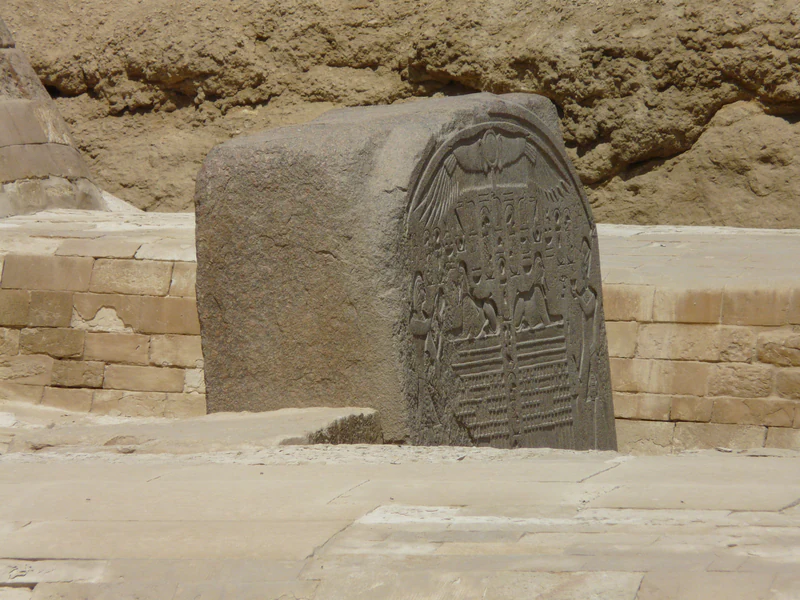
Thutmose IV's granite Dream Stela between the Great Sphinx's forepaws at Giza.
The National Museum of Egyptian Civilization understands the story as suggesting that Thutmose IV may not have been the legitimate crown prince.3 That makes the monument relevant to our question. Yet the need to present kingship as divinely sanctioned does not by itself establish an unexpected succession. Even if another heir was displaced, the text does not tell us whether that man died, was passed over, or was an older paternal brother.
The stela does not hand us the Exodus narrative in hieroglyphs and ask where we would like the footnotes. What it offers is a possible second part of the pattern: Amenhotep II was apparently a younger son, and his successor may not have been the originally expected heir. The first proposition has more direct support than the second.
The Fit
Here is the argument laid out in two stages, with their different evidentiary weights kept visible:
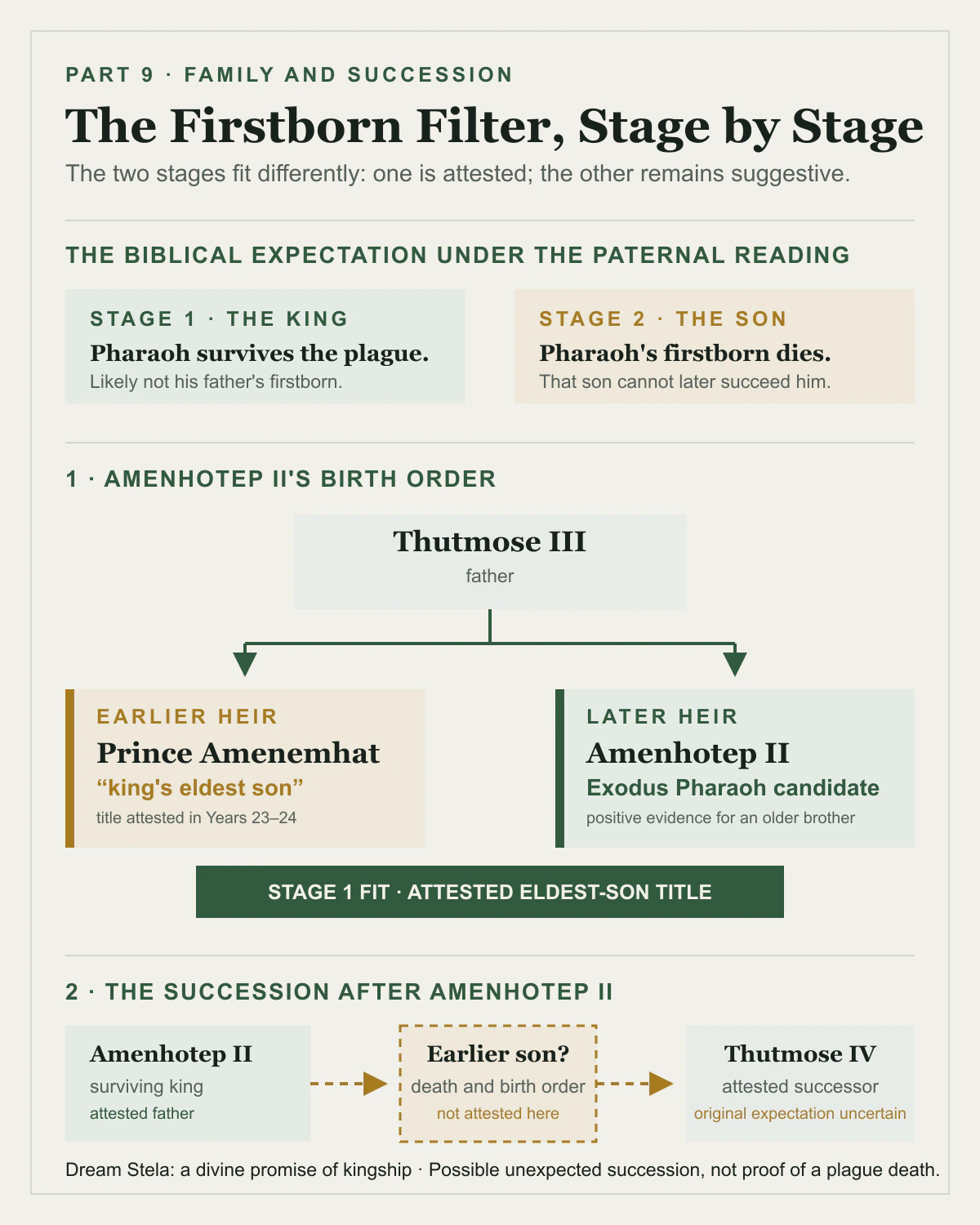
The chronology brought us to this family before we asked about its birth order. That gives the comparison interest beyond an isolated story about the Sphinx. Still, these are two related observations within one family sequence, not two equally secure proofs of the plague. Their value becomes clearer when we ask the same questions of the alternatives.
Compare Ramesses II
Ramesses II reigned for more than sixty years. That longevity matters to the succession story: it helps explain how a younger son could eventually inherit after an older heir died before his father. But it does not tell us whether the firstborn died on any proposed plague night. A younger son on the throne decades later is compatible with many different dates for his older brother's death.4
The sharper question is therefore the timing of the firstborn son's death. For each proposed Exodus date, can that son have died on the plague night? Evidence that he survived afterward would conflict with that identification and date. Evidence that he had already died would prevent us from identifying his death with the plague.
These are dates proposed by defenders of a Ramesside Exodus. James Hoffmeier identifies the later proposal as about 1270–1260 BC. In an interview recorded in 2002, Kenneth Kitchen gives his estimate as "about 1250, 1260 BC in the heart of the reign of Rameses." The comparison below samples those proposals; it is not an exhaustive survey of every Ramesside chronology.5, p. 225; 6, The Date of the Exodus
The prince in question is Amun-her-khepeshef. Frédéric Payraudeau identifies him with Seth-her-khepeshef in diplomatic correspondence from Ramesses' Years 20–21. Payraudeau places his probable death in the thirties of the reign, before Year 39. The correspondence supplies evidence of survival; the proposed death window remains a reconstruction.7, §§1, 3–4
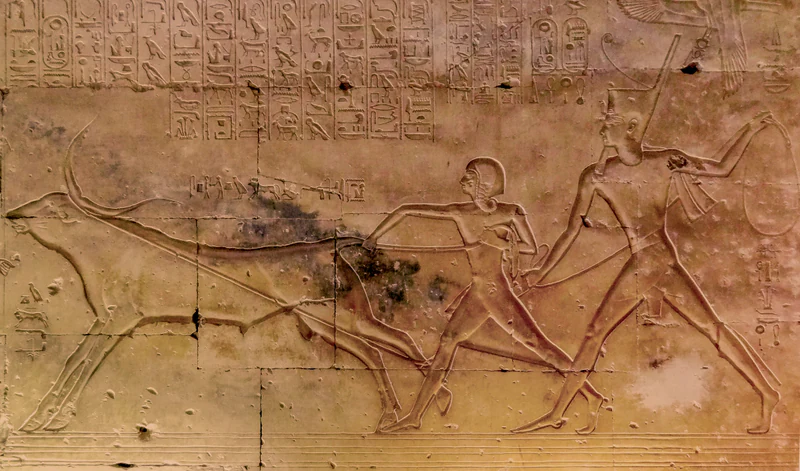
Ramesses II and his son Amun-her-khepeshef in the wild-bull-hunt relief at the Temple of Seti I, Abydos.
For a consistent comparison, I use University College London's accession date around 1279 BC throughout. These are approximate conversions of the proposed dates onto that baseline, not a claim that every advocate uses an identical accession date or regnal calendar.4
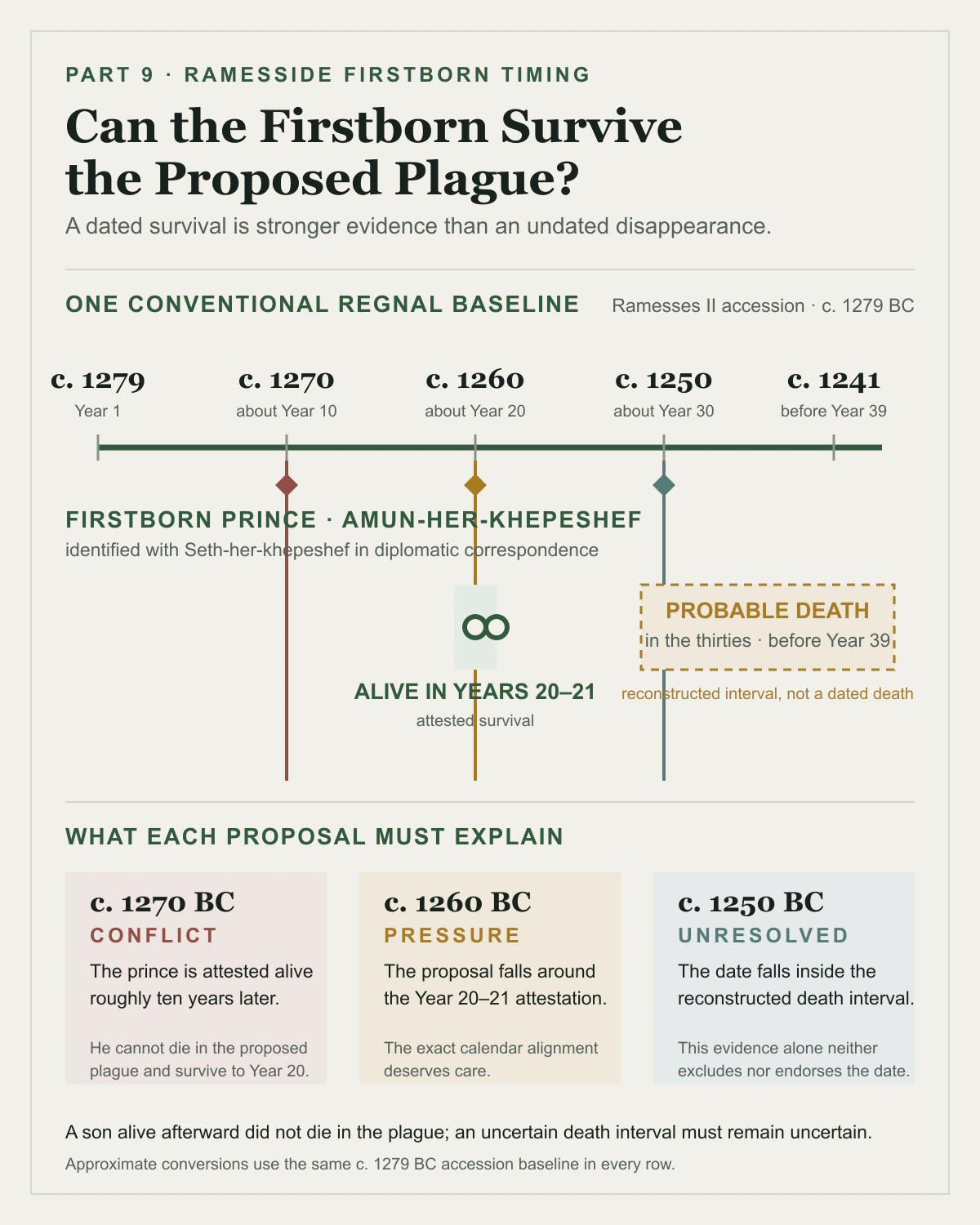
The test remains straightforward even where the records are not. A son who died beforehand cannot die in the plague; a son who lived afterward did not die in it. An uncertain interval must be left uncertain. Disappearance from the surviving record is not itself a dated death, and we should not quietly change the accession chronology between proposals.
Nor would a younger son's eventual accession answer the timing objection. The test requires a firstborn death at the proposed Exodus date, not simply a younger son on the throne at some later point.
Around 1250 BC therefore remains open on this evidence alone. That is a limit of this particular test, not an endorsement of the date. Part 11 will apply the wilderness and settlement timetable to the same proposals, and Part 12 will bring those results together. A date has to survive the whole comparison.
Compare Mainstream 18th Dynasty Dating
The mainstream 18th Dynasty early-date model has a different problem. If the Exodus is placed in 1446 BC while keeping the usual Egyptian chronology, the Exodus Pharaoh is normally Thutmose III rather than Amenhotep II.
That creates pressure at the first stage of the filter. An Ohio State historical overview describes Thutmose III as Thutmose II's only son. I would state the historical limit more cautiously: he is the only known son in the family account used here.8 Under the paternal reading, his survival would call for an older paternal brother missing from that record or an exemption not stated in the narrative. A different reading of the plague's scope would change the test, but needs its own argument.
Only known son does not mean certainly firstborn. The gap in the family record leaves room for an answer, so this is a less direct difficulty than a securely documented survival after a proposed plague date. It still matters in a comparison: an attested older brother gives us something more concrete than the possibility of an unattested one.
Nor can we exclude Thutmose III by pretending to know when Amenemhat died. Piccione's broad window does not establish whether that prince was alive or dead at a 1446 BC Exodus on conventional dates. The pressure on Thutmose III here concerns his own birth order. For Amenhotep II, the attested earlier heir supplies the older-brother evidence we lack for his father.
The Curmudgeon Says
This is the kind of argument that makes me sit up a little straighter.
The firstborn test began with the Lord's warning about his son and Pharaoh's son. Applied consistently, it makes us ask about both the king's birth order and the timing of his son's death. It puts pressure on particular Ramesside dates and raises a family question for Thutmose III. Amenhotep II, meanwhile, has an attested earlier heir ahead of him and a suggestive succession after him.
Of the reconstructions examined here, I find the Amenhotep II to Thutmose IV succession far more suggestive of the father-and-son pattern Exodus leads us to expect. Our candidate Pharaoh has an attested older brother, while the succession after him raises a real question about whether the eventual heir was originally expected. No other reconstruction we have examined presents that pattern nearly as naturally.
We are comparing patterns, not announcing that an Egyptian death register has finally arrived in the post. The Thutmose IV inference carries less weight than Amenemhat's attestation. That is enough to strengthen the case without claiming that the succession proves the plague, that the alternatives are impossible, or that every missing name has been recovered.
Scripture gets the gavel. Egypt gives testimony. Here the testimony is incomplete, but it is worth hearing.
Coming Up
Part 10 follows Israel out of Egypt and into the wilderness, where the argument shifts from Pharaohs and thrones to geography, memory, movement, and the long Egyptian shadow over Israel's wilderness years.
Discussion
Thoughtful, good-faith discussion is welcome.
Loading comments…