

Must Christians Obey a Tyrant?
Calling a ruler a tyrant can be an act of moral clarity. It can also be a way of skipping the argument.
The word does not tell us which acts make rule tyrannical, whether the ruler still holds office, who may judge the case, what remedies remain, or whether resistance will leave the people worse off. Christian reflection had to develop those questions while holding together commands that seem to pull in opposite directions: submit to authority, love enemies, protect neighbors, punish wrongdoing through public office, and obey God above men.
It did not produce one uninterrupted consensus.
The Early Christian Problem
Early Christian sources contain a serious strand of opposition to military killing and coercive public office. Tertullian described military service as entangled with idolatry and rejected the Christian's use of the sword.1, chaps. 17–19; 2, chaps. 1, 11–12 Origen argued that Christians served rulers through prayer rather than military service.3, VIII.68–75 A church-order tradition associated with the Apostolic Tradition places severe restrictions on soldiers and magistrates.4, chap. 16
Those witnesses cannot simply be converted into a unanimous early-church vote. The texts differ in date, setting, and authority. Christian soldiers existed. Some church orders may preserve local ideals more clearly than universal practice. Yet the pacifist and anti-office case is too early and too substantial to dismiss as a modern invention.
It also presses the right theological question. If Jesus commands enemy-love, rejects retaliation, and refuses to have his kingdom defended at the Passion, how can a Christian deliberately use coercion? A theory that answers only with “the state must do it” has not shown why a disciple may occupy the state's office.
The sources do not all make the same objection. Tertullian connects service to idolatrous ceremonies, divided allegiance, punishment, and killing. His own complaint about Christian soldiers shows that such soldiers existed; the argument was already being contested in practice. Origen answers a pagan critic who wanted Christians to fight and govern for Rome. He does not answer with civic indifference. Christians, he says, aid rulers and the commonwealth through prayer and a priestly service more necessary than civil office. The church-order text addresses admission and discipline, distinguishing people already in the army from believers who volunteer to enter it.
The early evidence resists both a manufactured consensus and meaningless diversity. Long before the American controversy, substantial Christian voices understood discipleship to exclude killing, military oaths, punitive office, or some combination of them, even as Christian soldiers show that participation occurred. Their case was not that government had no public task. It was that the church served that task by another vocation.
The objection reaches everything that follows. A lesser-magistrate argument can identify a public officer and still fail if Christians may not hold the coercive office. A just-war test can discipline violence and still fail if Jesus' command forbids the disciple to perform it. The later public-vocation synthesis must therefore answer a theological objection, not merely fill a constitutional vacancy.
The Augustinian and Thomistic accounts should not be presented as though the church simply remembered an obvious apostolic rule. They are arguments: attempts to hold enemy-love, nonretaliation, public justice, protection of the innocent, and political office inside one moral account. Their success depends upon whether the role distinction preserves Christ's commands rather than evading them.
Soldiers Inside the New Testament Narrative
The New Testament does not settle that dispute with a direct command that Christians either enter or leave military service. Its narratives nevertheless refuse to make the soldier's vocation invisible.
When soldiers ask John the Baptist what repentance requires, his first prohibition uses διασείω (diaseiō), a verb for extracting money by force or threat of violence – in other words, shaking someone down.5, p. 236 They are also told not to accuse anyone falsely and to be content with their wages (Luke 3:14And the soldiers likewise demanded of him, saying, And what shall we do? And he said unto them, Do violence to no man, neither accuse any falsely; and be content with your wages.). John identifies sins common to their power without narrating a command to abandon the occupation. The centurion of Capernaum is praised for extraordinary faith and presented as a benefactor; the centurion at the cross recognizes what others miss. Cornelius is devout, receives the Holy Spirit, and is baptized, again without a narrated vocational renunciation (Luke 7:1–10Chapter 7, verse 1: 7:1Now when he had ended all his sayings in the audience of the people, he entered into Capernaum. Chapter 7, verse 2: 7:2And a certain centurion’s servant, who was dear unto him, was sick, and ready to die. Chapter 7, verse 3: 7:3And when he heard of Jesus, he sent unto him the elders of the Jews, beseeching him that he would come and heal his servant. Chapter 7, verse 4: 7:4And when they came to Jesus, they besought him instantly, saying, That he was worthy for whom he should do this: Chapter 7, verse 5: 7:5For he loveth our nation, and he hath built us a synagogue. Chapter 7, verse 6: 7:6Then Jesus went with them. And when he was now not far from the house, the centurion sent friends to him, saying unto him, Lord, trouble not thyself: for I am not worthy that thou shouldest enter under my roof: Chapter 7, verse 7: 7:7Wherefore neither thought I myself worthy to come unto thee: but say in a word, and my servant shall be healed. Chapter 7, verse 8: 7:8For I also am a man set under authority, having under me soldiers, and I say unto one, Go, and he goeth; and to another, Come, and he cometh; and to my servant, Do this, and he doeth it. Chapter 7, verse 9: 7:9When Jesus heard these things, he marvelled at him, and turned him about, and said unto the people that followed him, I say unto you, I have not found so great faith, no, not in Israel. Chapter 7, verse 10: 7:10And they that were sent, returning to the house, found the servant whole that had been sick.; Luke 23:47Now when the centurion saw what was done, he glorified God, saying, Certainly this was a righteous man.; Acts 10). Roman officers later protect Paul from mob violence and unlawful killing (Acts 21:31–36Chapter 21, verse 31: 21:31And as they went about to kill him, tidings came unto the chief captain of the band, that all Jerusalem was in an uproar. Chapter 21, verse 32: 21:32Who immediately took soldiers and centurions, and ran down unto them: and when they saw the chief captain and the soldiers, they left beating of Paul. Chapter 21, verse 33: 21:33Then the chief captain came near, and took him, and commanded him to be bound with two chains; and demanded who he was, and what he had done. Chapter 21, verse 34: 21:34And some cried one thing, some another, among the multitude: and when he could not know the certainty for the tumult, he commanded him to be carried into the castle. Chapter 21, verse 35: 21:35And when he came upon the stairs, so it was, that he was borne of the soldiers for the violence of the people. Chapter 21, verse 36: 21:36For the multitude of the people followed after, crying, Away with him.; Acts 23:12–35).
Taken separately, none of those scenes is a treatise on warfare. John does not address battlefield killing, pagan oaths, or an unjust military command. Luke's principal concern in Acts 10 is Gentile inclusion, not the ethics of every task attached to Cornelius's rank. Narrative silence cannot bear the weight of a complete Christian doctrine of force.
The cumulative pattern still carries limited force. A vocation portrayed as categorically incompatible with discipleship would be an unusual choice for these repeated scenes of repentance, faith, divine welcome, confession, and protection without any notice of required resignation. The narratives support compatibility more readily than approval of every military act. Joined to Romans 13's account of public coercive office, they keep the Augustinian answer open; joined to Jesus' commands and the early Christian objections, they keep that answer under strict moral discipline.
Augustine's Public Role
Augustine's answer was not that love ceases when public duty begins. He distinguished the inward vice of vengeance from the outward act required by a public role. He held that force is lawful under legitimate authority, for a just cause, and with the intention of securing peace rather than satisfying cruelty.6, XXII.74–76
He made that argument while defending Old Testament holy persons against a Manichaean critic, not while composing a complete manual of war. Even so, the core move is plain. The ruler authorizes public force for communal peace and safety; the soldier acts through an assigned public role; cruelty, vengeance, revolt, and lust for power remain sins even when a war is publicly commanded. Turning the other cheek describes the charity that must govern the person, not a rule that every public duty is exhausted by literal passivity.
This synthesis changed the shape of the question. A Christian can act coercively not as a private avenger but as an officer responsible for the protection and order of others. The same act – striking, restraining, even killing – could not be judged only by its physical description. Authority, cause, intention, and object mattered.
The peace-church reply can now be stated at full strength. Describing the agent as an officer identifies whose violence the state recognizes; it does not by itself show that Christ recognizes a moral exception. The Augustinian answer is that neighbor-love, responsibility for the innocent, and public office sometimes require outward restraint while forbidding hatred within. The disagreement is not over whether Christians should love enemies. It is over what love may require from a person entrusted with other people's safety.
The danger is obvious. Public titles can become moral laundering. Officials may call ambition peace, revenge justice, and conquest protection. Augustine's categories are not a permission slip; they expose public force to additional judgment. The officer must answer not only whether harm was done, but whether he possessed authority, acted for a just cause, remained ordered to peace, and avoided the inward rule of hatred.
Aquinas and the Conditions of War
Thomas Aquinas gave the synthesis a compact form. For war to be just, he required authority in the ruler who summons it, a just cause against those who deserve attack for wrongdoing, and right intention directed to good and the avoidance of evil.7, II-II, q. 40, a. 1
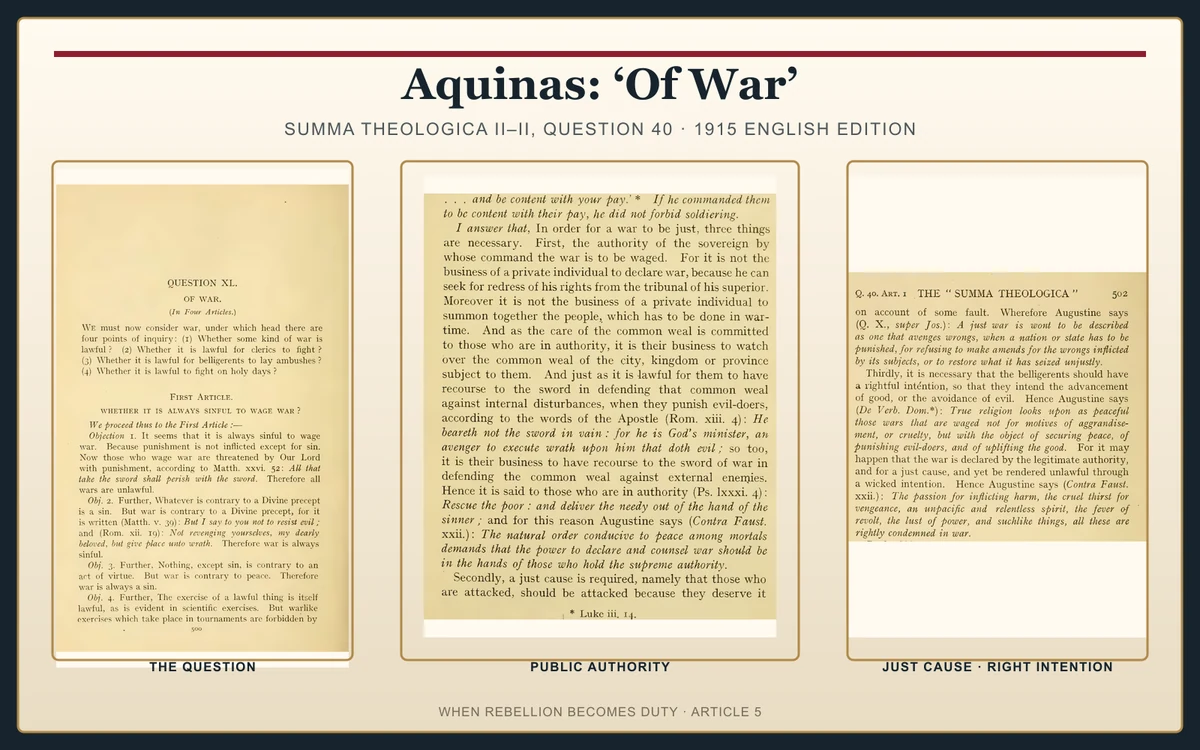
Public authority receives first place for a reason. Private persons may defend themselves within limits, but they do not possess responsibility for the whole commonwealth or the public sword by which it is defended. A sincere conviction that violence would improve society does not make a person a ruler.
Aquinas's account does not solve every divided-sovereignty problem. What if a king, estates, city magistrates, and representative bodies all claim parts of public authority? What if the superior becomes the threat? The just-war conditions tell us what questions must be answered; they do not identify the right claimant in every constitution.
They nevertheless close two bad roads. Christian nonretaliation cannot be turned into indifference toward the victim if one holds a real protective office. And the duty to protect cannot be turned into holy violence detached from public authority, just cause, right intention, and peace.
Authority Is a Relation, Not a Costume
Aquinas's first condition is sometimes reduced to official appearance. A uniform, title, legislature, or successful command is treated as enough to make force public. His logic is more demanding. The authority must be charged with the care of the political community and possess jurisdiction over the object for which force is summoned. Public force belongs to the ruler because the commonwealth has been entrusted to public care, not because powerful people can issue orders.
That relational account explains why usurpation and abdication are difficult. An officeholder may retain a title while betraying the end of office. A rival body may protect people effectively while lacking an established jurisdiction. Military success proves capacity, not right. Formal continuity proves title, not fidelity. Identifying public authority therefore requires attention to the constitution through which responsibility was assigned and to the people whose good is claimed.
The conditions are also conjunctive. Public authority cannot make an unjust cause just. A just cause cannot supply missing authority. Right intention cannot rescue unnecessary force, and a peaceful slogan cannot disguise an object of conquest. Later just-war reasoning would name necessity, proportionality, discrimination, and reasonable prospect more explicitly, but the governing discipline is already present: no single moral good purchases permission to ignore the others.
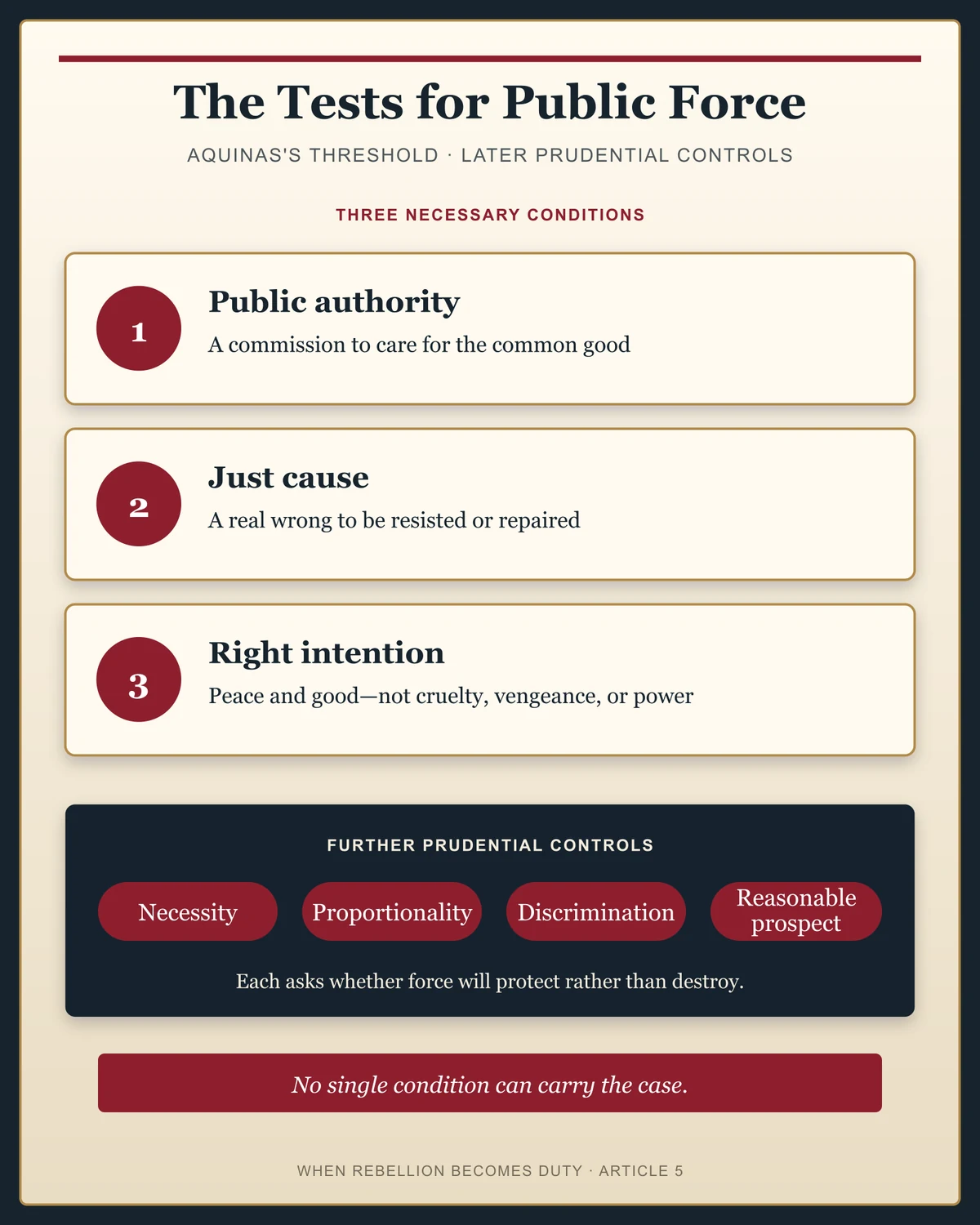
War and Resistance Are Not Identical
Just-war doctrine is sometimes recruited as though it already contained a theory of revolution. It does not. A king defending a realm against invasion, a city magistrate resisting the king, a neighboring prince aiding the city, and a private league overthrowing a ruler present different authority questions even if each alleges a just cause.
The three Thomistic conditions remain necessary across those cases, but their application changes. “Public authority” cannot be treated as a box checked by whoever controls soldiers. “Just cause” must identify an injury grave enough for the contemplated force. “Right intention” concerns the governing purpose of institutions as well as the private motives of participants. The object may be defense, restraint, deposition, punishment, conquest, or separation; one does not become another simply because the same weapons are used.
The American case therefore requires separate judgments on taking up arms and independence. Defensive war could be justified while permanent separation remained premature. Independence could later become necessary without making every earlier military venture just. Medieval categories discipline the judgment; they do not collapse its stages.
Proving Tyranny
A moral definition of tyranny also requires evidence. It is not enough to collect angry quotations or identify one unconstitutional act. A sound judgment asks whether a ruler or governing structure persistently subordinates the common good to private domination, whether ordinary correction remains possible, how grave the threatened harms are, and what a proposed remedy will do to the people.
That burden protects rulers from factional accusation and subjects from official euphemism. A government cannot make public injury righteous by calling it administration. An opposition cannot make private ambition public by calling the ruler a tyrant.
The Declaration of Independence would eventually allege a “long train” of abuses directed toward despotism. That formulation resembles the kind of cumulative case tyranny language requires. The Declaration's assertion is not proof of the train. Its principal families of grievances must be tested against the British explanations and the connection between royal action and parliamentary statute.
Tyranny as Rule for Private Good
In De regno, Aquinas defines political rule by its end. Right rule directs a multitude toward the common good and peaceful unity. Tyranny directs rule toward the private good of the ruler.8, I.1–3, paras. 8–18
That definition is more useful than a list of disliked policies. A harsh measure may be mistaken or unjust without turning the whole government into tyranny. Conversely, orderly administration can be tyrannical when offices and law are systematically made instruments of a ruler's private domination.
The common-good test also binds those who resist. A faction that overthrows a ruler to obtain its own private advantage has not escaped tyranny's moral logic. It has changed beneficiaries.
Aquinas accordingly rejects private tyrannicide. He warns that private persons can mistake a good ruler for a tyrant, that assassination can invite a worse successor, and that failed action may make oppression more severe. Even a real but limited tyranny may sometimes need to be endured because the cure would do greater harm.8, I.7, paras. 44–47
This is not cowardice. It is proportionality. The condition of the people, not the resister's sense of moral purity, controls the remedy.
Public Remedy, Not Private License
Aquinas does leave room for remedy. If a political community possesses the right to establish its king, it may have authority to restrict or depose him for tyrannical abuse. If a higher public authority appointed the ruler, remedy belongs to that authority. His examples are conditional upon the constitution that established office.8, I.7, paras. 48–50
The Summa makes the moral distinction from another direction. Sedition is a grave wrong against the lawful unity and common good of a people. But those who defend the common good against a seditious attack are not therefore seditious. A tyrannical regime, because it serves a private rather than common good, can itself disorder political unity. Disturbing it is not automatically sedition, unless the disturbance inflicts greater harm upon the subjects than the tyranny did.9, II-II, q. 42, a. 2 and ad 3
That formulation refuses both absolutes. It denies that every disturbance of the ruler is morally rebellion. It also denies that naming tyranny excuses the consequences of resistance.
Public remedy must therefore be judged by the political good it preserves. If a community or superior authority restrains a tyrant, the act is not justified merely because the target deserves opposition. The remedy must restore or protect lawful common life. A faction that destroys courts, security, peace, and the conditions of justice may injure the subjects more than the ruler it removes. Aquinas's greater-harm warning makes consequence a moral control without making survival or victory the source of right.
Four questions follow. Who possesses the authority to act? What public good has the ruler gravely attacked? What less destructive remedies remain? What will the proposed action probably do to the people? Those questions do not guarantee agreement, but they prevent tyrant from serving as a conclusion disguised as a premise.
What America Still Has to Establish
Aquinas did not write a doctrine for British colonies. The American case must separately establish that colonial institutions possessed authority within a complex hereditary empire. His warnings about faction, failed resistance, and worse disorder can support a Loyalist case.
Nor does medieval just-war doctrine automatically become a right of revolution. Authority to fight an external enemy does not necessarily include authority to resist a superior. Deposition, defensive force, and political separation remain distinct remedies.
The narrower conclusion is firm. Before the Reformation, Christian thought already possessed a grammar in which public coercion could be a vocation, political authority existed for the common good, tyranny was a moral corruption of rule, private vengeance was forbidden, public remedy depended upon actual jurisdiction, and consequences could make resistance unjust even against a tyrant.
Those categories make later resistance arguments intelligible. They do not decide them.
A Divided Christian Inheritance
The pacifist objection remains. Peace-church critics judge Augustine's synthesis a post-Constantinian accommodation that dulls the sharper edge of Jesus' teaching. Christian disobedience and neighbor-love do not by themselves compel acceptance of lethal force in public office.
The just-war answer remains equally serious. Civil office is described in Scripture as a ministry for good that bears the sword. Protection of the weak and punishment of grave wrongdoing are not exceptions to love of neighbor; they can be forms of it. The soldier narratives make Christian participation compatible with the canon without turning participation into approval of every assigned act. Force is lawful only within the discipline of office, cause, intention, necessity, proportionality, and peace.
That public-vocation synthesis cannot simply brush aside the pacifist challenge. Not all Christian traditions agree, and a tradition's age does not make it correct.
There is no general right of individuals to overthrow rulers. The harder conclusion is equally real: under extreme conditions, an existing public office charged with protection carries a duty to act, and culpable neglect of that duty is itself sinful. The Reformation would state that duty with unsettling force.
Discussion
Thoughtful, good-faith discussion is welcome.
Loading comments…