

Presidio Heights: The Bluff That Broke The Case Open
San Francisco, October 11, 1969. The Zodiac has left the lonely roads behind.
No lover's lane. No lake. No hood. No payphone on a quiet country road. This time the stage is Presidio Heights, a rich neighborhood of clipped lawns, big houses, and streets that should have been lousy with witnesses. Paul Stine, 29, is driving Yellow Cab #912. He stops at Washington and Cherry. A passenger shoots him in the head.
Then the killer does something colder than running.
He stays.
Teenage witnesses across the street see a man in the cab with Stine slumped partly over him. The man appears to search Stine's pockets, wipe surfaces, and work around the front of the cab. Then he gets out, walks around the cab, and disappears north on Cherry Street toward the Presidio.
That should have been the end of him.
It was not.
Presidio Heights is where the Zodiac case becomes almost unbearable. The police have a fresh scene, living witnesses, a description, fingerprints of possible value, a murdered cab driver, missing property, and, within days, a letter with a piece of Stine's shirt. This is the city crime, the tight net, the moment when the phantom should stop being a phantom.
Instead, he walks into the fog and writes the punchline himself.
The Scene: Washington And Cherry
The first SFPD report puts the cab at the northeast corner of Washington and Cherry Streets. Stine had been shot once in the head with a 9mm automatic. The DoJ summary gives the time as approximately 9:55 p.m.; the autopsy material places the entry wound on the right side of the head near the upper/front attachment of the right ear, with blackening around the wound. In plain English: close range, fast death, no warning that matters.
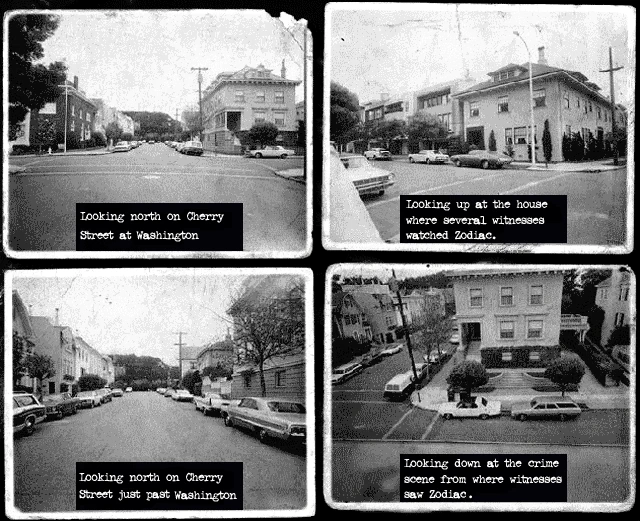
This was initially a robbery scene, or at least it could pretend to be one. Stine's wallet and currency were missing. The cab ignition keys were gone. A dead cab driver, missing money, missing keys: any overworked city detective could be forgiven for seeing a grim ordinary murder in the first minutes.
But the witnesses complicated that. They saw the suspect lingering, not bolting. They saw him doing something around the victim and cab surfaces. The SFPD report records that he was last seen walking north on Cherry Street toward the Presidio. The description was not perfect, because no witness description ever is, but it was better than Zodiac deserved: white male, early forties, about 5'8", heavy build, reddish-blond crew cut, glasses, dark trousers, dark parka-style jacket, dark shoes.
That is a face-shaped hole, not a name.
The killer did not leave a symbol on the cab. He did not write on the door. He did not call police from a payphone that night, at least not in the way he had after Blue Rock Springs and Berryessa. He took something better for his purposes: cloth.
The Shirt: Proof In The Envelope
On October 14, 1969, the San Francisco Chronicle received a Zodiac letter. This one did not merely claim the Stine murder. It enclosed proof.
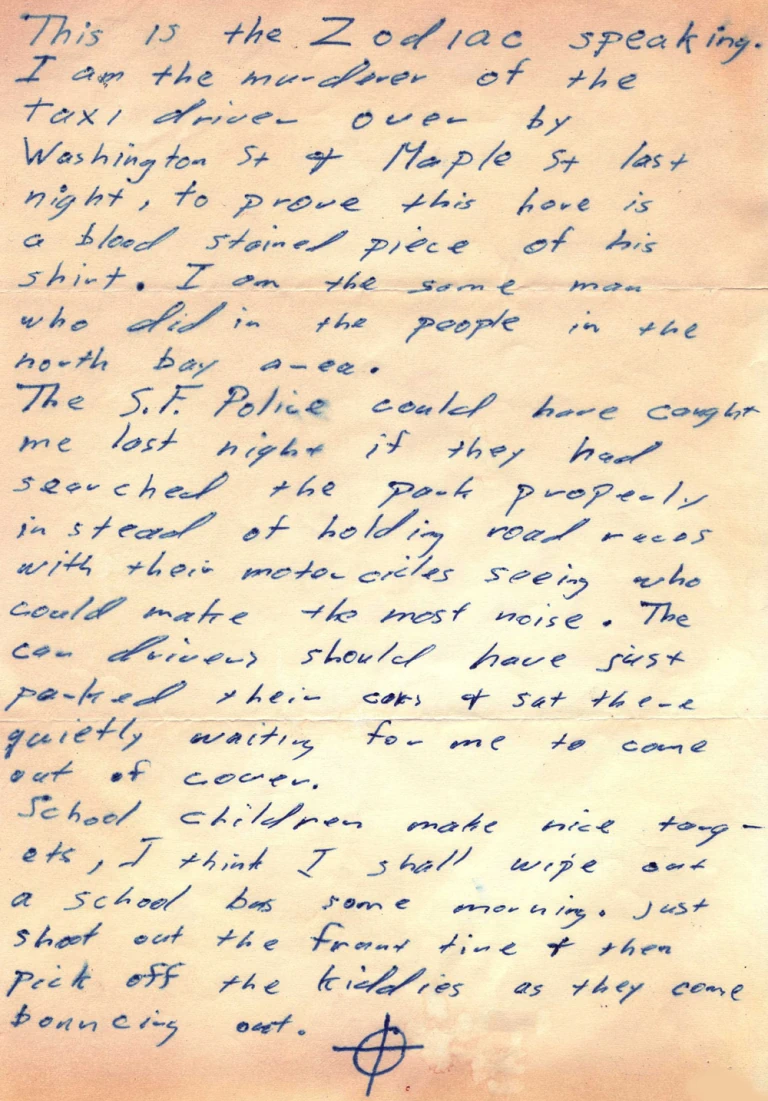
The DoJ summary says the letter contained cloth identified by Inspector Armstrong as a portion of Paul Stine's shirt, torn at the time of the homicide. Later, the Melvin Belli letter carried another piece also identified as part of Stine's shirt. That matters more than any boast, spelling tic, or creepy little symbol. Anybody can write a letter. Very few people can mail the dead man's clothing.
This is where Stine locks into the Zodiac series. Not because the crime looks like Lake Herman or Blue Rock Springs. It does not. Not because the method matches Berryessa. It does not. The link is authorship by possession. The killer had Stine's shirt, and the letter writer had Stine's shirt.
Good luck hand-waving that away without spraining something.
The destination muddles the map in its own ugly way. Zodiac wrote as if the murder happened "over by" Washington and Maple, but the released police report places the cab and body at Washington and Cherry. Later reporting and case-board archaeology drag in Stine's possible waybill, a claimed Washington-and-Maple destination, and even a Washington-and-Laurel wanted-poster wrinkle. Was Maple the intended stop? A memory slip? A bad report? A deliberate signal that he knew what Stine wrote down? The file gives us the body and the cab. It does not yet give us the clean route inside the killer's head.
Back to the evidence we can hold: a dead man, a missing wallet, missing keys, a torn shirt, and a letter that turns an apparent cab robbery into the most dangerous Zodiac proof yet.
The Witnesses: A Sketch Without A Name
The teenage witnesses are crucial because they saw the killer doing what killers are usually too smart to do: hanging around.
They described him as a white man, heavy build, crew cut, glasses, dark clothing. A composite sketch followed. Then a revised sketch sharpened the face. And there the case does its favorite trick: it gives us something that feels useful without giving us enough.
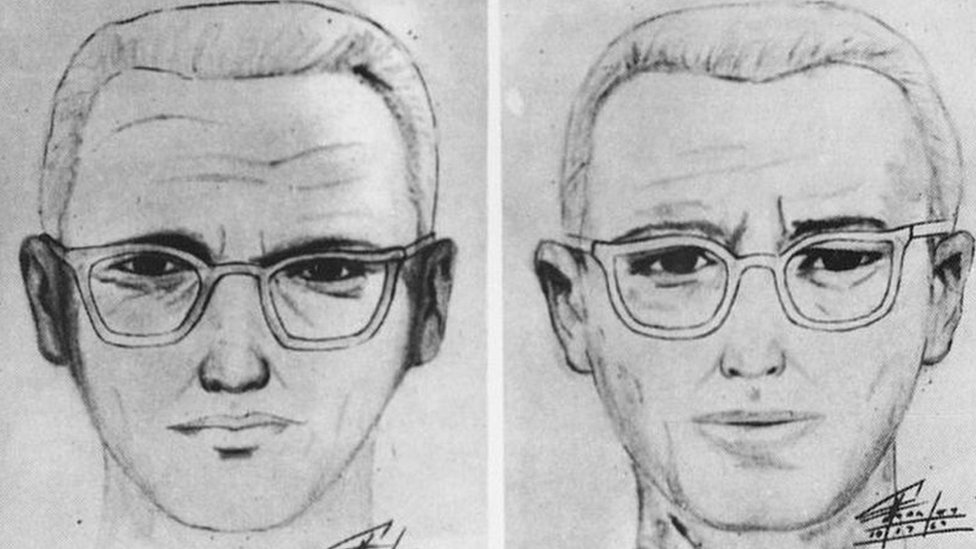
The Stine sketch became an icon because it is the closest the case gets to a public face. But sketches are not photographs. Witnesses are not cameras. Night, distance, fear, angle, and a few seconds of attention all get baked into the drawing. The result can guide a search. It cannot convict a ghost.
Still, the Stine witnesses did something priceless: they put a white male suspect leaving north on Cherry toward the Presidio. That single direction turns the next phase from police legend into geography.
If the killer went north, he was heading toward cover. Trees, paths, darkness, the Presidio. A city can hide a man almost as well as a country road if the timing is right and the first broadcast is wrong.
And here comes the part where the case starts chewing on itself.
The Near-Miss: Fouke, Zelms, And The Story That Will Not Sit Still
The famous near-miss does not appear in the first SFPD incident report on the Stine scene. That matters. The report gives the scene, the witnesses, the suspect description, the missing property, and the direction of travel. It does not document Donald Fouke, Eric Zelms, a radio-description race error, or an officer encounter with the suspect.
So where does the story come from?
First, from Zodiac's letters, but not all at once.
In the October 13/14 Stine letter, the one that enclosed part of Stine's shirt, Zodiac taunted police for not searching the park properly. This taunt was not floating in a vacuum, however. The October 12 Chronicle had already reported that someone was seen running into Julius Kahn playground and that police dog units were pressed into the search. By October 18, the Chronicle had printed Zodiac's park-search claim from the Stine letter alongside Chief Martin Lee's rebuttal. So no, the park-search chatter is not magic knowledge that only the killer could have known. It was public before the bigger near-miss story appeared.
That sharper story came later. In a November 9, 1969 letter later printed by the Chronicle, Zodiac claimed that "two cops pulled a goof." He said officers called him over about three minutes after he left the cab, asked whether he had seen suspicious activity, and that he sent them away in the wrong direction. Classic Zodiac: smug, theatrical, and allergic to shutting up.
Then, three days later, Fouke's memo enters the record. Dated November 12, 1969, it says that while responding to the area of Cherry and Washington, Fouke saw a white male adult walking east on Jackson Street and then north on Maple. The memo says the subject was not stopped because the broadcast description was of a Black male. Fouke described the man in terms that sit uncomfortably close to the Stine witness description: white male, stocky build, crew cut, glasses, dark clothing, moving with a shuffling lope, head down.
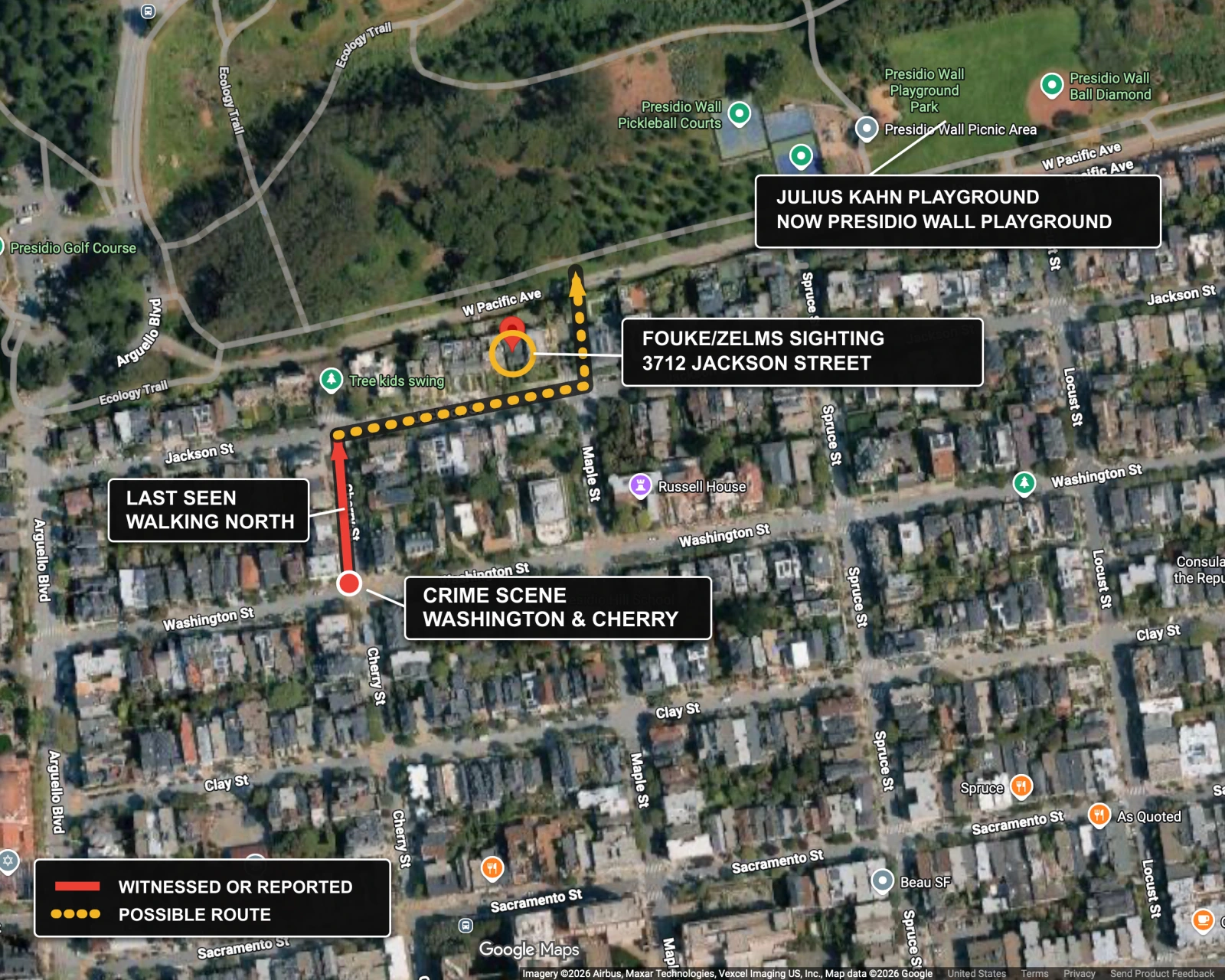
That is the hard knot. The park-search material had already been reported and argued over in public. The specific two-officer encounter is different. The claim that officers saw or spoke with a white man near Jackson and Maple does not appear to have been public before Zodiac wrote on November 9. That does not prove Zodiac told the truth. It does mean the detail is harder to dismiss as mere newspaper recycling.
The sighting is stronger than the conversation. That sentence should be tattooed on every reconstruction of this case.
Fouke said he saw the man but did not stop him. Zodiac said officers called him over and he misdirected them. Chief Lee publicly denied that officers had stopped or questioned suspects that night. Later accounts only made the mess messier. Fouke denied the stop. Other recollections and secondhand claims complicated the denial. The clean version is not available. The honest version is this: Fouke and Zelms likely saw a man who may have been Zodiac. Whether they actually spoke with him remains disputed.
If they did, the case did not merely miss Zodiac. It brushed against him and kept driving.
The Search: Dogs, Lights, And A Convenient Darkness
Zodiac loved to pretend the police were fools and he was a mastermind. Spare me the cape.
The search after Stine was real. Newspapers reported police and dog units in the Presidio/Julius Kahn area. Fouke's memo says a later search toward Julius Kahn playground produced negative results. But this was not a movie grid closing around a glowing suspect dot. It was nighttime city terrain, changing descriptions, confused timing, officers converging from different directions, and a killer who had a few minutes of lead time.
Chief Martin Lee bristled at Zodiac's taunts. Good. He should have. Zodiac's letters were designed to humiliate police, provoke sloppy responses, and make ordinary confusion look like the work of a criminal genius. But police defensiveness is not evidence either. The files leave us with something uglier than a simple blunder: a search that may have had the right man in view and still failed to hold him.
The most damaging part is not that police searched the wrong park or failed to bring enough lights. The most damaging part is the description problem. If Fouke's memo is accurate, he and Zelms did not stop the white man because they had been told to look for a Black suspect. By the time the description changed, the man was gone.
That is not a conspiracy. It is worse. It is a few wrong words moving through a radio at exactly the wrong time.
The Prints: Evidence Without A Name
The lazy version says Zodiac left no fingerprints.
The file says otherwise.
An FBI latent-print report dated October 29, 1969 says three submitted photographs from the Stine case showed thirty latent fingerprints, three latent palm prints, and one additional latent impression of value. One latent fingerprint was identified as Stine's. The others were compared against available suspects without producing an identification.
That distinction matters. "No fingerprints" makes Zodiac sound supernatural. "Latent impressions of value, but no identification" makes him sound like what he was: lucky, careful, or both. It also explains why later suspect discussions keep running into the same wall. If a suspect does not match the available cab prints, that weakens him. It does not automatically prove the cab prints are Zodiac's. Stine's cab was a working vehicle. People touched it for a living.
Evidence can be real and still refuse to finish the job. Presidio Heights is full of that kind of evidence.
The same goes for ballistics. DoJ says the 9mm weapon used in Stine's murder was not the same gun used in the Blue Rock Springs attack. So much for the tidy version where one magic pistol marches through the whole case. Zodiac changed weapons, changed settings, changed method, changed risk. The only thing he kept consistent was the need to own the story afterward.
Suspects: The City Does Not Save Them
Presidio Heights ought to help the suspect board. It gives us witnesses, a sketch, possible prints, an urban escape, and a police near-miss. Instead, it does what this case always does: it raises pressure and refuses to name a man.
- Arthur Leigh Allen - Heat after Presidio Heights: low to moderate. Allen remains the loudest name in the case, but Stine does not help him much. The available print comparisons did not tie him to the cab evidence, and the Stine sketch is not a clean gift. His overall heat stays alive because of the broader police history and Vallejo material, not because Presidio Heights gives him a strong scene link.
- Paul Doerr - Heat after Presidio Heights: low. Doerr may matter later for letters, ciphers, and profile arguments. The Stine scene does not put him in the cab, on Cherry Street, or near the Presidio.
- Richard Gaikowski - Heat after Presidio Heights: low to moderate. San Francisco geography and later voice/suspect-culture claims make him more interesting here than at Lake Herman, but "interesting" is not "identified." Without a solid scene bridge, he stays in the low-to-moderate lane.
- Gary Francis Poste - Heat after Presidio Heights: fringe / unsupported. Anagrams do not become better evidence in a nicer neighborhood. Poste gets no lift from Stine.
The hottest suspect after Presidio Heights is still the unknown offender who had Stine's shirt. That sounds like cheating. It is also the truth.
Why It Matters: The Myth Gets Teeth
Presidio Heights is the most damaging Zodiac crime for three reasons.
First, Paul Stine was not attacked in remote darkness. He was killed in San Francisco, in a neighborhood with witnesses close enough to watch the killer move inside the cab. Zodiac was no longer relying only on isolation. He was relying on nerve.
Second, the shirt piece gave him proof. Lake Herman was claimed months later. Blue Rock Springs had the phone call. Berryessa had the car door. Stine had fabric from the dead man's body. It is grotesque, but evidentially powerful. The shirt made the letter writer the killer in a way no cipher ever could.
Third, the police may have seen him.
That is the wound that will not close. If Fouke and Zelms only passed a similar man, the story is still brutal. If they passed Zodiac, it is worse. If they actually stopped and spoke with him, it becomes the case's cruelest little hinge: the killer not hidden in darkness, not disguised under a hood, not miles away from the scene, but close enough to answer a question and keep walking.
This is where Zodiac's myth gets teeth because the myth has a real bite under it. He did not need to be a genius. He needed a few minutes, a wrong description, a city full of corners, and the gall to mail the evidence afterward.
Back to the file. It is always less tidy than the legend, and more infuriating.
Coming Up: The Suspect Circus
Next comes the rogues' gallery: Arthur Leigh Allen, Paul Doerr, Richard Gaikowski, Gary Francis Poste, and the long parade of men shoved under the hood by obsession, bad logic, and the occasional book deal. We will use the same heat system from the series so far, but this time the suspects get the full treatment.
Who survives contact with the evidence? Who collapses into smoke? And why is the best named suspect still nowhere near enough?
Did Zodiac bluff his way past police after Paul Stine's murder, or did the story grow teeth after the fact? Drop your thoughts below or on X with #ZodiacKiller.
Discussion
Thoughtful, good-faith discussion is welcome.
Loading comments…